Crossfire Hurricane was the FBI’s counterintelligence investigation into possible links between Donald Trump’s 2016 presidential campaign and Russian election interference. This timeline follows the investigation from its opening through the Carter Page FISA applications, Inspector General findings, congressional oversight, and subsequent reforms. Explore the key events, primary source documents, and related Truth Trench Think Tank research in chronological order.
Table of Contents
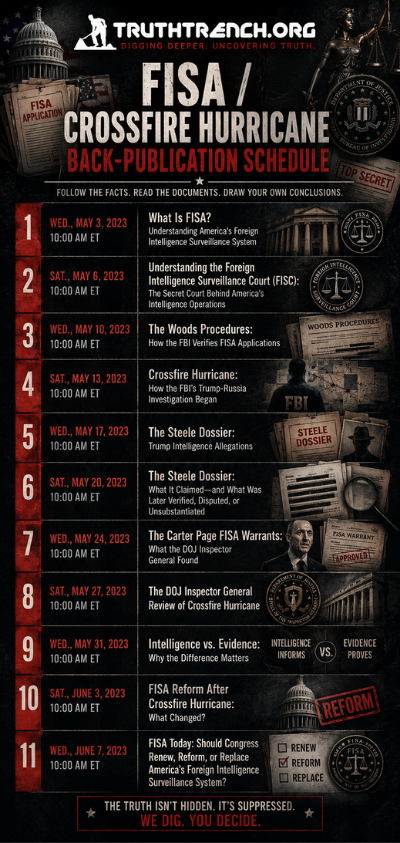
Follow the timeline below, or jump directly to an article.
- What Is FISA? Understanding America’s Foreign Intelligence Surveillance System
https://truthtrench.org/what-is-fisa-understanding-americas-foreign-intelligence-surveillance-system/ - Understanding the Foreign Intelligence Surveillance Court (FISC): The Secret Court Behind America’s Intelligence Operations
https://truthtrench.org/understanding-the-foreign-intelligence-surveillance-court-fisc-the-secret-court-behind-americas-intelligence-operations/ - The Woods Procedures: How the FBI Verifies FISA Applications
https://truthtrench.org/the-woods-procedures-how-the-fbi-verifies-fisa-applications/ - Crossfire Hurricane: How the FBI’s Trump-Russia Investigation Began
https://truthtrench.org/crossfire-hurricane-how-the-fbis-trump-russia-investigation-began/ - The Steele Dossier: Trump Intelligence Allegations
https://truthtrench.org/steele-dossier-trump-intelligence-allegations/ - The Steele Dossier: What It Claimed—and What Was Later Verified, Disputed, or Unsubstantiated
https://truthtrench.org/the-steele-dossier-what-it-claimed-and-what-was-later-verified-disputed-or-unsubstantiated/ - The Carter Page FISA Warrants: What the DOJ Inspector General Found
https://truthtrench.org/the-carter-page-fisa-warrants-what-the-doj-inspector-general-found/ - The DOJ Inspector General Review of Crossfire Hurricane
https://truthtrench.org/the-doj-inspector-general-review-of-crossfire-hurricane-what-the-investigation-found/ - Intelligence vs. Evidence: Why the Difference Matters
https://truthtrench.org/intelligence-vs-evidence-why-the-difference-matters/ - FISA Reform After Crossfire Hurricane: What Changed?
https://truthtrench.org/fisa-reform-after-crossfire-hurricane-what-changed/ - FISA Today: Should Congress Renew, Reform, or Replace America’s Foreign Intelligence Surveillance System?
https://truthtrench.org/fisa-today-should-congress-renew-reform-or-replace-americas-foreign-intelligence-surveillance-system/
Follow the timeline below for the complete story.
Timeline
The investigations, intelligence reports, surveillance applications, court proceedings, political disputes, and government reviews associated with the 2016 presidential election did not unfold as one single event.
They developed in layers.
Russian intelligence operations targeting the American political system formed one layer.
The FBI’s Crossfire Hurricane investigation formed another.
Christopher Steele’s opposition-research reporting entered through a separate channel.
The surveillance of Carter Page introduced the Foreign Intelligence Surveillance Act and the Foreign Intelligence Surveillance Court.
The appointment of Special Counsel Robert Mueller shifted portions of the investigation into a new structure.
Congressional investigations, declassified records, Inspector General reviews, criminal cases, and reforms followed.
Years of public argument often compressed these separate events into one generalized controversy commonly described as the “Trump-Russia investigation.”
That shorthand obscures important distinctions.
Crossfire Hurricane was not the Mueller investigation.
The Steele dossier did not open Crossfire Hurricane.
Evidence that Russia interfered in the election did not automatically verify every allegation involving Donald Trump or his campaign.
The Inspector General’s conclusion that Crossfire Hurricane met the FBI’s threshold for opening did not mean the Carter Page surveillance applications were properly handled.
And the serious failures identified in those applications did not establish that Russian election interference never occurred.
This timeline organizes the major events into chronological order and connects each stage with Truth Trench Think Tank’s deeper research.
The objective is not to provide a political conclusion.
It is to give readers a map.
How to Use This Timeline
This article functions as the central research hub for the Truth Trench FISA and Crossfire Hurricane collection.
Each section identifies a major event, explains why it matters, and directs readers toward the related article or primary source.
Readers can move through the events chronologically or enter the research at the point most relevant to their questions.
The individual articles examine the institutions, documents, investigative decisions, surveillance procedures, oversight findings, and competing perspectives in greater depth.
The timeline provides the terrain.
The linked research allows readers to enter the trench.
The Foundation: FISA Before Crossfire Hurricane
1978 — Congress Enacts the Foreign Intelligence Surveillance Act
Congress enacted the Foreign Intelligence Surveillance Act following years of concern about domestic surveillance abuses and unchecked executive intelligence activity.
FISA established a legal framework governing certain forms of foreign intelligence surveillance and created the Foreign Intelligence Surveillance Court, commonly known as the FISC.
The law attempted to balance two important responsibilities:
- protecting the United States from foreign intelligence threats; and
- protecting Americans from improper government surveillance.
FISA has since been amended repeatedly as national security threats and communications technology have changed.
Read the foundational explainer:
What Is FISA? Understanding America’s Foreign Intelligence Surveillance System
1978 — The Foreign Intelligence Surveillance Court Is Established
The Foreign Intelligence Surveillance Court was created to review government applications involving certain foreign intelligence surveillance activities.
Unlike an ordinary criminal court proceeding, FISA matters are generally conducted in secret because they involve classified intelligence, active investigations, sensitive collection methods, and national security concerns.
The proceedings are also ordinarily ex parte, meaning the government presents its application without the surveillance target or an opposing attorney appearing before the court.
That structure places an extraordinary responsibility upon government investigators and attorneys to provide accurate and complete information.
Explore the institution:
Understanding the Foreign Intelligence Surveillance Court (FISC): The Secret Court Behind America’s Intelligence Operations
2001 — The FBI Establishes the Woods Procedures
The FBI developed what became known as the Woods Procedures to improve the accuracy of factual assertions submitted in FISA applications.
The procedures require the FBI to maintain supporting documentation for factual claims contained in an application.
The supporting records are maintained in a Woods File so reviewers can trace assertions back to their underlying source material.
The principle is simple:
If the government tells the court that something is true, it should be able to show where the information came from.
The later Carter Page applications demonstrated that documentation alone does not guarantee accuracy or completeness.
Examine the verification process:
The Woods Procedures: How the FBI Verifies FISA Applications
Russian Election Interference and the Opening of Crossfire Hurricane
Spring and Summer 2016 — Russian Election-Interference Concerns Intensify
During the 2016 election cycle, intelligence and law-enforcement agencies were examining cyber activity and influence operations associated with Russia.
Computer systems connected to the Democratic National Committee were compromised, and stolen materials were released publicly.
The later Special Counsel investigation documented extensive Russian efforts to interfere in the election through hacking, information operations, social-media activity, and related conduct. The Mueller report described the Russian government’s interference as sweeping and systematic. (Department of Justice)
This broader foreign-interference environment formed the national security context in which the FBI received information involving Trump campaign foreign policy adviser George Papadopoulos.
July 2016 — Information Concerning George Papadopoulos Reaches U.S. Authorities
The FBI received information from a friendly foreign government regarding statements attributed to Papadopoulos.
The information suggested that the Trump campaign had received indications that Russia could assist the campaign through the release of damaging information concerning Hillary Clinton.
This reporting—not the Steele dossier—became the basis for the FBI’s decision to open Crossfire Hurricane.
The distinction is central to understanding the investigation’s origin.
July 31, 2016 — The FBI Opens Crossfire Hurricane
The FBI formally opened Crossfire Hurricane on July 31, 2016.
The investigation sought to determine whether individuals associated with the Trump campaign were coordinating, knowingly or unknowingly, with Russian efforts to interfere in the presidential election. The DOJ Inspector General later confirmed this opening date and examined whether the decision complied with FBI and Department of Justice policies. (DOJ Inspector General)
Crossfire Hurricane began as a counterintelligence investigation.
It was not yet the Special Counsel investigation later led by Robert Mueller.
Examine the opening of the investigation:
Crossfire Hurricane: How the FBI’s Trump-Russia Investigation Began
August 2016 — The FBI Opens Four Individual Investigations
Following the opening of Crossfire Hurricane, the FBI opened individual investigative files involving:
- George Papadopoulos;
- Carter Page;
- Paul Manafort; and
- Michael Flynn.
Each investigation involved different factual circumstances and questions.
Opening an investigation did not establish that any individual had committed a crime.
It authorized investigators to gather information and assess potential counterintelligence concerns.
The Steele Dossier Enters the Investigation
2016 — Fusion GPS Retains Christopher Steele
Fusion GPS retained former British intelligence officer Christopher Steele to conduct opposition research concerning Donald Trump and Russia.
The work was funded through a law firm representing the Democratic National Committee and Hillary Clinton’s presidential campaign.
Steele produced a series of memoranda containing allegations about:
- Donald Trump;
- members of his campaign;
- Russian officials;
- possible compromising information;
- contacts involving campaign associates; and
- potential coordination between Russian interests and people connected to the campaign.
The reports later became collectively known as the Steele dossier.
Summer and Fall 2016 — Steele’s Reporting Circulates
Steele’s reports circulated among political researchers, journalists, government officials, and eventually the FBI.
This is where public understanding frequently becomes confused.
The dossier did not cause the FBI to open Crossfire Hurricane.
However, Steele’s reporting later became important to the FBI’s attempt to obtain surveillance authority targeting Carter Page.
Those are separate facts.
Understanding What the Dossier Was
The Steele dossier was a collection of raw intelligence reporting.
It was not a completed intelligence-community assessment.
It was not a criminal indictment.
It was not a judicial finding.
And the existence of the documents did not establish that every allegation inside them was true.
Some broad themes overlapped with independently established facts about Russian interference.
Some specific allegations were disputed or contradicted.
Others remained unsubstantiated.
Examine the underlying material:
The Steele Dossier: Trump Intelligence Allegations
Examine how its claims compare with later findings:
The Steele Dossier: What It Claimed—and What Was Later Verified, Disputed, or Unsubstantiated
Carter Page and the FISA Applications
October 2016 — The Government Seeks FISA Surveillance Authority Against Carter Page
The FBI and Department of Justice submitted an application to the Foreign Intelligence Surveillance Court seeking authorization to conduct electronic surveillance targeting Carter Page.
Page was an American citizen and former foreign policy adviser to the Trump campaign.
The government’s application included information concerning Page’s contacts and activities involving Russia.
Steele’s reporting played an important role in the application, particularly in supporting allegations that Page was coordinating with Russian officials regarding the election.
The court approved the initial surveillance order.
2017 — The Government Obtains Three Renewals
The government returned to the FISA Court three times seeking continued surveillance authority against Page.
Each renewal required the government to justify extending the surveillance.
Every renewal also provided another opportunity to:
- reassess the available information;
- evaluate Steele’s reporting;
- incorporate newly discovered facts;
- disclose information weakening earlier claims; and
- correct prior errors.
The Department of Justice Inspector General later found significant failures across all four applications.
January 2017 — The FBI Interviews Steele’s Primary Sub-Source
The FBI interviewed the person identified as Steele’s Primary Sub-source.
Information obtained during those interviews raised questions concerning the characterization, sourcing, and reliability of portions of Steele’s reporting.
The Inspector General later found that relevant information from those interviews was not adequately reflected in the FISA renewal applications.
This became one of the central examples of why intelligence must be continuously reassessed as new information emerges.
Carter Page’s Prior Government Relationship
The FBI also received information concerning Page’s prior relationship with another U.S. government agency.
That information indicated that Page had previously served as an operational contact and had provided information concerning certain Russian contacts.
The context was potentially important because some of those contacts were later treated as suspicious in the FISA applications.
The Inspector General found that the full context was not properly presented to the FISA Court.
The Altered Email
Former FBI attorney Kevin Clinesmith altered an email concerning Page’s relationship with the other government agency.
The alteration indicated that Page was “not a source,” when the underlying agency information indicated that he had previously maintained an operational relationship with it.
Clinesmith later pleaded guilty to making a false statement.
The incident became one of the clearest examples of individual misconduct associated with the Carter Page surveillance process.
Examine the applications and Inspector General findings:
The Carter Page FISA Warrants: What the DOJ Inspector General Found
Public Disclosure and the Special Counsel Investigation
January 2017 — The Steele Dossier Becomes Public
The dossier entered broad public discussion after its publication in January 2017.
Its release transformed raw intelligence reporting and opposition research into a national political controversy.
The public now had access to allegations that had circulated privately among journalists, political operatives, government officials, and investigators.
The publication created an enduring analytical problem:
Was the public reading verified intelligence—or a collection of allegations still requiring investigation?
That distinction remains central to the broader story.
January 2017 — The Intelligence Community Releases Its Election Assessment
The U.S. intelligence community released an assessment concerning Russian activities and intentions during the 2016 election.
The assessment concluded that Russian President Vladimir Putin ordered an influence campaign directed at the election.
The intelligence-community assessment and the Steele dossier were separate products.
They had different authors, sourcing, purposes, and levels of institutional review.
The existence of the intelligence-community assessment did not validate every allegation in the dossier.
May 9, 2017 — President Trump Removes FBI Director James Comey
President Donald Trump removed FBI Director James Comey.
The dismissal intensified political scrutiny surrounding the Russia investigation and raised questions concerning the future of the FBI’s work.
May 17, 2017 — Robert Mueller Is Appointed Special Counsel
Acting Attorney General Rod Rosenstein appointed former FBI Director Robert Mueller as Special Counsel on May 17, 2017. Mueller was authorized to investigate Russian interference in the 2016 presidential election, links or coordination involving the Russian government and individuals associated with the Trump campaign, and related matters arising from the investigation. (Department of Justice)
The appointment marked an important transition.
Crossfire Hurricane had begun as an FBI counterintelligence investigation.
The Special Counsel investigation operated under a separate appointment and organizational structure.
The two were related but not identical.
2017–2019 — The Special Counsel Investigation Proceeds
The Special Counsel’s office investigated Russian election interference, contacts involving individuals associated with the Trump campaign, obstruction-of-justice questions, and related criminal matters.
The investigation produced criminal charges and convictions involving several individuals, although those cases involved differing conduct and did not collectively establish a Trump campaign conspiracy with the Russian government.
The Mueller report documented extensive Russian interference and numerous contacts involving Russians and people associated with the Trump campaign.
The investigation did not establish that members of the Trump campaign conspired or coordinated with the Russian government in its election-interference activities.
This distinction is essential:
Russian interference was established.
A prosecutable election-interference conspiracy involving the Trump campaign was not established by the Special Counsel.
March 22, 2019 — Mueller Submits His Report
The Special Counsel concluded his investigation and submitted his confidential report to the Attorney General on March 22, 2019. (Department of Justice)
April 18, 2019 — The Redacted Mueller Report Is Released
The Department of Justice released a redacted version of the Mueller report.
The public report was divided into two major volumes:
- Volume I examined Russian election interference and contacts involving the Trump campaign.
- Volume II examined potential obstruction-of-justice issues.
The report became one of the major primary sources for understanding the broader investigation.
The Investigation of the Investigation
2018–2019 — The DOJ Inspector General Reviews Crossfire Hurricane
The Department of Justice Office of Inspector General, led by Michael Horowitz, conducted a broad review of Crossfire Hurricane.
The OIG examined:
- the decision to open the investigation;
- the opening of the individual investigations;
- early investigative steps;
- the use of confidential human sources;
- the role of Christopher Steele;
- the Carter Page FISA applications;
- compliance with FBI and DOJ policies; and
- allegations of political bias.
December 9, 2019 — The Inspector General Releases Its Report
The OIG released Review of Four FISA Applications and Other Aspects of the FBI’s Crossfire Hurricane Investigation on December 9, 2019.
The findings did not fit comfortably into one political narrative.
The Inspector General found that:
- Crossfire Hurricane had sufficient predication under applicable FBI policy;
- the four individual investigations examined also met the applicable threshold;
- the OIG did not find documentary or testimonial evidence that political bias caused the investigation to be opened;
- the FBI did not place a confidential human source inside the Trump campaign;
- existing confidential sources and undercover employees were used to interact with campaign associates; and
- the Carter Page FISA applications contained serious failures.
The Inspector General issued nine recommendations to the FBI and Department of Justice. (DOJ Inspector General)
Examine the full oversight review:
The DOJ Inspector General Review of Crossfire Hurricane
The Inspector General Identifies 17 Significant Inaccuracies and Omissions
The OIG identified seven significant inaccuracies and omissions in the initial Carter Page application and a total of 17 across the four applications by the final renewal.
The Inspector General concluded that the Crossfire Hurricane team failed to meet the requirement that the applications be scrupulously accurate.
The problems were primarily attributed to the investigative team’s failure to provide all relevant information to the Justice Department’s National Security Division, leaving Department decision-makers without the full factual picture. (DOJ Inspector General)
This created a crucial distinction:
The Inspector General found sufficient predication to open the investigation.
The Inspector General also found severe failures in the FISA process.
Both findings are part of the historical record.
The FISA Court Responds
December 2019 and January 2020 — The FISA Court Demands Corrective Action
Following the Inspector General’s findings, the Foreign Intelligence Surveillance Court required the government to explain how it intended to address the problems.
The court stated that the FBI’s handling of the Carter Page applications, as described by the Inspector General, was antithetical to the FBI’s duty of candor to the court. (Foreign Intelligence Surveillance Court)
The court also received notice that material misstatements and omissions affected the Carter Page matters. (Foreign Intelligence Surveillance Court)
The response demonstrated why the controversy extended beyond the conduct of one investigative team.
If the government’s internal verification system fails, the FISA Court cannot properly perform its judicial-review function.
March 2020 — The FISA Court Examines Proposed Reforms
The FISA Court reviewed corrective measures proposed by the government.
The court emphasized that omissions of material facts were among the most serious problems identified in the Carter Page applications. (Foreign Intelligence Surveillance Court)
The reforms focused on:
- factual accuracy;
- completeness;
- source reliability;
- supervisory review;
- communication between the FBI and DOJ attorneys;
- Woods Procedures compliance; and
- the government’s duty of candor to the court.
The Woods Procedures Review Expands
March 2020 — The Inspector General Reviews Additional FISA Applications
The DOJ Inspector General examined a sample of 29 FISA applications involving U.S. persons that were unrelated to Crossfire Hurricane.
The OIG identified Woods Procedures noncompliance in all 29 applications reviewed during the initial assessment. (DOJ Inspector General)
This did not mean every application lacked probable cause or contained errors as significant as the Carter Page applications.
It did mean the FBI’s compliance with its own verification requirements was not an issue limited to one politically sensitive investigation.
September 2021 — The OIG Releases Its Woods Procedures Audit
The Inspector General released a broader audit examining FBI compliance with the Woods Procedures.
The OIG reported widespread noncompliance and raised serious questions about the adequacy and execution of the supervisory-review process in place during the period examined. (DOJ Inspector General)
The audit resulted in additional recommendations intended to strengthen verification and reduce the risk that unsupported or erroneous information would enter future FISA applications.
Examine the broader verification issue:
The Woods Procedures: How the FBI Verifies FISA Applications
Intelligence, Evidence, and Public Understanding
The Crossfire Hurricane controversy repeatedly exposed confusion among several different categories of information:
- allegations;
- raw intelligence;
- investigative leads;
- corroborated intelligence;
- evidence;
- admissible evidence; and
- facts established under a legal standard.
These categories are not interchangeable.
A source making an allegation does not establish that the allegation is true.
A document containing an allegation does not verify the underlying event.
An investigation does not establish guilt.
The absence of criminal charges does not necessarily mean every underlying concern was fictional.
Intelligence can justify further investigation without being sufficient to establish criminal conduct.
Evidence can support an investigative theory without proving it beyond a reasonable doubt.
The public debate surrounding the Steele dossier, Carter Page, and Crossfire Hurricane often collapsed these distinctions.
Explore the analytical framework:
Intelligence vs. Evidence: Why the Difference Matters
Reform After Crossfire Hurricane
2020 and Beyond — The FBI and DOJ Implement Corrective Measures
The FBI and Department of Justice implemented reforms intended to address failures identified in the Carter Page applications and subsequent Woods Procedures reviews.
The changes included greater emphasis on:
- source reliability;
- documentation;
- supervisory review;
- accuracy checks;
- disclosure of information that weakens the government’s case;
- communication between investigators and attorneys;
- training;
- auditing;
- accountability; and
- technological controls.
The reforms developed through multiple institutions rather than one single law.
The FBI changed internal procedures.
The Department of Justice strengthened oversight.
The FISA Court imposed requirements and monitored corrective efforts.
The Inspector General conducted additional audits.
Congress continued debating the future of foreign intelligence surveillance.
Examine what changed:
FISA Reform After Crossfire Hurricane: What Changed?
FISA and the Continuing National Debate
The controversies surrounding Crossfire Hurricane remain relevant because the legal authorities, institutional tensions, and technological capabilities involved continue to exist.
The United States still faces genuine foreign intelligence threats.
Foreign governments conduct espionage.
Cyber actors target American systems.
Terrorist organizations communicate across borders.
Foreign influence operations target political institutions and public opinion.
At the same time, surveillance capabilities are becoming more powerful.
Artificial intelligence can analyze enormous datasets.
Commercial data brokers maintain detailed information about personal behavior.
Global cloud infrastructure moves communications across national boundaries.
Government agencies can collect, purchase, search, and analyze information at a scale the creators of FISA could not have anticipated in 1978.
The policy debate is therefore no longer limited to what occurred during the 2016 election.
Congress and the public face a larger question:
Can the existing foreign intelligence surveillance framework adapt to modern technology while preserving constitutional rights, national security, and public trust?
Examine the continuing debate:
FISA Today: Should Congress Renew, Reform, or Replace America’s Foreign Intelligence Surveillance System?
What the Timeline Establishes
Taken together, the public record establishes several important distinctions.
Russia Interfered in the 2016 Election
The Special Counsel investigation and intelligence-community findings documented substantial Russian efforts to interfere in the election.
The Steele Dossier Did Not Open Crossfire Hurricane
Crossfire Hurricane was opened based on information involving George Papadopoulos.
Steele’s reporting entered the investigation through a separate path.
Steele’s Reporting Became Important to the Carter Page FISA Applications
The dossier did not begin the investigation, but it became significant when the government sought surveillance authority against Carter Page.
The Inspector General Found the Investigation Was Sufficiently Predicated Under FBI Policy
The OIG did not find documentary or testimonial evidence that political bias caused the investigation to be opened.
The Inspector General Also Found Serious FISA Failures
The OIG identified 17 significant inaccuracies and omissions across four Carter Page applications and concluded that the FBI failed to meet its obligation to ensure the applications were scrupulously accurate.
The Mueller Investigation Did Not Establish a Trump Campaign Conspiracy With Russia
The Special Counsel documented Russian interference and numerous contacts but did not establish that members of the Trump campaign conspired or coordinated with the Russian government in its election-interference activities.
Oversight Produced Reform—but Debate Continues
The Inspector General, FISA Court, FBI, Justice Department, and Congress responded through audits, corrective measures, policy changes, and legislative debate.
Whether those reforms are sufficient remains contested.
Primary Sources and Government Records
Readers examining this history should consult original documents whenever possible.
Important primary sources include:
- the DOJ Inspector General’s Review of Four FISA Applications and Other Aspects of the FBI’s Crossfire Hurricane Investigation;
- the Inspector General’s testimony concerning the report;
- the redacted Mueller report;
- the Special Counsel appointment order;
- declassified Carter Page FISA application materials;
- Foreign Intelligence Surveillance Court orders responding to the Inspector General findings;
- the OIG audit of the FBI’s execution of the Woods Procedures;
- intelligence-community assessments concerning Russian election interference;
- congressional reports and hearing records;
- court filings involving related criminal cases; and
- the Steele memoranda themselves.
Truth Trench Think Tank’s related articles provide context for navigating these documents, but the original records remain the foundation.
Why Truth Trench Built This Research Collection
The events surrounding Crossfire Hurricane became difficult for the public to understand because the information arrived through disconnected channels.
Government reports appeared years apart.
Court records were partially classified or heavily redacted.
Political actors emphasized different findings.
News organizations focused on different moments.
Public debate frequently treated complex intelligence questions as simple partisan choices.
Truth Trench Think Tank organized this collection to restore the sequence.
Understanding requires more than selecting one report or one quotation.
It requires examining:
- what happened;
- when it happened;
- what information was available at the time;
- what investigators later learned;
- which allegations were corroborated;
- which remained unsubstantiated;
- how government authority was exercised;
- what oversight discovered; and
- what changed afterward.
The timeline gives readers a place to begin.
The deeper articles provide the context necessary to continue.
What Are Your Thoughts?
Did the FBI have sufficient reason to open Crossfire Hurricane?
Did the investigation remain appropriately focused as new information emerged?
Did the Carter Page FISA applications demonstrate isolated misconduct or broader institutional weaknesses?
How should politically funded intelligence be handled when it reaches federal investigators?
Should secret surveillance applications involving U.S. citizens receive additional independent scrutiny?
Did the reforms following the Inspector General’s findings go far enough?
And how should the United States preserve the intelligence capabilities necessary to confront foreign threats while protecting Americans from improper government surveillance?
Truth Trench Think Tank is collecting public perspectives on foreign intelligence surveillance, election security, federal investigations, constitutional rights, government accountability, and institutional trust as part of our continuing research.
As an independent research institute, Truth Trench Think Tank does not engage in lobbying or partisan political activity. Our mission is to improve public understanding through transparent, evidence-based research and encourage informed civic participation grounded in publicly available information.
History becomes difficult to understand when every fact is buried in a different place.
This timeline provides the map. The documents provide the terrain. The deeper research shows where to dig.
Keep digging.