The FBI investigation known as Crossfire Hurricane became one of the most consequential and controversial counterintelligence investigations in modern American history.
Opened during the 2016 presidential election, the investigation examined whether individuals associated with Donald Trump’s presidential campaign were coordinating, knowingly or unknowingly, with Russian efforts to interfere in the election.
The investigation eventually became intertwined with questions involving Russian election interference, Trump campaign associates, Christopher Steele’s intelligence reporting, the surveillance of Carter Page, the Foreign Intelligence Surveillance Court, confidential human sources, and the conduct of the FBI itself.
As political controversy surrounding the investigation intensified, another investigation began.
This time, the investigators were investigating the investigators.
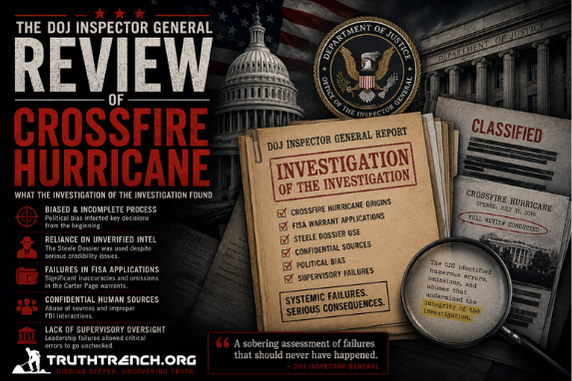
The Department of Justice Office of Inspector General, led by Inspector General Michael Horowitz, conducted an extensive review examining key aspects of the FBI and Department of Justice’s handling of Crossfire Hurricane.
The resulting report—formally titled Review of Four FISA Applications and Other Aspects of the FBI’s Crossfire Hurricane Investigation—was released on December 9, 2019. The OIG examined the origins of the investigation, the FBI’s use of confidential human sources and undercover employees, the role of Christopher Steele’s reporting, and four applications submitted to the Foreign Intelligence Surveillance Court seeking surveillance authority targeting Carter Page. The report ultimately produced nine recommendations to the FBI and Department of Justice.
Its findings were complicated.
The Inspector General found that the FBI had sufficient predication under applicable FBI policy to open Crossfire Hurricane and did not find documentary or testimonial evidence that political bias caused the investigation to be opened.
At the same time, the OIG uncovered serious failures in the FBI’s handling of the Carter Page FISA applications.
Those failures were not minor.
The Inspector General identified significant inaccuracies and omissions across four applications and concluded that FBI personnel responsible for the process fell far short of the requirement that FISA applications be “scrupulously accurate.”
The result was a report that resisted simple political narratives.
It did not conclude that the entire investigation was fabricated.
It did not conclude that everything the FBI did was proper.
Instead, it documented a much more complicated institutional story—one in which an investigation could be properly opened under existing FBI standards while serious failures subsequently occurred in the exercise of one of the government’s most intrusive surveillance authorities.
Understanding that distinction is essential to understanding what the Inspector General actually found.
Why Did the Inspector General Conduct the Review?
By 2018, questions surrounding the origins and conduct of Crossfire Hurricane had become a major national controversy.
Members of Congress and the public were asking fundamental questions.
Why did the FBI open an investigation involving individuals associated with a presidential campaign?
What role did the Steele dossier play?
Did political bias influence investigative decisions?
Did the FBI improperly place confidential human sources inside the Trump campaign?
Was information from Christopher Steele properly evaluated?
Did the FBI accurately represent the evidence when seeking surveillance authority against Carter Page?
And did investigators follow Department of Justice and FBI policies?
The Office of Inspector General undertook a review to examine many of these questions.
The OIG’s work covered multiple aspects of the investigation rather than focusing exclusively on the FISA applications.
That broader scope is important.
Crossfire Hurricane and the Carter Page surveillance were connected.
But they were not the same event.
The investigation existed before the Carter Page FISA surveillance began.
The Inspector General therefore examined both why the investigation was opened and how certain investigative authorities were subsequently used.
Related Truth Trench Research: Crossfire Hurricane: How the FBI’s Trump-Russia Investigation Began
What Was Crossfire Hurricane?
The FBI opened Crossfire Hurricane on July 31, 2016.
The investigation was prompted by information received from a Friendly Foreign Government concerning statements attributed to Trump campaign foreign policy adviser George Papadopoulos.
According to the information received by the FBI, Papadopoulos had suggested that the Trump campaign had received indications that Russia could assist the campaign through the anonymous release of information damaging to Hillary Clinton.
The FBI opened a counterintelligence investigation to determine whether individuals associated with the Trump campaign were coordinating, knowingly or unknowingly, with Russian efforts to interfere in the election.
This timing matters because it addresses one of the most persistent misconceptions surrounding the investigation.
The Steele dossier did not cause the FBI to open Crossfire Hurricane.
Christopher Steele’s reporting entered the FBI’s investigative picture separately.
The Inspector General found that the decision to open Crossfire Hurricane had sufficient predication under the FBI’s applicable investigative standards.
That does not mean the Inspector General concluded that every subsequent decision was correct.
It means the threshold required under FBI policy to initiate the investigation was met.
Those are two very different conclusions.
Did Political Bias Cause the FBI to Open Crossfire Hurricane?
One of the central questions examined by the Inspector General was whether political bias influenced the decision to open the investigation.
The OIG reviewed documentary evidence, communications, testimony, and other information concerning the FBI personnel involved.
The Inspector General did not find documentary or testimonial evidence that political bias or improper motivation influenced the decision to open Crossfire Hurricane.
That finding is significant and should be represented accurately.
But it is also important to understand what the finding means.
The OIG did not declare that every FBI employee involved in the broader investigation was politically neutral in every personal communication.
Publicly disclosed text messages involving certain FBI employees had already generated significant controversy.
Rather, the Inspector General examined whether available evidence demonstrated that political bias caused the specific decision to open Crossfire Hurricane.
The OIG did not find such evidence.
This distinction illustrates a recurring problem in public discussions of government investigations.
The existence of politically charged personal communications does not automatically prove that every official investigative decision resulted from political bias.
At the same time, the absence of evidence establishing political motivation does not automatically prove that every investigative decision was correct.
Motivation and execution are separate questions.
The FBI Opened Individual Investigations
After opening Crossfire Hurricane, the FBI opened individual investigations involving several people associated with the Trump campaign.
These included:
- George Papadopoulos,
- Carter Page,
- Paul Manafort,
- and Michael Flynn.
The OIG examined the decisions to open these investigations and found that each met the FBI’s applicable threshold for predication.
Again, the standard for opening an investigation is not the same as proving wrongdoing.
An investigation exists to determine facts.
Opening an investigation means investigators believe sufficient information exists under applicable policy to examine a potential national security or criminal concern.
It does not establish guilt.
This distinction is particularly important when discussing counterintelligence investigations.
An individual can become the subject of legitimate investigative interest without ultimately being charged with a crime.
Intelligence investigations frequently seek to understand relationships, foreign influence, recruitment efforts, or national security risks rather than simply build a criminal prosecution.
Did the FBI Place Spies Inside the Trump Campaign?
Another major allegation surrounding Crossfire Hurricane was that the FBI had planted confidential human sources inside the Trump campaign.
The Inspector General examined the FBI’s use of confidential human sources and undercover employees during the investigation.
The OIG did not find evidence that the FBI placed a confidential human source within the Trump campaign or recruited a campaign member to serve as a source for the investigation.
However, the FBI did use existing confidential human sources and undercover employees to interact with individuals associated with the campaign.
That distinction matters.
The OIG’s review specifically examined whether the FBI’s use of these investigative techniques complied with applicable policies and whether sources had been inserted into the campaign itself.
Public debate frequently collapses these different questions into the single word “spying.”
A more precise analysis asks:
Was a source planted inside the campaign?
Was an existing source tasked to interact with campaign associates?
Were undercover employees used?
Were those activities properly authorized?
Did investigators follow applicable policies?
Those are separate questions and should be evaluated separately.
Christopher Steele and the FBI
Christopher Steele was a former British intelligence officer who compiled a series of reports containing allegations concerning Donald Trump, individuals associated with his campaign, and Russia.
His work was conducted as part of opposition research ultimately funded through a law firm representing the Democratic National Committee and Hillary Clinton’s presidential campaign.
Steele’s reporting eventually reached the FBI.
The Inspector General examined the FBI’s relationship with Steele, the handling of his reporting, and the role that reporting played in the investigation.
One of the most important findings is again a matter of chronology:
Steele’s reporting did not initiate Crossfire Hurricane.
But it later became highly consequential.
In particular, Steele’s reporting played an important role in the FBI’s effort to obtain FISA surveillance authority targeting Carter Page.
That makes the distinction between investigative origin and subsequent investigative use essential.
Someone can accurately say:
The Steele dossier did not start Crossfire Hurricane.
And also accurately say:
Steele’s reporting became important to the Carter Page FISA applications.
Both statements can be true.
Related Truth Trench Research: The Steele Dossier: Trump Intelligence Allegations
Related Truth Trench Research: The Steele Dossier: What It Claimed—and What Was Later Verified, Disputed, or Unsubstantiated
The Carter Page FISA Applications
The most serious criticism in the Inspector General’s report concerned the FBI’s handling of applications seeking surveillance authority against Carter Page.
Page had served for a period as a foreign policy adviser to the Trump campaign.
The FBI and Department of Justice obtained an initial FISA order targeting Page and subsequently obtained three renewals.
The Inspector General examined all four applications.
The OIG found that FBI personnel failed to meet the standards expected of them in preparing the applications. Horowitz later testified that factual assertions relied upon by the FISA Court were, in multiple instances, inaccurate, incomplete, or unsupported by appropriate documentation based on information already in the FBI’s possession.
This became the most consequential institutional finding of the review.
The problem was not simply that investigators later learned new information.
The Inspector General found instances in which relevant information was already available to the FBI but was not accurately reflected in the applications presented to the court.
Related Truth Trench Research: The Carter Page FISA Warrants: What the DOJ Inspector General Found
The 17 Significant Inaccuracies and Omissions
The Inspector General identified seven significant inaccuracies and omissions in the initial Carter Page application, with the cumulative total reaching 17 across the four applications.
The issues included information affecting the reliability of Steele’s reporting, information concerning Carter Page’s prior relationship with another U.S. government agency, and other facts relevant to the court’s evaluation of the surveillance request.
These problems became increasingly significant because the government returned to the FISA Court three additional times seeking continued surveillance authority.
Each renewal created another opportunity to reassess the evidence.
Each renewal created another opportunity to incorporate new information.
Each renewal created another opportunity to correct previous representations.
Yet the problems persisted.
Horowitz concluded that the FBI’s performance in preparing the Carter Page applications fell short of what should be expected from an agency entrusted with such an intrusive surveillance authority.
Carter Page’s Relationship With Another Government Agency
One of the significant omissions involved Carter Page’s prior relationship with another U.S. government agency.
The FBI received information indicating that Page had previously been approved as an operational contact for that agency and had provided information concerning contacts with certain Russian intelligence officers.
That context was potentially important.
Some of Page’s interactions with Russians were relevant to the FBI’s concerns about him.
But if Page had previously reported certain foreign contacts to another part of the U.S. government, that information could affect how those contacts were interpreted.
The OIG found that relevant information concerning this prior relationship was not properly reflected in the FISA applications.
The issue became even more serious because of what happened later.
The Altered Email
Former FBI attorney Kevin Clinesmith altered an email concerning Carter Page’s prior relationship with another U.S. government agency.
The alteration conveyed that Page was “not a source” for the agency when the underlying information indicated that he had previously maintained an operational relationship with it.
Clinesmith later pleaded guilty to making a false statement in connection with the altered email.
This incident became one of the clearest examples of individual misconduct arising from the Crossfire Hurricane review.
But the institutional question extends beyond one person.
How did inaccurate information move through a process involving multiple layers of review?
Why did the surrounding system fail to identify the problem?
What safeguards should exist to prevent a similar failure?
Those questions became part of the broader reform effort that followed.
What Did the OIG Find About the Steele Primary Sub-Source?
The FBI interviewed Steele’s Primary Sub-source in January 2017.
Information obtained during those interviews raised questions about aspects of Steele’s reporting.
According to the Inspector General, relevant information concerning those interviews was not adequately incorporated into subsequent FISA renewal applications.
This finding is particularly important because intelligence reliability can change over time.
Investigators may initially consider information credible.
Later investigation may weaken that assessment.
A source may clarify an earlier statement.
A sub-source may explain that information was speculative.
Investigators may discover that a claim was based on rumor or secondhand reporting.
When surveillance authority is being renewed, those developments matter.
The government cannot responsibly treat an intelligence assessment as frozen in time.
New information must change the analysis when appropriate.
The Woods Procedures Failed
The FBI had procedures specifically designed to ensure the accuracy of FISA applications.
They are known as the Woods Procedures.
The basic concept is simple:
Factual assertions in a FISA application should be supported by documentation maintained by the FBI.
The Carter Page applications demonstrated that this verification system did not function as intended.
The failures also prompted a larger question:
Were the problems unique to Crossfire Hurricane?
The Inspector General subsequently expanded its examination to other FISA applications and identified broader compliance problems involving the FBI’s execution of Woods Procedures.
This transformed the controversy from a single politically sensitive investigation into a larger institutional issue involving the government’s verification of secret surveillance applications.
Related Truth Trench Research: The Woods Procedures: How the FBI Verifies FISA Applications
What Did the Inspector General Not Find?
Understanding the report requires being equally clear about what the OIG did not conclude.
The Inspector General did not conclude that Russian interference in the 2016 election was fictional.
The report did not conclude that Crossfire Hurricane was opened because of the Steele dossier.
The OIG did not find documentary or testimonial evidence that political bias caused the FBI to open Crossfire Hurricane.
The report did not conclude that the FBI had planted confidential human sources inside the Trump campaign.
The Inspector General also did not conclude that every action taken during Crossfire Hurricane was proper.
Instead, the report drew distinctions.
The opening of the investigation met the FBI’s applicable predication standard.
Certain investigative techniques were authorized under existing policies.
But the Carter Page FISA process contained serious failures.
Those conclusions can coexist.
Predication Does Not Equal Vindication
One of the most important lessons from the Inspector General’s report is the difference between determining that an investigation was sufficiently predicated and determining that the investigation was ultimately correct.
Predication answers a threshold question:
Did investigators possess enough information under applicable policy to begin investigating?
It does not answer:
Were all of the suspicions ultimately proven?
Nor does it answer:
Did investigators properly conduct every part of the investigation?
This distinction is essential.
A properly opened investigation can uncover no criminal conspiracy.
A properly opened investigation can later be mishandled.
An improperly handled surveillance application does not automatically prove that the original investigative concern was fabricated.
Government accountability requires examining each stage independently.
The Inspector General Made Nine Recommendations
The OIG’s report resulted in nine recommendations directed to the FBI and Department of Justice.
The recommendations addressed deficiencies identified during the review and sought improvements to policies, procedures, communication, oversight, and the FISA process.
The significance of those recommendations extended beyond Crossfire Hurricane.
The government had to confront weaknesses involving how intelligence was evaluated, how factual information moved between investigators and attorneys, how FISA applications were verified, and how information potentially undermining an investigative theory was communicated.
The official OIG report lists nine recommendations arising from the review.
Reform efforts subsequently involved the FBI, Department of Justice, and Foreign Intelligence Surveillance Court.
Related Truth Trench Research: FISA Reform After Crossfire Hurricane: What Changed?
Supporters’ Perspective
Those defending the FBI’s decision to investigate emphasize several findings from the Inspector General’s review.
Russia was conducting efforts to interfere in the 2016 election.
The FBI received information concerning statements attributed to a Trump campaign adviser.
The OIG found sufficient predication under applicable FBI policy to open Crossfire Hurricane and the individual investigations it examined.
The Inspector General did not find documentary or testimonial evidence establishing that political bias caused the investigation to be opened.
From this perspective, the fundamental decision to investigate a potential foreign intelligence threat was legitimate.
Supporters argue that the serious failures involving the Carter Page FISA applications should be addressed directly without retroactively transforming every aspect of Crossfire Hurricane into an illegitimate investigation.
Under this view, the lesson is:
Investigate legitimate national security concerns—but strengthen the safeguards governing how intrusive authorities are used.
Critics’ Perspective
Critics focus on the seriousness and persistence of the failures identified in the FISA process.
The government sought secret surveillance authority against an American citizen.
That individual had been associated with a presidential campaign.
The surveillance process occurred without the target present to challenge the government’s evidence.
The FBI returned to the court repeatedly.
And significant inaccuracies and omissions remained across four applications.
Critics argue that the failures demonstrate problems involving confirmation bias, source verification, supervision, institutional accountability, and the willingness of investigators to sufficiently challenge information supporting their investigative theory.
From this perspective, the fact that Crossfire Hurricane met the FBI’s threshold for opening does not excuse failures that occurred afterward.
The government must be judged not only on whether it had authority to begin an investigation but also on how responsibly it exercised its power once the investigation was underway.
The Report’s Most Important Lesson
The DOJ Inspector General’s Crossfire Hurricane review is often presented through competing political narratives.
One side points to the finding that the investigation had sufficient predication.
Another points to the failures in the Carter Page FISA applications.
But focusing exclusively on one finding while ignoring the other misses the larger institutional lesson.
Both matter.
The government must be able to investigate legitimate national security threats.
The government must also accurately present information when seeking intrusive surveillance authority.
Those responsibilities are not mutually exclusive.
In fact, they depend upon each other.
A foreign intelligence system that cannot investigate genuine threats is ineffective.
A foreign intelligence system that cannot reliably police its own use of power will eventually lose public trust.
The strength of the institution therefore depends upon its ability to do both.
Intelligence vs. Evidence
Crossfire Hurricane also demonstrates why intelligence must be distinguished from evidence.
Investigators frequently begin with incomplete information.
A foreign government provides a report.
A confidential source makes an allegation.
An intelligence officer identifies a suspicious contact.
An intercepted communication raises questions.
An analyst develops an assessment.
Those pieces of information can justify further investigation.
But an investigative lead is not automatically an established fact.
Raw intelligence is not automatically corroborated intelligence.
Corroborated intelligence is not automatically courtroom evidence.
And evidence that supports suspicion is not automatically proof of criminal conduct.
Confusing those stages can distort public understanding of an investigation.
It can also create institutional problems when investigators themselves become too confident in information that has not been sufficiently tested.
Related Truth Trench Research: Intelligence vs. Evidence: Why the Difference Matters
Why the Inspector General Review Still Matters
The Crossfire Hurricane review matters beyond Donald Trump, Hillary Clinton, Carter Page, Christopher Steele, or the 2016 election.
The underlying questions remain relevant whenever the federal government investigates politically sensitive national security matters.
How much information should be required to open an investigation?
How should investigators evaluate politically connected intelligence?
How should confidential sources be used?
How aggressively should investigators search for evidence contradicting their own theories?
What information must be presented to a secret surveillance court?
How should mistakes be corrected?
Who investigates the investigators?
And how can the public evaluate a system when much of the underlying information is classified?
These are not questions belonging exclusively to one political party.
The same surveillance authority available under one administration remains available under the next.
The same investigative powers used against one political movement can potentially be used against another.
Institutional safeguards therefore should not depend upon who currently holds political power.
They should be designed to endure.
Continue Your Research
Timeline of Events and Primary Sources: Crossfire Hurricane, FISA, and the Trump-Russia Investigation
What Are Your Thoughts?
Can an investigation be properly opened but improperly conducted?
Did the FBI’s internal safeguards function adequately during Crossfire Hurricane?
Should politically sensitive counterintelligence investigations receive additional independent oversight?
Should information that weakens an investigative theory receive the same institutional attention as information supporting it?
And when government agencies investigate matters involving presidential campaigns, what additional safeguards—if any—should exist to protect both national security and public confidence in democratic institutions?
Truth Trench Think Tank is collecting public perspectives on intelligence oversight, FISA, federal investigations, civil liberties, national security, government accountability, and institutional trust as part of our continuing research.
As an independent research institute, Truth Trench Think Tank does not engage in lobbying or partisan political activity. Our mission is to improve public understanding through transparent, evidence-based research and encourage informed civic participation grounded in publicly available information.
The Inspector General’s review demonstrates why oversight cannot end when an investigation begins.
Sometimes the most important trench is the one dug back through the government’s own work.
Keep digging.