The Foreign Intelligence Surveillance Act—better known as FISA—is one of the most important and frequently misunderstood national security laws in the United States.
For some Americans, FISA represents an essential legal framework that allows the federal government to identify foreign spies, terrorists, hostile intelligence services, cyber threats, and other national security dangers.
For others, FISA represents one of the most powerful—and potentially intrusive—surveillance authorities available to the federal government.
Both concerns deserve serious consideration.
The United States needs the ability to identify genuine foreign intelligence threats.
Americans also have constitutional rights that government agencies are obligated to respect.
FISA exists in the space between those two responsibilities.
Understanding the law is particularly important because “FISA” is often discussed as though it were a single surveillance program or a secret warrant the FBI can simply obtain whenever it wants.
It is neither.
FISA is a broader legal framework governing several forms of foreign intelligence collection. It established specialized courts, procedures for certain surveillance applications, rules governing the handling of collected information, and mechanisms intended to provide oversight of some of the government’s most sensitive intelligence activities.
To understand controversies involving Crossfire Hurricane, Carter Page, the Steele dossier, Section 702, or modern debates over government surveillance, it helps to begin with the foundation.
What exactly is FISA?
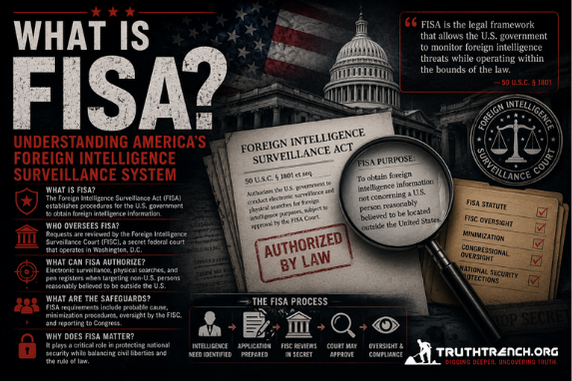
What Does FISA Stand For?
FISA stands for the Foreign Intelligence Surveillance Act.
Congress enacted the law in 1978.
At its core, FISA created a statutory framework governing certain government activities undertaken to obtain foreign intelligence information.
The law established procedures for electronic surveillance and subsequently evolved to address additional investigative techniques and intelligence authorities.
FISA also created the Foreign Intelligence Surveillance Court, commonly called the FISC, to review government applications seeking authorization for certain foreign intelligence activities. The court describes its primary role as reviewing executive branch applications for various means of obtaining foreign intelligence, principally when those activities occur in the United States or are directed at U.S. persons. (Foreign Intelligence Surveillance Court)
The Department of Justice’s National Security Division plays an important role in administering the government’s use of FISA authorities and publicly maintains FISA-related reports and information concerning Section 702. (Department of Justice)
Why Was FISA Created?
FISA emerged from an earlier era of controversy over government surveillance.
During the twentieth century, revelations concerning intelligence and law-enforcement surveillance of Americans—including political organizations, activists, civil-rights leaders, and others—raised serious questions about the limits of executive power.
Congress confronted a difficult problem.
Foreign espionage and national security threats were real.
The government needed intelligence capabilities to identify and counter them.
But secret surveillance conducted without meaningful legal boundaries also created opportunities for abuse.
FISA represented an attempt to establish rules.
Rather than leaving certain foreign intelligence surveillance decisions entirely within the executive branch, Congress created a statutory process that included judicial review.
The basic principle was significant:
National security surveillance should operate under law.
That did not eliminate secrecy.
Intelligence operations often depend upon secrecy.
But FISA attempted to place legal procedures around that secrecy.
What Is Foreign Intelligence?
The term “foreign intelligence” can sound straightforward, but the underlying issues are broad.
Foreign intelligence can involve information concerning:
- foreign governments,
- international terrorism,
- espionage,
- clandestine intelligence activities,
- foreign cyber operations,
- weapons proliferation,
- threats to national security,
- and activities conducted by foreign powers or their agents.
The FBI and other intelligence agencies may need to understand what foreign governments or organizations are doing, who they are communicating with, and whether individuals inside the United States are knowingly or unknowingly assisting foreign intelligence operations.
That mission creates an obvious challenge.
Foreign intelligence threats do not always remain neatly outside America’s borders.
A foreign intelligence officer may communicate with someone inside the United States.
A terrorist organization operating overseas may contact an individual in America.
A foreign government may attempt to recruit an American citizen.
A cyber operation originating overseas may target infrastructure located inside the United States.
FISA helps establish legal rules governing certain intelligence activities when those worlds intersect.
FISA Is Not the Same as a Criminal Search Warrant
One of the most important distinctions is between a traditional criminal investigation and a foreign intelligence investigation.
A criminal investigation generally focuses on whether someone committed a crime and whether evidence can be gathered for prosecution.
A foreign intelligence investigation may have a different objective.
Investigators may be attempting to determine:
Is a foreign government conducting espionage?
Is an intelligence service attempting to recruit someone?
Is a terrorist organization planning an attack?
Is a foreign actor attempting to compromise government systems?
Is an individual acting as an agent of a foreign power?
Those questions may eventually lead to criminal investigations or prosecutions, but prosecution is not necessarily the initial purpose of the intelligence collection.
Traditional criminal wiretaps and FISA surveillance therefore operate under different statutory frameworks, although both include authorization procedures and safeguards concerning surveillance and intercepted information. (Department of Justice)
Understanding this distinction is critical.
A FISA order should not simply be described as an ordinary criminal “warrant” with a different name.
The underlying legal purpose and process can be different.
What Is the Foreign Intelligence Surveillance Court?
The Foreign Intelligence Surveillance Court is a specialized federal court located in Washington, D.C.
Congress established it in 1978 when it enacted FISA.
The court considers government applications seeking approval for electronic surveillance, physical searches, and certain other investigative activities conducted for foreign intelligence purposes. (Foreign Intelligence Surveillance Court)
Unlike most courts Americans encounter, much of the FISA Court’s work involves classified national security information.
Proceedings can therefore occur in secret.
Another important distinction is that FISA proceedings are generally ex parte.
That means the government appears before the court, while the person who may become the target of surveillance is generally not present with an attorney to challenge the government’s assertions.
This structure creates a special responsibility for the government.
When there is no opposing attorney standing before the judge saying, “That’s incorrect,” or “You’re missing important information,” the court must depend heavily upon the accuracy and completeness of the government’s representations.
DOJ Inspector General Michael Horowitz highlighted precisely this concern when discussing FISA surveillance involving Carter Page: FISA orders can target U.S. persons, potentially collect information concerning constitutionally protected activities, and are considered in proceedings where the government’s counterparty is not present. (DOJ Inspector General)
That makes accuracy essential.
Related Truth Trench Research: Understanding the Foreign Intelligence Surveillance Court (FISC): The Secret Court Behind America’s Intelligence Operations
Who Can Be Targeted Under FISA?
This is where FISA becomes more complicated.
Different provisions of FISA apply to different circumstances.
Traditional FISA authorities can involve surveillance or searches directed at individuals believed to be agents of foreign powers, subject to statutory requirements and judicial review.
The standards and procedures can differ depending upon factors including whether the target is a U.S. person.
A “U.S. person” generally includes U.S. citizens and lawful permanent residents, as well as certain U.S.-based associations and corporations.
The government faces additional legal considerations when intelligence activities involve Americans.
That distinction reflects a central tension within foreign intelligence law.
The government may have legitimate reasons to investigate whether an American is working with a hostile foreign intelligence service.
But American citizenship does not disappear simply because a national security investigation begins.
Constitutional protections remain relevant.
What Does the Government Have to Show?
For traditional FISA surveillance, the government submits an application through the legal process established under the statute.
Depending upon the authority involved, the government may need to establish probable cause concerning matters such as whether the proposed target is a foreign power or an agent of a foreign power and whether the facility or place targeted by the surveillance meets applicable statutory requirements.
The details matter.
The court does not simply receive a request saying:
We believe this person is suspicious. Let us listen.
Applications can involve factual representations, certifications, descriptions of the surveillance sought, information concerning the target, and procedures governing how collected information will be handled.
Because these proceedings often occur without an opposing party, the integrity of that information is fundamental to the process.
That principle became central to the controversy surrounding the surveillance of Carter Page.
What Are Minimization Procedures?
Foreign intelligence surveillance can collect information beyond the specific intelligence ultimately sought.
An American may communicate with a foreign surveillance target.
A conversation may contain both relevant and irrelevant information.
Information involving U.S. persons may be collected during legitimate intelligence activities.
FISA therefore includes concepts and procedures intended to limit how certain information is acquired, retained, and disseminated.
These are commonly discussed as minimization procedures.
The underlying principle is straightforward:
The government’s authority to collect foreign intelligence does not necessarily mean every piece of information encountered should be retained indefinitely or distributed without restriction.
Minimization is therefore one of the safeguards intended to balance intelligence collection with privacy and civil-liberties concerns.
What Are the Woods Procedures?
FISA’s legal requirements are accompanied by internal government processes designed to improve accuracy.
One of the best-known examples is the FBI’s Woods Procedures.
The basic purpose is to ensure that factual assertions presented in FISA applications are supported by documentation.
If an application makes a factual claim, there should be underlying material supporting that claim.
The process sounds simple.
But Crossfire Hurricane demonstrated that verification involves more than proving that individual facts have supporting documents.
An application can contain supported information while still creating a misleading picture if significant contradictory or qualifying information is omitted.
That became one of the major lessons arising from the Carter Page FISA applications.
Related Truth Trench Research: The Woods Procedures: How the FBI Verifies FISA Applications
What Happened With Carter Page?
Carter Page was a former foreign policy adviser to Donald Trump’s 2016 presidential campaign.
The FBI obtained FISA surveillance authority targeting Page and subsequently obtained three renewals.
The Department of Justice Office of Inspector General later conducted an extensive review of the applications.
The Inspector General identified 17 significant inaccuracies and omissions across the four applications.
The findings raised serious concerns about the FBI’s verification process, the handling of information concerning sources, communication between investigators and Justice Department attorneys, and whether the FISA Court received information necessary to properly evaluate the government’s case.
The controversy became one of the most consequential examinations of FISA procedures in the law’s history.
It also demonstrates why two questions must be kept separate.
The first is:
Should the United States have the legal ability to conduct foreign intelligence surveillance?
The second is:
Did government officials properly follow the rules when using that authority in a particular case?
Supporting the existence of FISA does not require defending every use of FISA.
Criticizing government failures does not require arguing that the United States should have no foreign intelligence capabilities.
Both the authority and its execution can be evaluated independently.
Related Truth Trench Research: The Carter Page FISA Warrants: What the DOJ Inspector General Found
What Is Section 702?
Section 702 is another major part of the modern FISA debate.
Congress added Section 702 to FISA in 2008.
It provides authority for targeted foreign intelligence collection involving non-U.S. persons reasonably believed to be located outside the United States.
That is fundamentally different from the traditional FISA surveillance process associated with Carter Page.
Section 702 is not designed as a mechanism for obtaining an individualized FISA order targeting an American inside the United States.
The DOJ Inspector General describes Section 702 as permitting targeted electronic surveillance of non-U.S. persons outside the United States for foreign intelligence purposes. (DOJ Inspector General)
But the intelligence collected can include communications involving Americans.
That creates what is sometimes called incidental collection.
For example, if a lawful foreign intelligence target overseas communicates with an American, the American’s side of that communication may also be collected.
That leads to another controversial question:
Under what circumstances should government personnel be permitted to search previously collected Section 702 information using an identifier associated with an American?
That question has become central to modern debates over privacy, national security, and FISA reform.
Is Section 702 “Warrantless Surveillance”?
The phrase is commonly used, but it can obscure important distinctions.
Section 702 does not require the government to obtain an individualized warrant for each non-U.S. person targeted outside the United States.
However, the program operates under a statutory and judicial oversight structure involving certifications and procedures reviewed by the FISA Court.
The controversy centers in part on the fact that communications involving Americans can enter the resulting intelligence databases even though the American was not the surveillance target.
Critics argue that subsequent searches involving Americans can implicate Fourth Amendment concerns and should sometimes require a warrant.
Supporters argue that Section 702 is directed at foreigners overseas and provides intelligence essential to national security, while existing rules and reforms provide protections concerning U.S.-person information.
This is why simply asking whether someone “supports FISA” is often insufficient.
The more useful question is:
Which FISA authority are we discussing, and what government activity does it permit?
Does the FISA Court Approve Everything?
The FISA Court is sometimes characterized as a “rubber stamp.”
The criticism often arises from the historically high percentage of government applications ultimately approved.
But raw approval statistics do not necessarily reveal the entire process.
Applications can be modified during the review process.
Government attorneys may revise submissions in response to questions.
Applications can be withdrawn.
The court can impose conditions.
And the government may choose not to submit an application if concerns arise during internal review.
Federal judiciary reporting distinguishes among applications or certifications that are granted, modified, or denied and also reports certain information concerning the use of amici curiae. (United States Courts)
That does not eliminate legitimate questions about whether the court provides sufficient independent scrutiny.
It does mean that evaluating the court requires more than looking at a single approval percentage.
Who Watches the FISA System?
FISA oversight operates through multiple layers.
Depending upon the authority involved, oversight can include:
- the Foreign Intelligence Surveillance Court,
- the Foreign Intelligence Surveillance Court of Review,
- the Department of Justice,
- the FBI,
- the Office of the Director of National Intelligence,
- agency compliance offices,
- Inspectors General,
- congressional intelligence and judiciary committees,
- and statutory reporting requirements.
The Foreign Intelligence Surveillance Court of Review exists to review decisions of the FISA Court. (Foreign Intelligence Surveillance Court)
The Department of Justice also publishes annual FISA reports to Congress, while the federal judiciary publishes statistics concerning FISA Court activities. (Department of Justice)
Some FISA Court filings and opinions have also been made publicly available, although substantial portions of the system necessarily continue to involve classified information. (Foreign Intelligence Surveillance Court)
The existence of multiple oversight layers, however, raises the same lesson seen throughout the Crossfire Hurricane controversy:
A safeguard only works when the people responsible for it actually perform the function.
Supporters’ Perspective
Supporters of FISA argue that foreign intelligence surveillance is an unavoidable requirement of national defense.
Foreign governments conduct espionage.
Intelligence services attempt to recruit Americans.
Terrorist organizations communicate across borders.
Cyber actors attack American infrastructure from overseas.
Hostile governments conduct influence operations.
Under this view, requiring intelligence agencies to operate without effective foreign surveillance capabilities would leave the United States dangerously exposed.
Supporters also emphasize that FISA created legal procedures and judicial oversight where intelligence activities had previously been subject to fewer statutory constraints.
From this perspective, the solution to failures is not eliminating FISA.
It is strengthening the system.
Improve verification.
Increase accountability.
Modernize oversight.
Correct failures.
Preserve the capability.
Critics’ Perspective
Critics argue that secret surveillance authorities inherently create risks to constitutional rights.
The target may never know surveillance occurred.
The public cannot examine much of the underlying evidence.
Proceedings are often ex parte.
Government agencies possess enormous technological capabilities.
And history demonstrates that intelligence and law-enforcement authorities can be misused.
The Carter Page applications intensified those concerns because significant inaccuracies and omissions survived multiple layers of review.
Separate controversies involving searches of Section 702 information have raised additional questions about Americans’ communications and government database queries.
From this perspective, internal safeguards alone may be insufficient.
Critics argue that stronger judicial review, warrant requirements in certain circumstances, greater transparency, independent participation before the FISA Court, and more meaningful consequences for misconduct may be necessary.
FISA Is Ultimately About Trust—but Trust Must Be Verified
Foreign intelligence surveillance requires secrecy.
That is unavoidable.
A government cannot publicly announce every intelligence target, source, collection method, or active counterintelligence investigation.
But democratic government also requires accountability.
That creates a difficult equation.
The public must allow intelligence agencies to conduct some activities it cannot observe directly.
Government institutions must therefore demonstrate that the systems operating behind closed doors contain meaningful safeguards.
Courts must scrutinize applications.
Investigators must verify facts.
Attorneys must present complete information.
Supervisors must challenge assumptions.
Inspectors General must investigate failures.
Congress must conduct oversight.
And when mistakes occur, the government must correct them.
Trust cannot simply be demanded.
It must be maintained.
Why Understanding FISA Matters
FISA is not merely an issue for intelligence professionals, attorneys, politicians, or national security experts.
It concerns the relationship between citizens and government power.
The United States faces genuine foreign intelligence threats.
The government requires tools to confront them.
Those tools can also be extraordinarily powerful.
The challenge is ensuring that the capability to defend the country does not become an unchecked capability to surveil the people the government exists to protect.
That tension will not disappear.
Technology will continue advancing.
Artificial intelligence will increase analytical capabilities.
Communications will become more global.
Commercial data will become more extensive.
Foreign intelligence services will adapt.
The question facing America is therefore not simply whether FISA was appropriate in 1978.
The question is whether America’s foreign intelligence surveillance system can continue evolving while preserving both national security and constitutional government.
Continue Your Research
Timeline of Events and Primary Sources: Crossfire Hurricane, FISA, and the Trump-Russia Investigation
What Are Your Thoughts?
Should the United States maintain a specialized surveillance system for foreign intelligence investigations?
Does the FISA Court provide sufficient oversight when proceedings are conducted largely in secret?
Should additional protections apply when surveillance involves an American citizen?
Should government searches involving Americans’ communications collected through foreign intelligence programs require greater judicial oversight?
And as artificial intelligence and modern data technologies transform surveillance capabilities, can a legal framework created in 1978 continue adapting—or will America eventually need something fundamentally new?
Truth Trench Think Tank is collecting public perspectives on FISA, foreign intelligence, national security, privacy, civil liberties, constitutional governance, and government accountability as part of our continuing research.
As an independent research institute, Truth Trench Think Tank does not engage in lobbying or partisan political activity. Our mission is to improve public understanding through transparent, evidence-based research and encourage informed civic participation grounded in publicly available information.
FISA operates largely out of public view. That makes understanding the system—not simply trusting or distrusting it—especially important.
If government power operates below the surface, that’s exactly where the public needs someone willing to dig.
Keep digging.