The controversy surrounding the FBI’s Crossfire Hurricane investigation did not end with the investigation itself.
The Department of Justice Office of Inspector General’s examination of the FBI’s surveillance of Carter Page exposed significant weaknesses in the process used to prepare, verify, review, and submit applications to the Foreign Intelligence Surveillance Court.
The Inspector General identified 17 significant inaccuracies and omissions across the four FISA applications targeting Page. The findings raised a fundamental question:
What happens when the safeguards designed to protect Americans from improper government surveillance fail?
The answer was not simply another investigation.
The FBI, Department of Justice, Foreign Intelligence Surveillance Court, and Congress all faced pressure to examine how foreign intelligence surveillance authorities were being used and what additional safeguards were necessary.
Policies changed.
Verification procedures received greater scrutiny.
The FISA Court demanded corrective action.
The FBI implemented new review requirements.
The Justice Department strengthened aspects of its oversight.
And the controversy became part of a much larger national debate over the future of FISA itself.
But “FISA reform” is not one single event.
Some changes directly addressed the failures exposed by the Carter Page applications. Others addressed separate compliance problems involving different provisions of FISA, particularly Section 702.
Understanding what changed requires separating those issues.
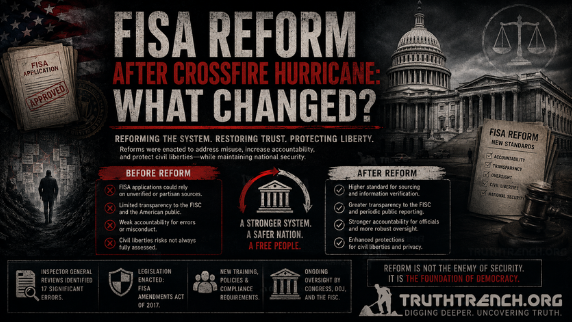
The Problem Exposed by the Carter Page Applications
The Carter Page controversy involved traditional FISA electronic surveillance authorities—not Section 702.
The distinction matters.
The government sought authorization from the Foreign Intelligence Surveillance Court to conduct surveillance targeting Carter Page based on probable cause that he was acting as an agent of a foreign power.
Because Page was an American citizen, the government’s surveillance authority carried significant constitutional and civil-liberties implications.
The proceedings were also ex parte.
Page and his attorneys were not present before the FISA Court to challenge the government’s assertions.
The court therefore depended heavily upon the FBI and Department of Justice to accurately present the evidence—including information that might weaken the government’s case.
The DOJ Inspector General’s investigation found that this process failed in significant ways.
Across four applications, the OIG identified 17 significant inaccuracies and omissions. The Inspector General concluded that the Crossfire Hurricane team failed to meet its obligation to ensure the applications were “scrupulously accurate.” (DOJ Inspector General)
That finding placed the government’s internal safeguards under intense scrutiny.
Related Truth Trench Research: The Carter Page FISA Warrants: What the DOJ Inspector General Found
That article examines the applications themselves, the role of Christopher Steele’s reporting, Carter Page’s prior relationship with another U.S. government agency, the altered email involving former FBI attorney Kevin Clinesmith, and the information that was not properly communicated during the FISA renewal process.
The FISA Court Demanded Answers
The Foreign Intelligence Surveillance Court did not simply accept the Inspector General’s findings and move on.
The court required the government to explain how it intended to address the problems exposed by the Carter Page applications.
This was significant because the controversy directly implicated the relationship between the government and the court.
FISA judges cannot independently investigate every factual assertion contained in every application.
They depend upon government agencies to follow procedures designed to ensure that the information presented is accurate and complete.
The court subsequently reviewed corrective actions proposed by the FBI and Department of Justice and examined whether those reforms went far enough.
In a March 2020 opinion, the FISA Court described omissions of material facts as among the most serious problems identified in the Carter Page applications. (Foreign Intelligence Surveillance Court)
The message was clear:
The integrity of the FISA process depends upon more than proving facts that support surveillance.
The government must also accurately communicate information that could undermine its own assertions.
Strengthening the Woods Procedures
One of the most important areas of reform involved the FBI’s Woods Procedures.
The Woods Procedures are designed to ensure that factual assertions made in FISA applications are supported by documentation maintained in what is commonly called a Woods File.
In principle, the system is straightforward.
If the FBI tells the FISA Court that a fact is true, investigators should be able to identify documentation supporting that assertion.
But the Carter Page investigation demonstrated an important limitation.
A verification process focused only on whether supporting documentation exists does not necessarily ensure that the court receives the complete factual picture.
An application can contain individually supported facts while still being misleading if investigators omit contradictory, exculpatory, or materially qualifying information.
That distinction became central to post-Crossfire Hurricane reform efforts.
The FBI and Department of Justice increased attention to the accuracy and completeness of FISA applications, the documentation underlying factual assertions, and the responsibilities of investigators and attorneys involved in the process.
Related Truth Trench Research: The Woods Procedures: How the FBI Verifies FISA Applications
The Inspector General Looked Beyond Carter Page
One of the most consequential developments following the Crossfire Hurricane review was the DOJ Inspector General’s decision to examine whether the problems were isolated.
The question was obvious.
If the Woods Procedures failed in the Carter Page applications, were similar problems occurring elsewhere?
The OIG subsequently reviewed the FBI’s execution of Woods Procedures in additional FISA applications involving U.S. persons.
That broader work identified deficiencies beyond the Crossfire Hurricane investigation.
The Inspector General’s 2021 audit examined FBI compliance with the procedures and made recommendations intended to reduce the risk of unsupported or erroneous information appearing in FISA applications. (DOJ Inspector General)
This changed the institutional significance of the Carter Page controversy.
The issue was no longer simply:
What went wrong in one politically sensitive investigation?
It became:
How reliable is the broader system used to verify applications for secret government surveillance?
That is a much larger question.
Accuracy Reviews Became More Important
Following the Inspector General’s findings, additional emphasis was placed on internal accuracy reviews.
These reviews are intended to examine whether FISA applications comply with verification requirements and whether the supporting documentation actually substantiates representations made to the court.
This creates another layer of oversight.
The investigator develops the case.
The factual assertions are documented.
Attorneys review the application.
Supervisors provide oversight.
The Department of Justice reviews the submission.
The FISA Court evaluates the government’s application.
And internal or external reviewers can subsequently examine whether the process was followed correctly.
In theory, these overlapping layers create redundancy.
That is important in systems involving extraordinary government authority.
But the Carter Page case demonstrated another reality:
Multiple layers of oversight are useful only if each layer performs its function.
A complicated process does not automatically create accountability.
People must still ask the right questions.
More Scrutiny for Sensitive Investigations
Crossfire Hurricane also intensified scrutiny of investigations involving elected officials, political candidates, campaigns, and other constitutionally sensitive activities.
This is one of the most difficult areas of federal investigative policy.
Political figures are not immune from legitimate investigation.
Foreign intelligence services can attempt to influence, recruit, compromise, or exploit individuals connected to political organizations.
At the same time, federal investigations involving political campaigns carry extraordinary consequences.
Even the existence of an investigation can affect public confidence, elections, political institutions, and perceptions of government neutrality.
The lesson emerging from Crossfire Hurricane was therefore not simply that politically connected individuals should never be investigated.
The larger lesson was that politically sensitive investigations require particularly disciplined oversight.
The more consequential the investigation, the greater the need for documented decision-making, accurate representations, independent review, and institutional accountability.
Greater Attention to Information That Cuts Against the Government’s Case
One of the most important lessons from the Carter Page applications involved information that did not support the FBI’s theory.
This included information concerning Page’s prior relationship with another U.S. government agency and information obtained during interviews that raised questions about aspects of Christopher Steele’s reporting.
The problem was not merely whether investigators possessed this information.
The problem was whether decision-makers—and ultimately the FISA Court—received it.
Post-Crossfire Hurricane reforms placed greater emphasis on ensuring that applications provide a complete picture rather than simply assembling facts supporting probable cause.
This principle is fundamental to an ex parte proceeding.
When only the government appears before the judge, the government effectively assumes an additional responsibility.
It must present its own case accurately while also ensuring that material information affecting the court’s evaluation is not improperly withheld.
That is one of the most enduring lessons of the Carter Page controversy.
Source Reliability Became a Central Issue
Crossfire Hurricane also exposed the importance of evaluating intelligence sources over time.
Christopher Steele’s reporting played a central and essential role in the FBI’s decision to seek FISA surveillance authority targeting Carter Page, according to the Inspector General. (DOJ Inspector General)
But intelligence does not become permanently reliable simply because investigators initially believe a source is credible.
New information can emerge.
Sources can contradict themselves.
Sub-sources can provide additional context.
Investigators can discover that information was based on rumor, speculation, misunderstanding, or secondhand reporting.
The key institutional question is what happens next.
If the government has already relied upon information in a surveillance application and subsequently learns facts that materially affect its reliability, those developments must be incorporated into future assessments and, where appropriate, communicated to the court.
The Carter Page renewals demonstrated the consequences when that process breaks down.
Related Truth Trench Research: The Steele Dossier: What It Claimed—and What Was Later Verified, Disputed, or Unsubstantiated
Accountability Became Part of the Reform Debate
Procedures alone cannot solve every problem.
The Carter Page controversy also raised questions about individual accountability.
Former FBI attorney Kevin Clinesmith pleaded guilty to making a false statement after altering an email concerning Page’s prior relationship with another government agency.
That episode became one of the clearest examples of misconduct associated with the FISA process.
But the broader Inspector General findings involved more than one individual.
They involved failures of communication, supervision, verification, documentation, and review.
That distinction is important.
An organization can discipline an individual who violates policy.
Fixing a systemic weakness is harder.
It requires asking why the surrounding process failed to identify the problem.
Why did another reviewer not catch it?
Why did contradictory information not move upward?
Why did subsequent applications repeat or compound earlier problems?
Why did multiple organizational layers fail to correct the record?
Those are questions of institutional design.
And institutional design became a major focus of FISA reform.
The Difference Between Carter Page Reform and Section 702 Reform
This is where public discussion of FISA can become confusing.
The Carter Page surveillance controversy involved one part of FISA.
Section 702 involves another.
Section 702 authorizes targeted foreign intelligence collection involving non-U.S. persons reasonably believed to be located outside the United States.
The Carter Page surveillance did not occur under Section 702.
However, separate compliance problems involving FBI searches—or “queries”—of information collected under Section 702 generated their own reform efforts.
The two controversies eventually became intertwined in the broader political debate over FISA.
That does not mean they are legally identical.
The reforms responding directly to Crossfire Hurricane focused heavily on application accuracy, Woods Procedures, source reliability, oversight, and the government’s obligations to the FISA Court.
Section 702 reforms focused more heavily on how collected intelligence could be queried, particularly when FBI personnel used U.S.-person identifiers.
Understanding that distinction prevents two separate surveillance debates from being incorrectly collapsed into one.
Section 702 Reforms Added Another Layer
Separate concerns about FBI compliance with Section 702 led to additional changes during 2021 and 2022.
The FBI implemented measures intended to reduce improper U.S.-person queries and improve compliance.
According to the FBI’s description of a subsequently released 2023 FISA Court opinion, those changes included technical and procedural reforms that substantially reduced the number of U.S.-person queries and improved compliance with applicable querying standards. The court calculated compliance at more than 98 percent for the period it reviewed following implementation of the reforms, while still identifying incidents of noncompliance. (fbi.gov)
This is evidence that procedural and technical controls can improve compliance.
But it also reinforces a larger Truth Trench principle:
Technology can help enforce rules.
Technology cannot replace institutional responsibility.
A database can require an additional approval.
A system can change a default setting.
Software can create an audit trail.
But people still make the decisions.
Did Congress Reform FISA?
Congressional debate over FISA continued well beyond Crossfire Hurricane.
Lawmakers from across the political spectrum proposed different approaches.
Some sought stronger protections for Americans.
Some advocated additional judicial oversight.
Some called for changes to the role of amici curiae—outside experts who can assist the FISA Court in certain significant cases.
Some sought greater transparency.
Others warned that overly restrictive reforms could impair legitimate intelligence operations necessary to protect the United States.
These debates became particularly significant during consideration of Section 702 reauthorization.
The result has been an evolving collection of statutory, judicial, administrative, technical, and procedural reforms rather than one single “Crossfire Hurricane reform law.”
That distinction matters.
The FBI changed procedures.
The Department of Justice changed oversight practices.
The FISA Court demanded corrective action.
Inspectors General conducted broader audits.
Congress continued debating and legislating surveillance authorities.
FISA reform therefore developed in layers.
Did the Reforms Fix the Problem?
There is no simple answer.
Supporters of the reforms point to stronger verification requirements, expanded reviews, greater oversight, additional accountability measures, and improved compliance statistics in areas such as Section 702 querying.
They argue that the system identified serious failures and responded by strengthening safeguards.
Critics remain skeptical.
They argue that internal reforms cannot fully address the fundamental challenge of secret surveillance proceedings in which the government presents its case without an opposing party present.
They also point to broader OIG findings concerning Woods Procedure compliance as evidence that accuracy problems were not confined to Crossfire Hurricane.
Both perspectives raise legitimate questions.
The existence of reform does not prove that every problem has been solved.
The existence of past failures does not prove that reform is impossible.
The real measure is whether the system can consistently detect mistakes, correct them quickly, hold individuals accountable when appropriate, and prevent the same failures from recurring.
Supporters’ Perspective
Supporters of the post-Crossfire Hurricane reforms argue that oversight worked.
The Inspector General investigated.
The findings became public.
The FISA Court responded.
The FBI implemented corrective measures.
The Department of Justice strengthened oversight.
Additional FISA applications were audited.
Congress examined the authorities.
From this perspective, accountability does not require a system in which mistakes never occur.
It requires a system capable of discovering failures and correcting them.
Supporters also warn that foreign intelligence threats remain real.
Russia, China, Iran, terrorist organizations, cyber actors, and other foreign adversaries continue conducting intelligence operations targeting the United States.
The government therefore requires effective surveillance authorities.
The challenge is preserving those capabilities while ensuring that constitutional protections and civil liberties remain intact.
Critics’ Perspective
Critics argue that the failures exposed by the Carter Page applications demonstrate structural weaknesses that procedural reforms cannot fully resolve.
They emphasize the secrecy of FISA proceedings.
The surveillance target cannot challenge the government’s evidence before authorization.
The public generally cannot examine the application.
Much of the underlying intelligence remains classified.
The court must rely heavily upon the government’s representations.
Under this view, the Carter Page controversy revealed the danger inherent in a system where inaccurate or incomplete information can potentially survive multiple levels of internal review.
Critics therefore argue for stronger external safeguards, greater transparency, more meaningful adversarial participation in sensitive cases, stricter consequences for misconduct, or higher standards when surveillance involves Americans engaged in constitutionally protected political activity.
The Larger Lesson of Crossfire Hurricane
The most important reform may not be a particular checklist, policy, or procedural requirement.
It may be the recognition that authority and accountability must grow together.
The more powerful the government tool, the stronger the safeguards surrounding its use should be.
FISA exists because the United States faces real foreign intelligence threats.
But the same secrecy that can make intelligence operations effective can also make mistakes difficult to detect.
That creates a permanent tension.
National security requires secrecy.
Democratic accountability requires oversight.
Civil liberties require restraint.
Effective intelligence requires speed and flexibility.
The challenge is not choosing one and abandoning the others.
The challenge is building institutions capable of doing all of them at the same time.
Continue Your Research
Timeline of Events and Primary Sources: Crossfire Hurricane, FISA, and the Trump-Russia Investigation
What Are Your Thoughts?
Did the reforms following Crossfire Hurricane go far enough?
Should politically sensitive FISA applications involving U.S. persons receive additional independent review?
Should the FISA Court have access to a stronger adversarial process when significant civil-liberties issues are involved?
Can internal government safeguards adequately protect against surveillance errors, or is greater external oversight necessary?
And how should the United States balance the need to identify genuine foreign intelligence threats with the responsibility to protect Americans from improper government surveillance?
Truth Trench Think Tank is collecting public perspectives on FISA, intelligence oversight, national security, civil liberties, government accountability, and institutional trust as part of our continuing research.
As an independent research institute, Truth Trench Think Tank does not engage in lobbying or partisan political activity. Our mission is to improve public understanding through transparent, evidence-based research and encourage informed civic participation grounded in publicly available information.
The tools of government may change. The technology may change. The threats may change. But the requirement for accountability does not.
When the system operates underground, somebody still has to get into the trench and inspect the foundation.
Keep digging.