A government investigator receives information from a confidential source.
An intelligence service intercepts a communication.
A foreign partner provides a report.
An analyst identifies a pattern.
A witness makes an allegation.
A journalist obtains a leaked document.
A federal agent develops an investigative lead.
Then the information reaches the public.
Within hours, the distinction between what was reported, what was suspected, what was corroborated, and what was actually proven can disappear.
An allegation becomes a fact.
An intelligence report becomes evidence.
An investigation becomes proof of wrongdoing.
A lack of criminal charges becomes proof that nothing happened.
And competing political narratives begin forming around information that may still be incomplete.
This problem sits at the center of many of the most controversial national security stories in modern America.
It was central to the debate surrounding the Steele dossier.
It affected public understanding of the FBI’s Crossfire Hurricane investigation.
It became important in evaluating the Carter Page FISA applications.
It remains relevant whenever intelligence agencies, law enforcement, journalists, elected officials, and the public attempt to understand information involving foreign governments, national security threats, espionage, terrorism, cyber operations, or political influence.
The fundamental principle is simple:
Intelligence and evidence are not the same thing.
Both can be valuable.
Both can be wrong.
Both can lead investigators toward the truth.
But they serve different purposes and should be evaluated using different standards.
Understanding that difference is essential to understanding how investigations actually work.
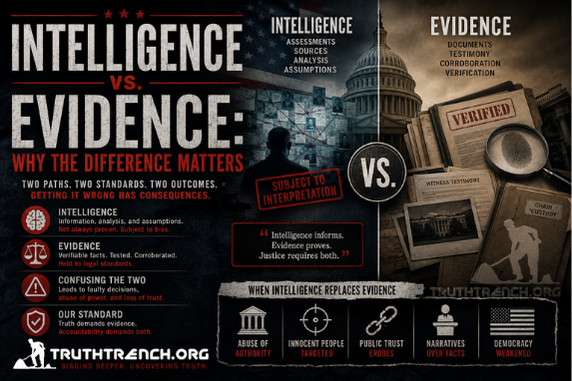
What Is Intelligence?
In its broadest sense, intelligence is information collected and analyzed to help decision-makers understand threats, opportunities, capabilities, intentions, relationships, or events.
Intelligence can come from many sources.
A human source may report something they heard.
A foreign intelligence service may provide information.
An intercepted communication may reveal a conversation.
Satellite imagery may show activity at a military installation.
Financial records may identify unusual transactions.
Open-source research may uncover relationships among individuals or organizations.
Cybersecurity systems may detect activity associated with a foreign threat actor.
An analyst may combine multiple pieces of information to identify a pattern that was not visible when each piece was examined independently.
Intelligence therefore often begins with fragments.
The job of intelligence professionals is to collect those fragments, evaluate their reliability, compare them with other information, identify gaps, and develop assessments.
But an intelligence report does not automatically establish that everything inside it is true.
That distinction is fundamental.
Raw Intelligence Is Not Established Fact
Consider a hypothetical example.
A confidential source tells an FBI agent:
A foreign government official secretly met with an American political adviser.
That statement is intelligence.
It may be extremely important.
It may justify additional investigation.
But several questions immediately arise.
How does the source know?
Did the source personally witness the meeting?
Did someone else tell the source?
How reliable has the source been previously?
Does the source have a motive to lie?
Could the source be mistaken?
Can investigators confirm that both individuals were in the same location?
Are there travel records?
Communications?
Photographs?
Witnesses?
Financial transactions?
Other intelligence reporting?
The original information may be entirely accurate.
It may be partially accurate.
It may be exaggerated.
It may be misunderstood.
It may be deliberate disinformation.
Or it may be impossible to verify.
The purpose of investigation is to determine which.
What Is Evidence?
Evidence is information or material used to establish or disprove a fact.
In a legal context, evidence may include documents, physical objects, electronic records, testimony, photographs, recordings, forensic analysis, financial records, communications, or other information that can be evaluated according to applicable rules and standards.
Evidence is generally expected to have a stronger foundation than an unverified intelligence allegation.
But even evidence is not automatically proof.
A photograph can be authentic but misinterpreted.
A witness can testify truthfully about what they believe they saw and still be mistaken.
A document can be genuine but lack important context.
A communication can contain sarcasm or coded language.
A financial transaction can appear suspicious while having a legitimate explanation.
Evidence must still be evaluated.
The critical difference is that evidence generally moves the inquiry toward something that can be tested, examined, challenged, authenticated, and weighed.
Intelligence Can Lead to Evidence
Intelligence and evidence are not opposing concepts.
They frequently operate as stages of the same process.
Imagine investigators receive intelligence suggesting that an individual is secretly working for a foreign government.
That intelligence might prompt investigators to examine travel records.
Travel records may identify unexplained trips.
Those trips may lead investigators to financial transactions.
Financial records may identify payments from an intermediary.
The intermediary may be connected to a foreign intelligence officer.
Investigators may obtain communications showing that the payments corresponded with specific activities.
A witness may then corroborate the relationship.
What began as an intelligence lead has now produced multiple pieces of potentially corroborating evidence.
The process might look like this:
Information → Intelligence → Investigative Lead → Corroboration → Evidence → Legal Finding
But the process is rarely perfectly linear.
Investigators may move backward.
New evidence may disprove an earlier intelligence assessment.
A source may lose credibility.
An apparently suspicious transaction may receive an innocent explanation.
An investigative theory may collapse.
That is not necessarily a failure.
Sometimes discovering that an allegation is false is exactly what a properly conducted investigation is supposed to accomplish.
Corroboration Is the Bridge
One of the most important concepts connecting intelligence and evidence is corroboration.
Corroboration means finding independent information that supports or confirms an assertion.
Suppose Source A says a meeting occurred.
Investigators discover travel records placing both individuals in the same city.
That supports the possibility of the meeting.
Then investigators find a calendar entry.
That provides additional support.
A surveillance image places both individuals at the same location.
A communication sent afterward references their conversation.
Each independent piece strengthens the original allegation.
But corroboration has to be genuinely independent.
If five news articles all repeat the same allegation from one anonymous source, that is not necessarily five independent confirmations.
It may simply be one allegation repeated five times.
The same problem can occur in intelligence reporting.
Source A tells Source B.
Source B tells Source C.
Source C reports the information to an intelligence officer.
A second report appears to confirm the first—but investigators later discover both reports ultimately originated from Source A.
What looked like multiple sources was actually one.
Understanding the provenance of information—where it originally came from—is therefore essential.
Source Reliability and Information Reliability Are Different
Intelligence professionals often have to evaluate two related but distinct questions.
Is the source reliable?
And:
Is this particular piece of information reliable?
A source with a strong history of accurate reporting can still be wrong.
A source with no established track record can still provide accurate information.
A dishonest person can occasionally tell the truth.
A trustworthy person can repeat a false rumor without realizing it.
This is why intelligence analysis cannot simply assign permanent labels such as “good source” or “bad source” and stop there.
The source must be evaluated.
The information must also be evaluated.
Those assessments can change as new information emerges.
The Steele Dossier Demonstrates the Problem
The collection of reports commonly known as the Steele dossier provides a useful example of why these distinctions matter.
Christopher Steele was a former British intelligence officer.
His professional background was relevant when evaluating why people initially took his reporting seriously.
But Steele’s credentials did not automatically establish that every allegation reported through his sources and sub-sources was accurate.
The FBI still had to evaluate the information.
Where did each allegation originate?
Did Steele have direct knowledge?
Did his source?
Did a sub-source?
Was the information firsthand?
Was it rumor?
Could it be independently corroborated?
Did later interviews strengthen or weaken the original reporting?
Those questions became increasingly important as Steele’s reporting moved from private opposition research into federal investigative activity and eventually into applications seeking surveillance authority targeting Carter Page.
Related Truth Trench Research: The Steele Dossier: Trump Intelligence Allegations
Related Truth Trench Research: The Steele Dossier: What It Claimed—and What Was Later Verified, Disputed, or Unsubstantiated
The larger lesson extends beyond the Steele dossier.
A report can be genuine while the allegations inside it remain unverified.
Proving that a document exists is not the same as proving that everything written in the document is true.
An Investigation Is Not Evidence of Guilt
Another common mistake occurs when the public learns that someone is under investigation.
The logic often becomes:
The FBI is investigating this person, therefore the FBI must have evidence that the person did something wrong.
That conclusion does not necessarily follow.
Investigations exist precisely because facts are uncertain.
Investigators may possess intelligence suggesting something happened.
Their job is to determine whether it actually did.
An investigation may ultimately:
- substantiate the allegation,
- partially substantiate it,
- identify unrelated wrongdoing,
- determine that available evidence is insufficient,
- contradict the original allegation,
- or leave the matter unresolved.
The existence of an investigation therefore establishes only that an investigation exists.
It does not establish guilt.
This principle matters regardless of who is being investigated.
Political affiliation should not change the standard.
The Absence of Charges Does Not Always Mean Nothing Happened
The reverse mistake also occurs.
If investigators do not bring criminal charges, people sometimes conclude:
Therefore, everything was false.
That also does not necessarily follow.
Criminal prosecution requires legal standards that may differ from intelligence or counterintelligence assessments.
Investigators may identify concerning behavior that is not criminal.
They may identify activity that cannot be proven beyond a reasonable doubt.
Evidence may be inadmissible.
A statute may not apply.
The government may lack sufficient evidence to identify who committed an act.
An individual may have unknowingly interacted with a foreign intelligence operation.
Or investigators may determine that the original suspicion was incorrect.
“No charges” is therefore an important fact.
But its meaning depends upon the circumstances.
It should not automatically be translated into either guilt or innocence regarding every factual question examined during an investigation.
Intelligence and Counterintelligence Have Different Objectives
This distinction becomes particularly important in counterintelligence investigations.
Criminal investigators generally seek to determine whether crimes occurred and whether sufficient admissible evidence exists to prosecute responsible individuals.
Counterintelligence investigators may be trying to answer different questions.
Is a foreign intelligence service operating inside the United States?
Who is it targeting?
Who is it attempting to recruit?
What information is it seeking?
Is an American being manipulated?
Is someone knowingly cooperating?
Has a foreign government compromised an institution?
What methods is the foreign intelligence service using?
A counterintelligence investigation may therefore produce valuable intelligence without producing a criminal prosecution.
That does not mean legal standards become irrelevant.
Government investigative authorities still operate under laws, policies, and constitutional constraints.
It means the mission itself may be different.
Intelligence Can Be Accurate Without Being Admissible Evidence
Another distinction involves courtroom admissibility.
An intelligence agency may possess highly reliable information that cannot easily be introduced into a public criminal trial.
Why?
Because revealing the information could expose:
- a classified collection capability,
- a human intelligence source,
- a foreign intelligence partnership,
- a surveillance method,
- a technical vulnerability,
- or an ongoing intelligence operation.
The government may therefore face a difficult choice.
Protect the intelligence capability.
Or expose it in court.
This does not mean intelligence agencies are permitted to ignore the law.
It means intelligence value and courtroom admissibility are separate considerations.
Information can be useful for understanding a threat without necessarily being usable as evidence in a public prosecution.
Evidence Can Also Be Misinterpreted
The word “evidence” carries authority.
But evidence still requires analysis.
Suppose investigators obtain an email saying:
Everything is ready. Proceed as discussed.
That is evidence that the communication occurred.
But what does it mean?
Without context, almost anything could be “ready.”
A business transaction.
A political event.
A birthday party.
A cyberattack.
Investigators need additional information.
Who sent it?
Who received it?
What had they previously discussed?
What happened afterward?
The evidence is real.
The interpretation remains uncertain.
This is why responsible analysis should distinguish between:
What the evidence shows directly
and
What investigators believe the evidence means.
Those are not always the same thing.
FISA Raises the Stakes
The distinction between intelligence and evidence becomes particularly important when intelligence is used to justify government surveillance.
Under the Foreign Intelligence Surveillance Act, the government may seek judicial authorization for certain surveillance activities conducted for foreign intelligence purposes.
The legal framework is not identical to an ordinary criminal prosecution.
But the consequences for the surveillance target can still be significant.
When intelligence-derived allegations are presented to the Foreign Intelligence Surveillance Court, investigators and attorneys must accurately explain the information supporting their application.
They must also properly account for information affecting source reliability and the government’s factual assertions.
The Carter Page FISA controversy demonstrated what can happen when those processes fail.
Related Truth Trench Research: What Is FISA? Understanding America’s Foreign Intelligence Surveillance System
Related Truth Trench Research: Understanding the Foreign Intelligence Surveillance Court (FISC): The Secret Court Behind America’s Intelligence Operations
The Carter Page Applications Show Why Verification Matters
The Department of Justice Inspector General identified significant inaccuracies and omissions across four FISA applications targeting Carter Page.
The problem was not simply that the FBI possessed intelligence.
Intelligence investigations necessarily involve uncertain information.
The problem was how information was evaluated, verified, updated, and presented as the government repeatedly sought surveillance authority.
Information concerning Christopher Steele’s reporting changed.
The FBI learned additional information from Steele’s Primary Sub-source.
Information existed concerning Carter Page’s prior relationship with another U.S. government agency.
The government had an ongoing responsibility to ensure that the factual picture presented to the FISA Court remained accurate and complete.
That is where intelligence verification becomes institutional accountability.
Related Truth Trench Research: The Carter Page FISA Warrants: What the DOJ Inspector General Found
The Woods Procedures Attempt to Check the Work
The FBI’s Woods Procedures are intended to ensure that factual assertions presented in FISA applications are supported by documentation.
This creates a verification trail.
But the Woods Procedures also demonstrate the limits of procedural verification.
A document can prove that a source made an allegation.
It cannot automatically prove the allegation itself.
A file can support every sentence included in an application.
It cannot necessarily identify important information that was omitted.
A checklist can confirm that a process occurred.
It cannot guarantee that investigators sufficiently challenged their own assumptions.
That requires human judgment.
Related Truth Trench Research: The Woods Procedures: How the FBI Verifies FISA Applications
Confirmation Bias Is an Investigative Risk
Once investigators develop a theory, there is a natural human tendency to notice information that supports it.
This is known as confirmation bias.
The problem is not unique to the FBI.
It affects journalists.
Researchers.
Intelligence analysts.
Police officers.
Prosecutors.
Business leaders.
Scientists.
Political activists.
And ordinary citizens.
Once we believe something is true, information supporting that belief tends to feel more important.
Contradictory information can feel like an obstacle.
A strong investigative process attempts to counteract this tendency.
Investigators should ask:
What evidence supports our theory?
But they should also ask:
What would prove us wrong?
That second question is often harder.
It is also essential.
The Public Faces the Same Problem
The intelligence-versus-evidence distinction is not only a government problem.
It is a public information problem.
Social media has dramatically accelerated the movement of allegations.
Someone posts a claim.
A larger account repeats it.
A news outlet reports that people are discussing the claim.
Political commentators react.
Screenshots circulate.
Within hours, millions of people may believe that something has been “confirmed.”
But what was actually confirmed?
That someone made the allegation?
That a document containing the allegation exists?
That investigators are examining the allegation?
Or that independent evidence established the underlying event?
Those are four completely different things.
The speed of modern information makes those distinctions more important, not less.
Journalism Faces the Same Challenge
Journalists regularly receive intelligence-like information.
Anonymous sources.
Leaked documents.
Government briefings.
Whistleblower allegations.
Internal communications.
Opposition research.
Tips.
Each may be newsworthy.
But publication creates another layer of responsibility.
A journalist can accurately report:
A source alleges X.
That is different from reporting:
X happened.
The first statement reports the existence of an allegation.
The second asserts the allegation as fact.
When reporting involves national security or politically sensitive investigations, failing to maintain that distinction can significantly affect public understanding.
The same principle applies to research institutions.
Truth Trench Think Tank may publish original documents, government reports, court records, intelligence material, and competing interpretations.
Our responsibility is to distinguish clearly between what a source claims and what the available evidence establishes.
Verified, Corroborated, Disputed, and Unsubstantiated
Precise language helps readers understand uncertainty.
A useful framework is:
Alleged — Someone has made the claim.
Reported — The information appears in a source or document.
Corroborated — Independent information supports the claim.
Verified — Available reliable evidence establishes the relevant fact to a reasonable degree of confidence.
Disputed — Credible evidence or parties conflict regarding the claim.
Unsubstantiated — Available investigation or evidence has not established the claim.
Contradicted — Reliable evidence conflicts with the claim.
Unresolved — Available information is insufficient to responsibly determine what occurred.
These categories prevent complicated information from being forced into a simplistic binary of “true” or “false.”
That is particularly important when examining intelligence.
The Standard Should Apply Regardless of Politics
Perhaps the most important principle is consistency.
If an intelligence allegation concerns a politician someone dislikes, the standard should not suddenly become:
The allegation exists, therefore it is true.
If the allegation concerns a politician someone supports, the standard should not become:
It has not been proven in court, therefore it is completely false.
The same analytical standard should apply to both.
What is the source?
How does the source know?
Is the information firsthand?
Has it been corroborated?
What evidence supports it?
What evidence contradicts it?
What remains unknown?
That approach may be less emotionally satisfying than immediately choosing a side.
But it is far more useful for understanding what actually happened.
Supporters of Intelligence Collection
Supporters of robust intelligence capabilities argue that the government cannot wait for courtroom-level evidence before investigating national security threats.
Foreign intelligence services operate secretly.
Terrorist organizations conceal their plans.
Cyber actors hide their identities.
Adversaries use intermediaries.
Waiting until investigators possess evidence sufficient for prosecution may mean waiting until after damage occurs.
Intelligence therefore provides early warning.
It helps identify potential threats before all facts are known.
From this perspective, uncertainty is inherent in intelligence work.
The solution is not to demand certainty before investigation.
It is to build disciplined systems for evaluating uncertain information.
Civil-Liberties Perspective
Civil-liberties advocates emphasize the danger of allowing unverified intelligence to justify increasingly intrusive government action.
An allegation may justify asking questions.
But should it justify surveillance?
Should it justify searching an American’s communications?
Should it justify continued surveillance after the original information has been weakened?
At what point must intelligence become sufficiently corroborated before government power expands?
These questions become especially important when surveillance occurs secretly and the target cannot challenge the government’s assertions.
From this perspective, the more intrusive the government action, the stronger the required verification should become.
A Ladder of Confidence
One way to understand the relationship between intelligence and evidence is as a ladder.
At the bottom:
Rumor
Then:
Allegation
Then:
Raw intelligence
Then:
Investigative lead
Then:
Partially corroborated information
Then:
Independently corroborated information
Then:
Evidence
Then:
Admissible evidence
Then:
Evidence sufficient to meet a particular legal standard
Not every piece of information climbs the entire ladder.
Some allegations stop immediately.
Some remain unresolved.
Some become highly reliable intelligence but never enter a courtroom.
Some produce evidence.
Some ultimately support criminal charges.
Others are disproven.
The important thing is knowing which rung you are standing on.
Why This Matters for Truth Trench
This distinction is fundamental to how Truth Trench Think Tank approaches research.
Our job is not to tell readers what they must believe.
Our job is to help readers understand the information available to them.
That means identifying original sources whenever possible.
Government documents.
Court records.
Inspector General reports.
Legislation.
Official testimony.
Primary-source materials.
Then we examine what those sources actually establish.
Not what someone on social media says they establish.
Not what a political party wants them to establish.
Not what produces the most provocative headline.
The objective is to separate:
What we know.
What we think.
What someone claims.
What the evidence supports.
And what remains unknown.
That separation is one of the most important tools available to anyone searching for truth.
Continue Your Research
Timeline of Events and Primary Sources: Crossfire Hurricane, FISA, and the Trump-Russia Investigation
What Are Your Thoughts?
How much corroboration should the government require before intelligence can justify intrusive surveillance?
Should the standard become progressively higher as government action becomes more intrusive?
How should journalists report intelligence allegations that cannot be independently verified?
Should investigators be required to document evidence that contradicts their investigative theories as aggressively as evidence supporting them?
And in an era when information can travel around the world in seconds, how can citizens better distinguish between something that has been reported and something that has actually been proven?
Truth Trench Think Tank is collecting public perspectives on intelligence, evidence, government investigations, national security, journalism, surveillance, civil liberties, and institutional accountability as part of our continuing research.
As an independent research institute, Truth Trench Think Tank does not engage in lobbying or partisan political activity. Our mission is to improve public understanding through transparent, evidence-based research and encourage informed civic participation grounded in publicly available information.
An allegation may tell you where to start digging. Evidence tells you what you actually found.
Know the difference. Keep digging.