Few documents associated with the 2016 presidential election generated as much controversy as the collection of intelligence reports commonly known as the Steele dossier.
Compiled during the 2016 campaign by former British intelligence officer Christopher Steele, the reports contained allegations concerning Donald Trump, members of his campaign, Russia, and potential connections between individuals in Trump’s orbit and Russian interests.
The dossier eventually became part of the FBI’s broader examination of Russian election interference and was used, among other information, in applications seeking surveillance authority involving former Trump campaign adviser Carter Page. It also became a political and media phenomenon after its publication in January 2017.
But the dossier was not a finished intelligence assessment, a criminal indictment, or a collection of facts established in court.
It was a compilation of raw intelligence reporting based largely on information attributed to sources and sub-sources.
That distinction is essential.
Years of investigations, court proceedings, Inspector General reviews, intelligence assessments, and public disclosures have provided considerably more information with which to evaluate the dossier.
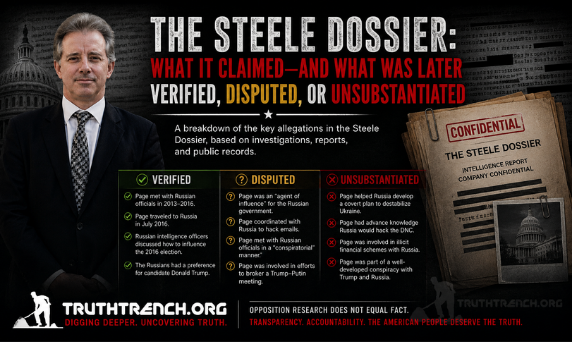
Some of its broader themes overlapped with facts later independently established about Russian interference in the 2016 election.
Some specific allegations were disputed or contradicted.
Others remain publicly unverified.
And some of the dossier’s most sensational claims have never been substantiated by publicly available evidence.
Understanding those distinctions is necessary to understand both the dossier itself and the larger controversy surrounding its role in the Trump-Russia investigations.
What Was the Steele Dossier?
The Steele dossier is a collection of reports prepared in 2016 by Christopher Steele, a former officer with Britain’s Secret Intelligence Service, commonly known as MI6. Read the full text here.
Steele’s work was conducted through his private intelligence firm, Orbis Business Intelligence, as part of opposition research commissioned through Fusion GPS.
The research was ultimately funded through a law firm working on behalf of the Democratic National Committee and Hillary Clinton’s presidential campaign.
The reports contained information attributed to sources who Steele believed had access to individuals or institutions connected to Russia.
The resulting memoranda described alleged relationships, meetings, intelligence activities, political strategies, and potential cooperation involving Russian officials and individuals associated with Donald Trump or his presidential campaign.
The reports were circulated among journalists, political figures, government officials, and eventually the FBI.
They later became collectively known as the Steele dossier.
Truth Trench Think Tank maintains a separate resource examining the dossier itself and the underlying memoranda:
Related Truth Trench Research: The Steele Dossier: Trump Intelligence Allegations
That resource allows readers to examine the material directly rather than relying exclusively on interpretations of what the dossier contained.
Raw Intelligence Is Not Established Fact
One of the most important concepts for understanding the dossier is the distinction between intelligence and evidence.
Raw intelligence may contain:
- accurate information,
- partially accurate information,
- misunderstanding,
- exaggeration,
- deliberate disinformation,
- speculation,
- or information that cannot be independently verified.
Intelligence professionals attempt to evaluate sources, corroborate information, compare reporting against other intelligence, and determine the reliability of individual claims.
The existence of an intelligence report therefore does not establish that the information contained within it is true.
This distinction became central to the controversy surrounding the Steele dossier.
Once the dossier entered public circulation, individual allegations were often discussed as though the entire document had to be either “true” or “false.”
The reality is considerably more complicated.
Each allegation must be evaluated independently.
What the Dossier Broadly Alleged
The Steele reports contained numerous allegations, but several broad themes became particularly significant.
The dossier alleged that:
- Russia had cultivated relationships with Donald Trump and individuals around him over an extended period.
- Russian officials possessed potentially compromising information concerning Trump.
- Individuals associated with the Trump campaign maintained contacts with Russian figures or intermediaries.
- Russia sought to influence the 2016 U.S. presidential election.
- There may have been cooperation or coordination between individuals associated with the Trump campaign and Russian interests.
- Carter Page allegedly maintained significant contacts with senior Russian officials.
- Former Trump attorney Michael Cohen allegedly participated in a secret meeting in Prague connected to Russian activities.
- Russian intelligence possessed compromising personal material involving Trump from a trip to Moscow.
These allegations varied dramatically in specificity, sourcing, and subsequent corroboration.
They should therefore not be treated as a single factual claim.
What Was Independently Established About Russian Interference?
One of the dossier’s broad themes—that Russia was attempting to interfere in the 2016 U.S. presidential election—was supported independently of the dossier.
The Mueller investigation concluded that the Russian government interfered in the 2016 presidential election in what the report described as a “sweeping and systematic” manner. Federal prosecutors also charged Russian intelligence officers in connection with hacking operations and charged Russian individuals and entities in connection with social-media influence operations.
This is an important distinction.
Evidence that Russia interfered in the election does not automatically verify the dossier’s specific allegations about Trump, Carter Page, Michael Cohen, or alleged coordination between the Trump campaign and Russia.
Those are separate factual questions.
The Mueller investigation examined links and contacts between individuals associated with the Trump campaign and Russia but did not establish that members of the Trump campaign conspired or coordinated with the Russian government in its election-interference activities.
Therefore, one broad premise associated with the dossier—Russian efforts to influence the election—was independently established.
That does not mean the dossier itself was the source of that conclusion or that its other allegations were thereby validated.
The Alleged Trump-Russia Conspiracy
Perhaps the most consequential implication of the dossier was that there existed a coordinated relationship between the Trump campaign and Russian authorities.
This became one of the central questions examined by federal investigators.
The Mueller investigation documented numerous contacts involving Russians and individuals associated with the Trump campaign. It also established extensive Russian efforts to interfere in the election.
But the investigation did not establish that members of the Trump campaign conspired or coordinated with the Russian government in those election-interference activities.
This finding is critical when evaluating the dossier.
The existence of Russian interference was established.
The broader allegation of a coordinated Trump campaign-Russian government election conspiracy was not established by the Special Counsel’s investigation.
Both facts can be true simultaneously.
The Carter Page Allegations
Carter Page, a former foreign policy adviser to the Trump campaign, became one of the most consequential figures connected to the dossier.
Steele’s reporting alleged that Page had contacts with senior Russian officials and participated in discussions involving matters of significant political and economic importance.
Page denied key allegations.
The FBI subsequently sought surveillance authority targeting Page under the Foreign Intelligence Surveillance Act.
The Department of Justice Office of Inspector General later conducted an extensive examination of the Carter Page FISA applications and identified significant problems in the FBI’s handling of the process.
The Inspector General found numerous significant errors and omissions in the applications and concluded that the FBI failed to meet its obligation to ensure that the applications were “scrupulously accurate.”
That does not mean every allegation concerning Page was necessarily false.
It does mean that the government’s presentation of information to the Foreign Intelligence Surveillance Court contained serious deficiencies and that information bearing on the reliability of certain allegations was not always properly reflected in the applications.
Related Truth Trench Research: Understanding the Foreign Intelligence Surveillance Court (FISC): The Secret Court Behind America’s Intelligence Operations
The Carter Page surveillance controversy is also examined separately in Truth Trench research concerning the FISA warrants and the procedures used to verify information presented to the court.
The Michael Cohen Prague Allegation
One of the dossier’s most specific allegations concerned Michael Cohen, Donald Trump’s former attorney.
The dossier alleged that Cohen traveled to Prague and participated in meetings connected to Russian election-interference activities.
Cohen repeatedly denied traveling to Prague.
Publicly available findings from subsequent federal investigations did not substantiate the allegation that Cohen participated in the alleged Prague meeting.
The allegation illustrates one of the central problems in evaluating raw intelligence.
A highly specific claim can appear significant when first reported. But unless investigators can independently corroborate the underlying information, specificity alone does not establish accuracy.
The Prague allegation remains one of the most frequently cited examples of a major dossier claim that was not substantiated by publicly disclosed investigative findings.
The Alleged Compromising Material
The dossier’s most sensational allegation involved claims that Russian authorities possessed compromising personal material involving Donald Trump from a visit to Moscow.
The allegation attracted enormous public attention after the dossier was published.
No publicly released investigation has established the existence of the alleged material described in the dossier.
That distinction should be stated clearly.
The absence of public substantiation does not logically prove that something could never have existed.
But responsible analysis cannot present an allegation as established fact when publicly available evidence has not substantiated it.
Based on the public record, the specific compromising-material allegation remains unsubstantiated.
The Dossier and Crossfire Hurricane
Another frequently misunderstood issue is whether the Steele dossier caused the FBI to open Crossfire Hurricane.
The Department of Justice Inspector General concluded that Crossfire Hurricane was opened on July 31, 2016, based on information concerning statements attributed to Trump campaign foreign policy adviser George Papadopoulos—not on Steele’s reporting.
The Inspector General found that the investigation had an authorized purpose and sufficient predication under the FBI’s applicable standards, while also finding serious deficiencies in the later Carter Page FISA process.
Special Counsel John Durham later reached a more critical assessment of the FBI’s conduct and investigative decision-making surrounding Crossfire Hurricane, concluding that the FBI failed to sufficiently analyze and corroborate important information and criticizing its reliance on politically connected material.
These findings are sometimes presented as though one government review completely cancels out the other.
A more accurate understanding is that the reviews examined overlapping events while applying different scopes and analytical perspectives.
The Inspector General found that the opening of Crossfire Hurricane met the FBI’s relatively low predication threshold while identifying major failures in the subsequent FISA process.
Durham was considerably more critical of the FBI’s overall analytical rigor and handling of the investigation.
Readers can examine the origins of the investigation separately in:
Related Truth Trench Research: Crossfire Hurricane: How the FBI’s Trump-Russia Investigation Began
The Dossier and the Carter Page FISA Applications
Although the dossier did not initiate Crossfire Hurricane, Steele’s reporting became important to the FBI’s effort to obtain FISA surveillance authority involving Carter Page.
This distinction matters.
The question:
“Did the Steele dossier start Crossfire Hurricane?”
is different from:
“Did Steele’s reporting play a role in the Carter Page FISA applications?”
The answer to the first, according to the DOJ Inspector General’s findings, is no.
The answer to the second is yes.
The Inspector General’s review found substantial problems with the accuracy and completeness of information provided during the FISA process, including issues involving the handling and assessment of Steele’s reporting.
This became one of the most significant institutional consequences of the entire controversy.
The debate was no longer merely about whether an opposition-research document contained questionable information.
It became a question of what standards federal investigators must meet before presenting intelligence-derived allegations to a secret federal court empowered to authorize surveillance.
Verified, Disputed, and Unsubstantiated Are Not the Same Thing
The history of the Steele dossier demonstrates why precise language matters.
A claim can be:
Verified — supported by independent evidence.
Partially corroborated — some elements are supported while others remain uncertain.
Disputed — credible parties or evidence conflict regarding the claim.
Unsubstantiated — available investigations have not established the claim.
Contradicted — reliable evidence conflicts with the allegation.
Unresolved — insufficient publicly available information exists to reach a responsible conclusion.
These categories are not interchangeable.
Calling every dossier allegation “debunked” oversimplifies the record.
Calling the dossier “verified” does the same.
The available evidence instead presents a mixed picture in which broad geopolitical observations sometimes overlapped with independently established events while numerous specific and consequential allegations were never substantiated or were challenged by later investigative findings.
Supporters’ Perspective
Those who defend the decision to examine Steele’s reporting argue that intelligence and law enforcement agencies cannot simply ignore potentially significant information because it originated in politically funded opposition research.
From this perspective, the appropriate response to questionable or politically connected intelligence is to investigate and corroborate it—not automatically dismiss it.
Supporters also emphasize that Russia did, in fact, conduct extensive operations intended to interfere in the 2016 election and that contacts between individuals associated with the Trump campaign and Russian figures provided legitimate counterintelligence concerns worthy of examination.
Under this view, the central failure was not necessarily examining Steele’s allegations but failing to consistently verify and accurately characterize them as the investigation progressed.
Critics’ Perspective
Critics argue that politically funded opposition research containing unverified allegations should never have been given the weight it ultimately received in a federal surveillance process.
They point to the Inspector General’s findings concerning errors and omissions in the Carter Page FISA applications as evidence that skepticism and verification procedures were inadequate.
Critics also argue that the inability to substantiate several of the dossier’s most significant allegations should have caused investigators to reassess their reliance on Steele’s reporting much earlier.
From this perspective, the controversy represents a broader institutional warning about confirmation bias, politically sensitive investigations, intelligence verification, and the extraordinary responsibility government officials assume when seeking secret surveillance authority.
Why the Steele Dossier Still Matters
The Steele dossier matters today for reasons extending beyond Donald Trump, Hillary Clinton, Christopher Steele, or the 2016 election.
It raises enduring questions.
How should intelligence agencies evaluate information originating from political opposition research?
When should raw intelligence become part of an official investigation?
How much corroboration should be required before allegations are presented to a court?
How should investigators disclose uncertainty or contradictory evidence?
What responsibility do journalists have when publishing intelligence material they cannot independently verify?
And what happens when raw intelligence escapes the controlled environment of government investigation and enters public political debate?
These questions are larger than any single presidential campaign.
They concern the relationship between intelligence, evidence, journalism, politics, surveillance, and public trust.
Continue Your Research
Timeline of Events and Primary Sources: Crossfire Hurricane, FISA, and the Trump-Russia Investigation
What Are Your Thoughts?
How should federal investigators treat politically funded intelligence research?
Should allegations contained in raw intelligence be subject to a higher standard of corroboration before they are used in applications for government surveillance?
Did the safeguards surrounding the Carter Page FISA process function as intended?
And how should the public distinguish between an intelligence allegation, an investigative lead, and an established fact?
Truth Trench Think Tank is collecting public perspectives on intelligence oversight, federal surveillance, election security, government accountability, and institutional trust as part of our continuing research.
As an independent research institute, Truth Trench Think Tank does not engage in lobbying or partisan political activity. Our mission is to improve public understanding through transparent, evidence-based research and encourage informed civic participation grounded in publicly available information.
The documents are available. The investigations have been conducted. The findings are part of the public record.
Now it’s time to get into the trench and keep digging.