Bring the Operating System to Your Leadership Team
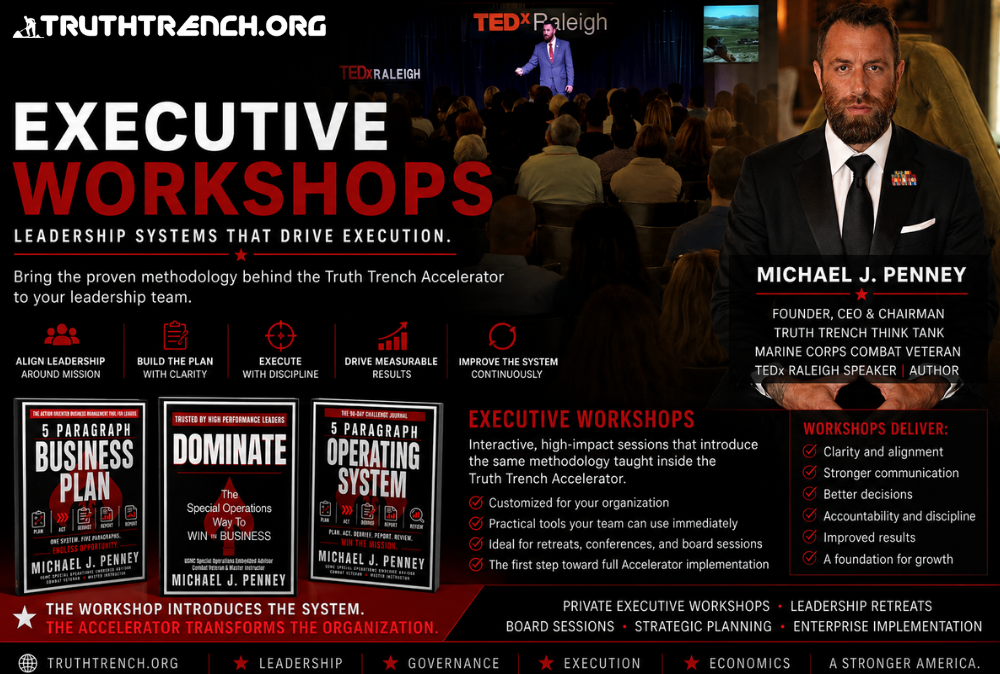
Private Executive Workshops by Michael J. Penney
Leadership isn’t learned in a conference room.
It is developed through shared understanding, disciplined execution, and practical implementation.
Michael J. Penney’s Executive Workshops introduce organizations to the same leadership framework taught inside the Truth Trench Accelerator.
These sessions are not motivational seminars.
They are working sessions designed to help leadership teams think differently, communicate more effectively, and leave with practical tools they can immediately implement.
Participants experience the principles behind the 5 Paragraph Business Management Method without committing to the full Accelerator implementation.
For many organizations, it becomes the first step toward a much larger organizational transformation.
Designed for Executive Leadership
These workshops are intentionally limited to organizations serious about improving leadership, communication, accountability, and execution.
Ideal audiences include:
- Executive Leadership Teams
- Company Owners
- Founders
- Boards of Directors
- C-Suite Executives
- Senior Managers
- Government Leadership
- Nonprofit Executives
- Family Businesses
- Professional Associations
Whether your organization has twenty employees or several thousand, the principles remain the same.
Clarity.
Alignment.
Execution.
What Your Team Will Learn
Every workshop is customized around your organization, but participants typically explore concepts including:
Mission Alignment
How leaders create organizational clarity that eliminates confusion before it begins.
The 5 Paragraph Planning Method
Transforming ideas into executable plans that every leader understands.
Executive Communication
Creating a common language throughout an organization that improves decision-making and accountability.
Leadership Rhythm
Implementing a repeatable operating cycle:
Plan. Act. Debrief. Report. Review.
Decentralized Leadership
Teaching leaders at every level how to make better decisions without waiting for permission.
After Action Reviews
Building organizations that continuously learn instead of repeatedly making the same mistakes.
Luxury Executive Retreats
The most meaningful conversations rarely happen inside the office.
Michael regularly delivers private executive workshops at destination retreats, executive resorts, corporate lodges, and leadership conferences where executive teams can step away from daily operations and focus on the future of their organization.
These retreats provide an opportunity for leadership teams to:
- Build organizational alignment
- Establish strategic priorities
- Improve executive communication
- Develop leadership cadence
- Strengthen governance
- Create accountability
- Prepare for sustainable growth
Every workshop is tailored to the organization’s mission, objectives, industry, and current challenges.
More Than Training
Most leadership training teaches information.
These workshops teach implementation.
Participants don’t simply hear new ideas.
They begin building the systems that make those ideas sustainable.
Every session introduces practical components of the methodology found in:
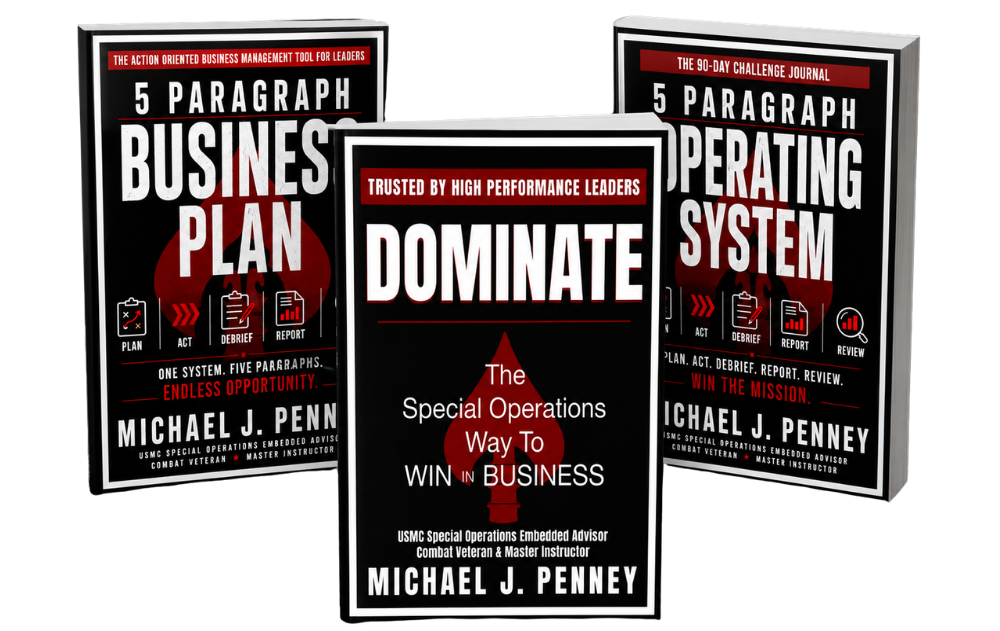
- DOMINATE — The Special Operations Way To Win In Business
- 5 Paragraph Business Plan
- 5 Paragraph Operating System
The workshop serves as an introduction to the complete operating system while delivering immediate value that organizations can begin applying the very next day.
Continue the Mission
Many organizations discover during these workshops that isolated leadership training is only the beginning.
Real transformation happens through implementation.
For organizations ready to build a complete operating system across executive leadership, departments, and management teams, the workshop naturally transitions into the Truth Trench Accelerator.
The Accelerator expands upon these concepts through structured implementation, executive coaching, peer accountability, leadership reviews, operational planning, measurable objectives, and a ninety-day execution framework designed to create lasting organizational change.
Think of the workshop as learning the blueprint.
The Accelerator is constructing the building.
Enterprise Implementation
For larger organizations, Michael and Truth Trench Think Tank offer customized enterprise engagements that extend beyond a single workshop.
Enterprise partnerships may include:
- Executive Leadership Retreats
- Multi-Day Workshops
- Strategic Planning Sessions
- Board Governance Workshops
- Department Leadership Training
- Enterprise Planning
- Quarterly Leadership Reviews
- Annual Strategic Summits
- Accelerator Enterprise Cohorts
- Custom Organizational Implementation
These engagements allow entire leadership teams to adopt a common operating language while building the systems necessary for long-term organizational excellence.
Hosted Through Truth Trench Think Tank
Executive Workshops are delivered through Truth Trench Think Tank, a nonprofit research institute for societal benefit dedicated to advancing leadership, entrepreneurship, government transparency, civic awareness, and organizational excellence.
Workshop honorariums are treated as charitable donations supporting the Think Tank’s educational mission, research initiatives, leadership development programs, and Truth Trench Accelerator.
Organizations receive far more than an executive workshop.
They help strengthen the next generation of American leaders.
Testimonials
Michael J. Penney’s impact on individuals and organizations is undeniable. With years of experience as a combat veteran, business coach, and Master Instructor, Michael has empowered leaders across industries to achieve their full potential. Below are just a few of the testimonials from those who have experienced firsthand the transformative power of his coaching, training, and strategic guidance.
Whether it’s through his leadership development programs, team-building strategies, or business consulting services, Michael’s approach to fostering accountability and high-performance cultures has earned him the respect and trust of clients worldwide.
Discover how Michael has helped businesses and individuals #DOMINATEyourbusiness and elevate their success through his proven, battle-tested expertise.
“Michael is a solid leader. His ability to take his Marine Corps knowledge and transition that to business success practices will be helpful to any firm. Semper Fi Michael keep up the great work…”
– Sean P Jensen, Marine, Author & CEO
“5Paragraph works… it’s that simple.”
– Nate Burns, Business Development Professional/ Independent Consultant
“Our mission is To provide excellent health services to improve the quality of life for people in our communities. Empowering our leaders with 5 Paragraph Business Plan helps us better serve Michigan communities.”
-Tammy Terrell, Chief Nursing Officer
“5 Paragraph Business Plan makes it easier for anyone to start or manage a business of any size. This is a great tool to have!”
– Adam Bird, Founder of Heroes Media Group
“Enlisting him to speak to your team, group, or employees will be money and time well spent.”
– James Amato, Design Thinker & Director of Strategic Business Development
“Michael is a dynamic speaker and storyteller, a great networker and someone I’m happy to call friend and colleague.”
– Chuck Hester, LinkedIn Executive Trainer, Speaker, LinkedIn Podcast Host, Managing Partner
“Mike’s rare combination of personality, leadership, passion, expert technical skills, and drive make him someone I would actively seek to serve with again in any capacity.”
– JP Carter, Operations & Strategy | M&A Integration Leader | Marine
“Filled full of relevant information that is applicable to any industry… The 5 Paragraph Business Plan is Fantastic!… Highly recommended!”
– David H.
“Michael was my direct supervisor when I served as an Infantry Mortarman in the United States Marine Corps. He was truly one of the best supervisors that I have worked under. He maintained a consistent high standard, while being a positive person to be around. Since leaving the Marine Corps, I have started down an entrepreneurial path. While first starting out, Michael reached out to me and again took on an instructor role.
He showed me a productive path in developing my business plan, when I otherwise didn’t have any guidance. His personability, commitment to excellence, and willingness to help people, make Michael a top-tier addition to any team.”
– Keith McCormick Marine, Entrepreneur, LEADER
“Michael, is the catalyst that when mixed into an organization produces a team that excels. His focus on communicating the purpose and effect/endstate desired by the decision enables independent decision making, dispersed action without the hampering of close supervision, develops momentum, and creates a teams bound by trust. He is the perfect fit to lead an organization.”
– Paul Herdener, Marine, Business Leader
“When it comes to deploying a clear process for businesses I know no better than Michael, his attention to detail is unparalleled.”
– Steven Eugene Kuhn, Army Veteran, Business LEADER, Investor
“Michael is a steadfast individual with determination and drive for excellence.”
– Michael Segaline, Marine, Business LEADER, SEO Specialist
“A great leader with the determination to ensure that everyone around him is successful and reaches past their limits.”
– Benjamin Dittenbir, Marine Corps Marketing
“Michael Penney is amazing!
A Marine, Patriot and lover of the USA! His business 5Paragraph is phenomenal for helping businesses Level UP!”
– L. Scott Ferguson, Veteran Podcaster
“Mike is a stellar individual and it is an honor to work with him. What he has created through 5Paragraph is not just business planning at its finest but is an empowerment tool for current and future business leaders.”
– Brian Tomlinson, Business Development Professional
“Michael Penney is an extraordinarily gifted speaker, interviewer, and, dare I say, captivating thought leader/entertainer to the audiences that have the privilege of bearing witness to his gifts on display.”
– Todd Connor, Navy Veteran, Business LEADER
“I have the privilege to work with Michael on a weekly basis. Michael is a diligent professional with a passion to add value to others’ lives. He is driven, honest, trustworthy and has exceptional organizational keenness to work with and lead others. He is a great asset to any organization that is lucky enough to have him.”
– Adam Bird, Army Veteran, Combat Veteran, Business LEADER, Founder of Heroes Media Group
“If you are looking for someone to network, brainstorm, contract, purchase from or collaborate, there is no better person.”
– Chris Cravens, Marine, Business LEADER
“I have found that the 5 Paragraph Business Plan is a perfect fit for our needs. Mike does an incredible job of taking his military experience and translating it into the civilian/corporate world. Mike is a strategist and he has helped us craft and create a culture of accountability that I’ve never seen before.”
– Gabe Roco, Business Development Professional, LEADER
“All you have to do to know Michael is watch the TedX Raleigh presentation. That is who I have seen every day since we met last year. Michael is a passionate and funny person with the leadership skills everyone says they are looking for. I have no hesitation to recommend my colleague and coworker Michael to lead your team to success.”
– Jim Roberts, Investor, Business LEADER
“Michael is a natural leader, not only did he focus on mission accomplishment but he also cared for and looked out for his guys. I learned a lot about being a Marine from him and given the opportunity I would follow him again.”
– Ryan O’Donnell, Marine Combat Veteran, LEADER
“Michael is more than just a great beard. He is a genuine, selfless leader and friend. My business wouldn’t be where it is today if it weren’t for Michael’s passion for inspiring fellow veterans to reach their full potential as entrepreneurs.”
– Thomas J. Brennan, Marine, Non-Profit LEADER
“While working with Michael J. Penney at MCB Quantico Weapons Training Battalion Michael showed great professionalism while instructing thousands of Marine Corps officers. His speaking abilities kept the audience involved and focused. It was a great pleasure working with Michael, I was able to learn a great deal from his speeches.”
– Stephen Mutschler, Marine, Business LEADER
“I’ve collaborated with Michael on several business initiatives and find his approach to challenges incredibly inspiring! Michael’s ‘Can-Do’ spirit and drive for excellence is extremely motivating and very contagious.”
– Eddie Lazzari, Army Veteran, Procurement Manager at Coca-Cola Beverages Northeast
“Mike has done a great job leading the efforts of Bunker Labs in the Raleigh area. As a Marine and entrepreneur, he immediately gains the trust of the audience. He is able to quickly put everyone at ease which helps facilitate dynamic discussions that ultimately help the entrepreneurs in the room succeed. He has shown on multiple occasions dedication to do whatever is needed to help an event/entrepreneur be successful.”
– Nick Bradfield, Marine, Economics Professional, Business LEADER
“Michael is an energetic and charismatic speaker. I’ve been lucky enough to be a part of events where he has spoken, taught and moderated. He is amazing at keeping the audience engaged and maintaining the tempo of an event. Will definitely work with him again in the future!”
– Joshua W. Robertson, Navy Veteran, Business Development Professional, Business LEADER
“Michael is very driven and has overcome some major challenges early in life, and he’s done so with more insight, humility, and grace than you would expect from someone so young. He has gone on to become a successful entrepreneur, podcast host, and speaker, and has worked tirelessly to empower our fellow veterans. I would highly recommend him in almost any scenario because of his dedication, work ethic, and unflinching integrity.”
– Jeremy Knauff, Marine, Founder of Spartan Media
“Michael is passionate about adding value to any situation, specifically in the Veteran entrepreneur space. He is helping so many Veterans via his podcast and mentorship, it is inspiring.”
– William Amos, Business LEADER
“Even if you aren’t starting a business, you can adapt your life around this book… Great job, great detail and highly recommended!”
– Military spouse
“Follow the process!… I’ve used this ‘manual’ over and over again when consulting to Sr Leadership across many different projects and industries…”
– Veteran consultant
“This is a solid business planning tool based on the same planning method we used in the Marine Corps… SF!”
– Marine Corps veteran
“The 5 paragraph business plan has helped me assist fellow Veterans in starting businesses and has allowed be to better organize my own business… This can help any business owner or aspiring business owner.”
– Entrepreneurial veteran
“Exceptional book written by someone who has been there and done that!… Highly Recommend this book for anyone planning to go into business for themselves or planning to expand their business.”
– Entrepreneurial reader
“The 5 Paragraph Business Plan makes it easier for anyone to start or manage a business of any size… This is a great tool to have!”
– Business owner
“As I went through the audio episodes I was motivated to continue on the path of becoming an entrepreneur and this book gives insight on how to progress in the business world which every inch helps. Highly recommended!”
– Aspiring entrepreneur
“Michael is well skilled in solving multiple problems at once while providing excellent leadership to subordinates. He thinks fast on his feet and can rapidly adapt in an ever-changing environment.”
– Chad Lane, Marine Leader
“Michael J. Penney has and always will be the inspirational leader you want to work with. His leadership knows no bounds. Such an exceptional talent that drives for success in all avenues. Michael has the ability to bring life and energy throughout the process. He will always go above and beyond the chance to make an acknowledgment towards you. Has a no quit attitude with abundance of knowledge and forthcoming with the desire to help. Always an inspiration and objective oriented passionate person. I would absolutely work with Michael anytime and any place. Such an acquisition in any asset he is in.”
– Ryne Ratti, Marine, Entrepreneur, Investor
Case Study #1
From $5 Million to $585 Million: Scaling a Medical Malpractice Insurance Company Through Strategic Distribution
Executive Summary
Industry: Medical Malpractice Insurance
Challenge: A successful regional insurance provider had reached the limits of its direct-sales model. Growth required more salespeople, more management, and more effort, creating a ceiling on expansion.
Solution: Shifted from a direct-sales organization to a broker-driven distribution model while aligning leadership around a common strategy, execution framework, and growth plan.
Results:
- Revenue growth from approximately $5 million annually to approximately $585 million annually.
- Nationwide expansion and market dominance.
- Creation of a scalable broker network that multiplied distribution capacity.
- Improved leadership alignment, operational visibility, and execution.
Key Lesson: The organizations that dominate do not simply work harder than their competitors. They build systems that allow them to scale.
When I first became involved with this medical malpractice insurance company, the business was already successful by most conventional measures. The organization had a strong product, a good reputation, and an experienced leadership team that understood the industry. Revenue was approximately $5 million annually, and the company had built a solid foundation serving healthcare providers within its existing markets. The challenge was not whether the company could sell insurance. The challenge was whether it could scale beyond the limits of the system that had created its initial success.
Like many growing businesses, the company relied heavily on a direct-sales model. Every new customer required direct effort from the organization. Every new market required additional personnel, additional management, and additional resources. Leadership found themselves working harder each year to generate incremental growth. The business was operating efficiently, but efficiency alone was not enough. The organization had unknowingly created a structure where growth was directly tied to effort. As a result, expansion became increasingly difficult, increasingly expensive, and increasingly dependent upon key individuals. The company was winning battles, but it lacked a strategy capable of winning the war.
The breakthrough occurred when leadership began looking at the business through a different lens. Rather than asking how to sell more insurance, the question became how to distribute more insurance. That distinction changed everything. The problem was not sales performance. The problem was distribution capacity. The company was attempting to achieve national growth using a regional operating model. No amount of additional effort could overcome that limitation. What the organization needed was leverage.
The answer was a broker-driven distribution strategy. Instead of attempting to reach every physician, healthcare system, and medical practice directly, the company would build a nationwide network of brokers capable of representing its products in markets across the country. Each broker relationship would serve as a force multiplier, providing access to existing relationships, established credibility, and local market expertise. The company would no longer rely solely on its own sales force to create growth. It would create a system that allowed others to generate growth on its behalf.
While the strategy itself was relatively straightforward, executing it successfully required significant organizational change. Broker networks do not create value simply because agreements are signed. They create value when they are supported by clear leadership, consistent communication, and disciplined execution. Every department within the organization needed to understand the mission. Sales, marketing, operations, underwriting, finance, and executive leadership all had to align around a single strategic objective. Without that alignment, the broker network would become fragmented and ineffective. The leadership team needed a common operating picture and a shared understanding of what success looked like.
This is where the principles behind the 5 Paragraph Business Plan and Operating System proved particularly valuable. Before execution could occur, clarity had to exist. The mission was clearly defined. Responsibilities were assigned. Communication channels were established. Measures of effectiveness were identified. Most importantly, feedback mechanisms were built into the process so leadership could continuously assess performance and make adjustments as conditions changed. Rather than operating from assumptions, decisions were increasingly driven by information flowing back from the field.
As the broker network expanded, the organization focused on creating systems capable of supporting growth at scale. Brokers were treated as strategic partners rather than outside vendors. Training programs were developed. Resources were standardized. Expectations were clearly communicated. Performance was measured consistently. Challenges were identified early and addressed quickly. The organization established a battle rhythm of planning, execution, feedback, and refinement that allowed leadership to maintain visibility without becoming a bottleneck. Instead of relying on heroic individual effort, the company began relying on repeatable processes.
The results were substantial. Markets that had previously been inaccessible suddenly became available. Opportunities emerged in regions where the company had no direct presence. Brokers opened doors that would have taken years for an internal sales force to penetrate. As success increased, the broker network itself became a competitive advantage. New brokers were attracted by the company’s reputation, products, and support structure. Each successful relationship created additional opportunities, and each opportunity generated momentum for further expansion. Growth became self-reinforcing.
Over time, the company transformed from a regional insurance provider into a nationally recognized leader within the medical malpractice insurance industry. Annual revenue grew from approximately $5 million to approximately $585 million. More importantly, leadership created a scalable operating model capable of sustaining growth long after the initial transformation. The company was no longer dependent upon a handful of individuals driving performance. It possessed a system that could repeatedly generate results across multiple markets and business cycles.
Looking back, the most important lesson from this engagement had very little to do with insurance. It had everything to do with leadership. Most organizations attempt to grow through addition. They hire more people, increase activity, and demand more effort. Truly dominant organizations grow through multiplication. They create systems that allow others to create value on their behalf. They build structures that expand capability without requiring proportional increases in management attention or operational overhead. They focus on leverage rather than labor.
The growth from $5 million to $585 million was not the result of a single sales tactic, a marketing campaign, or a lucky break. It was the result of leadership recognizing a structural limitation, developing a strategic solution, aligning the organization around a common mission, and executing with discipline over time. The company stopped asking how to work harder and started asking how to scale smarter. That shift transformed the organization and ultimately led to nationwide domination.
Years later, one of the executives involved in the transformation summarized the experience in a way that has always stayed with me. He looked across the table, laughed, and said, “You make selling insurance cool.”
What he was really describing was something much larger. People become energized when they understand the mission, see a path to victory, and operate within a system designed to help them succeed. Whether the industry is insurance, healthcare, manufacturing, technology, or professional services, the principle remains the same. Clear plans, aligned leadership, disciplined execution, and effective systems create extraordinary results. That is the essence of domination.
Case Study #2
Expanding Across the South: Building a Scalable Blue-Collar Workforce Organization Through Empowered Leadership
Executive Summary
Industry: Skilled Labor / Blue-Collar Services
Challenge: A successful labor services company sought aggressive expansion across the Southern United States but faced the common challenges of geographic growth, leadership development, operational consistency, and intense market competition.
Solution: Implemented an enterprise-wide strategic plan using the 5 Paragraph Business Plan and Operating System, while developing local leaders to operate each location with an entrepreneurial mindset and ownership mentality.
Results:
- Successful expansion into multiple Southern markets.
- Development of self-sustaining local leadership teams.
- Increased operational consistency across geographically dispersed locations.
- Improved competitiveness in crowded and highly fragmented markets.
- Creation of a scalable model for future growth.
Key Lesson: Sustainable expansion does not occur because headquarters becomes stronger. It occurs because leaders closest to the customer are empowered to make decisions, execute effectively, and win.
Growth often exposes weaknesses that success can hide. A company can dominate a single market through hard work, strong leadership, and operational excellence, only to discover that none of those strengths automatically transfer when expansion begins. This was the challenge facing a blue-collar labor services company that had established itself as a strong competitor within its existing territory and was preparing for significant growth across the Southern United States.
The organization had a solid reputation and a proven business model. Customers valued the quality of work, leadership understood the industry, and demand for services remained strong. On paper, expansion appeared straightforward. The company had a successful formula and simply needed to replicate it in new locations. In reality, growth is rarely that simple. Every new market introduces new competitors, new labor challenges, new customer expectations, and new operational complexities. What worked in one city does not automatically work in another. Leadership quickly recognized that opening additional locations would not be enough. They needed a system capable of creating success repeatedly across multiple markets.
One of the most common mistakes growing companies make is attempting to centralize every decision. Headquarters becomes overwhelmed trying to manage hiring, operations, sales, customer relationships, and problem-solving for locations spread across hundreds or even thousands of miles. As expansion accelerates, local leaders become managers rather than owners. Initiative declines. Decision-making slows. Opportunities are missed. Eventually growth stalls under its own weight.
This company chose a different path.
Rather than treating expansion as the process of opening new branches, leadership began treating expansion as the process of developing entrepreneurs. The goal was not merely to establish locations. The goal was to build leaders capable of owning outcomes, solving problems, creating opportunities, and competing aggressively within their local markets. Each location would operate within the larger organizational framework, but local leadership would be empowered to think and act like business owners.
That shift in philosophy became the foundation for everything that followed.
As expansion plans were developed, leadership utilized the principles of the 5 Paragraph Business Plan and Operating System to create alignment throughout the organization. Before opening new markets, leaders needed a common understanding of the mission, strategic objectives, operating standards, and measures of success. Everyone—from executive leadership to field supervisors—needed to understand not only what the company was trying to accomplish but how their role contributed to achieving it.
This clarity became increasingly important as the organization expanded geographically. Distance creates friction. Communication becomes more difficult. Assumptions multiply. Local conditions change. Without a common operating framework, organizations often find themselves managing a collection of disconnected offices rather than a unified company. The planning process helped prevent this outcome by establishing clear expectations while simultaneously providing flexibility for local leaders to adapt to conditions on the ground.
As new locations launched, leadership focused heavily on developing leaders at every level. Managers were encouraged to think beyond daily operations and understand the financial, operational, and strategic drivers of the business. Supervisors learned how to plan, communicate, and execute more effectively. Field leaders were given responsibility and accountability rather than simply tasks to complete. Instead of creating a culture where decisions flowed exclusively from the top down, the organization created a culture where leadership was expected at every level.
This approach proved especially valuable in highly competitive markets. The labor industry is often crowded with competitors offering similar services, competing for the same customers, and recruiting from the same labor pool. Price alone rarely creates long-term differentiation. Companies that consistently win are typically those that execute better than their competitors. They respond faster. They communicate more effectively. They solve problems more efficiently. They create stronger relationships with customers and employees alike.
By empowering local leaders to make decisions and act quickly, the organization gained a significant competitive advantage. Opportunities could be pursued without waiting for approval from distant executives. Customer concerns could be addressed immediately. Market-specific strategies could be implemented without unnecessary bureaucracy. The company remained aligned strategically while becoming increasingly agile operationally.
As the organization continued expanding throughout the South, a pattern began to emerge. The locations experiencing the greatest success were not necessarily operating in the strongest markets. They were operating under the strongest leaders. Leadership development became the multiplier. Markets mattered. Resources mattered. Processes mattered. But leadership consistently proved to be the decisive factor separating average performance from exceptional performance.
The operating system reinforced this advantage. Leaders at every level participated in planning, execution, debriefs, and after-action reviews. Successes were documented and shared. Mistakes were analyzed and corrected. Lessons learned in one location quickly became lessons applied throughout the organization. The company developed a continuous learning environment where improvement became part of the culture rather than an occasional initiative.
Over time, the organization successfully expanded across multiple Southern markets while maintaining operational consistency and competitive performance. More importantly, leadership avoided the trap that often accompanies rapid growth. Instead of building a company dependent upon a small group of executives, they built a company supported by leaders throughout the organization. The strength of the business no longer resided solely at headquarters. It existed within every market, every team, and every location.
Looking back, the most important lesson from this engagement was that expansion is ultimately a leadership challenge. Most organizations focus on facilities, equipment, technology, or capital when preparing for growth. While those resources are important, they are rarely the determining factor. Growth succeeds or fails based upon the organization’s ability to develop leaders capable of executing independently while remaining aligned with the larger mission.
The company’s success across the South was not the result of finding untapped markets or discovering a secret strategy. It was the result of creating a framework that empowered people to lead. By treating local managers as entrepreneurs rather than caretakers, the organization unlocked initiative, accountability, and competitive drive throughout the enterprise. The company did not simply grow geographically. It grew organizationally.
That distinction made all the difference.
The experience reinforced a principle that applies to every industry. Leaders cannot scale by personally controlling everything. At some point, growth requires trust, empowerment, and systems that allow others to lead effectively. The organizations that dominate are not those with the most centralized authority. They are the ones that create the greatest number of capable leaders.
In crowded and competitive markets, products can be copied. Services can be replicated. Pricing can be matched. Leadership, however, remains one of the few sustainable competitive advantages. When leaders at every level understand the mission, own the outcome, and possess the authority to act, extraordinary growth becomes possible.
That is exactly what happened here. The company expanded across the South, outcompeted larger and more established rivals, and built a foundation for continued growth—not because headquarters became stronger, but because leadership became stronger everywhere.
Case Study #3
Achieving Magnet Status in Half the Time: How Strategic Execution Helped a Healthcare System Reach Nursing Excellence
Executive Summary
Industry: Healthcare
Challenge: A healthcare system sought to achieve Magnet designation, the highest recognition awarded by the American Nurses Credentialing Center (ANCC), a subsidiary of the American Nurses Association. The process typically takes six years or longer and requires significant organizational alignment, cultural transformation, and measurable improvements in patient and staff outcomes.
Solution: Developed a comprehensive strategic plan with executive leadership, then worked directly with managers and frontline staff to identify operational improvements that would produce measurable outcomes. A major focus emerged around reducing slips, trips, and falls among employees and patients, improving both safety performance and organizational culture.
Results:
- Achieved Magnet designation in approximately three years.
- Significantly improved workplace safety metrics.
- Reduced preventable incidents and associated costs.
- Increased staff engagement and accountability.
- Created organization-wide alignment from the C-Suite to the frontline.
Key Lesson: Major organizational achievements are rarely accomplished through grand initiatives alone. They are achieved when leadership aligns the organization around hundreds of small improvements that compound over time.
Many leaders believe transformation begins in the boardroom. In reality, transformation begins where the work is performed. Strategies are developed in conference rooms, but results are created on hospital floors, in patient rooms, at nursing stations, and during thousands of daily interactions between staff and patients. This reality became clear during an engagement with a healthcare system pursuing one of the most respected achievements in modern healthcare: Magnet designation.
For healthcare leaders, Magnet status represents far more than a certification. It is widely recognized as the gold standard for nursing excellence and organizational performance. Hospitals that achieve Magnet designation are known for superior patient outcomes, strong leadership, exceptional nursing practices, and cultures of continuous improvement. The designation is awarded by the American Nurses Credentialing Center and is considered one of the highest honors a healthcare organization can receive.
The challenge is that earning Magnet status is not easy. Most organizations spend six years or more pursuing the designation. The process requires evidence of sustained excellence across leadership, clinical outcomes, employee engagement, professional development, patient safety, and organizational culture. It is not enough to simply implement new programs. Organizations must demonstrate that excellence has become part of how they operate every day.
When I first became involved, the healthcare system had a clear objective. Leadership wanted to achieve Magnet designation, but they also understood that the designation itself was not the true goal. The real objective was becoming the type of organization capable of earning it. That distinction mattered because certifications can be pursued as projects. Excellence must be pursued as a culture.
The engagement began where most successful transformations begin: with leadership alignment. Working closely with the C-Suite and key organizational leaders, we developed an overall strategic plan that established priorities, responsibilities, timelines, and measures of effectiveness. Everyone understood the destination. The challenge now was determining the most effective path to get there.
Like many organizations pursuing ambitious goals, there was an initial temptation to focus on large initiatives. Committees were formed. Programs were proposed. Metrics were reviewed. While these activities were important, they did not fully answer a critical question. What specific actions would create meaningful improvements in the daily experience of employees and patients?
To answer that question, we left the conference rooms and went to where the work was being performed.
We walked the floors.
We observed processes.
We spoke with nurses, supervisors, managers, and support staff.
We watched how people moved throughout the facility, how information flowed, how problems were handled, and where inefficiencies existed. Rather than assuming leadership already knew where improvements were needed, we allowed the frontline to reveal the answers.
What emerged was a lesson that applies to virtually every organization. Significant results are often hidden inside seemingly ordinary problems.
One issue repeatedly surfaced during observations and conversations with staff: slips, trips, and falls.
At first glance, the issue appeared almost too simple. Organizations pursuing major certifications often look for complex solutions. They focus on advanced systems, major policy changes, and large-scale initiatives. Yet slips, trips, and falls represented something much larger than isolated safety incidents. They reflected daily operational discipline, environmental awareness, accountability, communication, and culture. Every preventable fall represented a breakdown somewhere within the system.
More importantly, every prevented fall represented an opportunity to improve outcomes.
Leadership made a deliberate decision to focus significant attention on safety. Processes were reviewed. Hazards were identified. Reporting improved. Awareness increased. Staff became more engaged in identifying risks before incidents occurred. Managers began discussing safety not as a compliance requirement but as a leadership responsibility. The organization gradually shifted from reacting to incidents toward preventing them.
The impact extended far beyond safety metrics alone.
As slips, trips, and falls decreased, workplace injuries declined. Employee confidence increased. Staff engagement improved. Operational disruptions became less frequent. Patient safety indicators improved. Leaders gained greater visibility into how frontline operations were functioning. The organization became more proactive, more disciplined, and more aligned around continuous improvement.
One of the most important lessons from this process was recognizing how small improvements compound. Many organizations search for a single breakthrough that will transform performance. In reality, transformation is usually the result of hundreds of incremental improvements working together. Every hazard removed, every process improved, every communication strengthened, and every problem solved contributes to a larger cultural shift. Excellence is not created through one dramatic action. It is created through consistent discipline applied over time.
As momentum increased, the organization began seeing improvements across multiple areas measured during the Magnet evaluation process. Leadership engagement strengthened. Nursing participation increased. Performance indicators improved. The culture became increasingly focused on ownership, accountability, and professional excellence. Rather than viewing Magnet designation as an external requirement, staff began viewing it as a reflection of who they were becoming as an organization.
This shift proved critical. Sustainable success cannot be imposed from the top down. It must be embraced throughout the organization. Nurses, managers, supervisors, executives, and support personnel all played a role in the outcome. The strategic plan provided direction, but the people executing the plan created the results.
The organization ultimately achieved Magnet designation in approximately three years—roughly half the time often associated with the process. The accomplishment represented a significant achievement for the healthcare system and demonstrated what is possible when leadership alignment is combined with disciplined execution and frontline engagement.
The most important lesson from this case study extends far beyond healthcare. Leaders frequently assume that major achievements require major initiatives. While large initiatives certainly have their place, extraordinary results are often produced by identifying the right problem and relentlessly improving it. In this case, focusing on something as seemingly simple as slips, trips, and falls created ripple effects throughout the organization. Safety improved. Culture improved. Accountability improved. Outcomes improved.
What began as a workplace safety initiative ultimately became a leadership initiative.
And what began as a leadership initiative became a cultural transformation.
The designation itself was the visible outcome, but the real victory occurred long before the award was granted. The real victory occurred when people throughout the organization began thinking differently about excellence. They stopped viewing quality as someone else’s responsibility and started treating it as their own.
That is why the healthcare system achieved Magnet status in three years instead of six.
The organization did not find a shortcut.
It found alignment.
It found ownership.
It found discipline.
Most importantly, it found a way to connect executive vision with frontline execution.
That is where real transformation always occurs.
Bring the Workshop to Your Organization
Whether you’re planning an executive retreat, leadership summit, strategic planning session, or private board workshop, Michael delivers practical leadership systems that continue creating value long after the event concludes.
Discover why organizations across business, government, healthcare, and the nonprofit sector are implementing the principles behind the Truth Trench Accelerator.
Build the Plan.
Align the Team.
Execute the Mission.
Contact Truth Trench Think Tank to discuss your Executive Workshop or Enterprise Leadership Retreat.