For nearly half a century, the Foreign Intelligence Surveillance Act has existed at the intersection of two responsibilities of the federal government that are often difficult to reconcile.
Protect the United States from foreign threats.
Protect the constitutional rights and civil liberties of the people who live here.
Congress enacted FISA in 1978 following revelations about abuses of government surveillance authority. The law created a legal framework for certain foreign intelligence surveillance activities and established the Foreign Intelligence Surveillance Court to review government applications involving some of the nation’s most sensitive intelligence collection. FISA has since been amended repeatedly as threats, communications technology, and intelligence capabilities have changed. (Bureau of Justice Assistance)
Today, the debate surrounding FISA is no longer simply about whether the United States needs foreign intelligence surveillance.
Few serious participants in the debate argue that the United States should have no capability to monitor genuine foreign intelligence threats.
The harder questions are about how that power should operate.
How much authority should intelligence agencies have?
What protections should apply when Americans’ communications are collected?
When should a warrant be required?
How should government representations to secret courts be verified?
What happens when investigators make serious mistakes?
And can a surveillance framework created in 1978 continue adapting to a world of artificial intelligence, encrypted communications, cloud computing, cyber warfare, global telecommunications platforms, and data moving across national borders almost instantaneously?
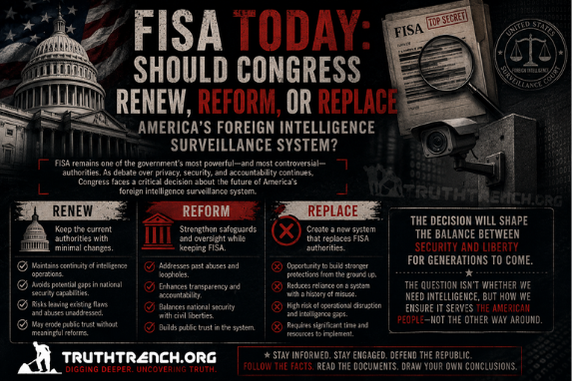
The debate over FISA today can therefore be framed around three possible directions:
Renew it.
Reform it.
Or replace significant portions of the system with something fundamentally different.
Each approach carries consequences for national security, privacy, civil liberties, intelligence operations, and public trust.
What Is FISA Today?
FISA is not one single surveillance program.
It is a broader statutory framework governing several categories of foreign intelligence collection.
The original law established procedures for electronic surveillance conducted for foreign intelligence purposes and created the Foreign Intelligence Surveillance Court. Over time, Congress expanded and modified FISA to address physical searches, pen registers and trap-and-trace devices, business records, and additional intelligence collection authorities. (Bureau of Justice Assistance)
This distinction matters because public debates frequently use the word “FISA” to describe very different surveillance authorities.
The traditional FISA process involving an individualized court application is different from Section 702, which Congress added in 2008.
Section 702 permits the government to target non-U.S. persons reasonably believed to be located outside the United States for foreign intelligence purposes under a different legal structure. Intelligence collected under the program can nevertheless include communications involving Americans, which has generated continuing controversy over privacy protections and government searches of previously collected information. (Intel)
The surveillance of Carter Page, for example, involved traditional FISA authorities.
It was not Section 702 surveillance.
The distinction is essential to understanding the current debate.
Crossfire Hurricane Changed the FISA Debate
The Crossfire Hurricane investigation and the surveillance of Carter Page fundamentally changed public discussion surrounding FISA.
The Department of Justice Office of Inspector General identified 17 significant inaccuracies and omissions across four FISA applications involving Page.
Those findings raised serious questions about the government’s internal verification procedures, the handling of intelligence sources, the disclosure of information potentially undermining the government’s case, and the responsibilities of investigators appearing before a court where the surveillance target has no attorney present.
The controversy demonstrated an uncomfortable reality.
A surveillance system can have rules.
It can have investigators.
It can have supervisors.
It can have attorneys.
It can have verification procedures.
It can have a federal court.
And significant errors can still move through multiple layers of review.
That does not necessarily mean the entire FISA system is illegitimate.
But it does mean that the existence of oversight mechanisms alone does not guarantee that oversight will always work.
Related Truth Trench Research: The Carter Page FISA Warrants: What the DOJ Inspector General Found
Related Truth Trench Research: FISA Reform After Crossfire Hurricane: What Changed?
Those articles examine the failures identified in the Carter Page applications and the subsequent efforts to strengthen verification, review, and accountability.
Section 702 Created a Different Debate
While Crossfire Hurricane focused attention on individualized FISA applications, Section 702 generated another major surveillance controversy.
Section 702 is designed to collect foreign intelligence by targeting non-U.S. persons located outside the United States.
The government argues that the authority provides critical intelligence concerning terrorism, espionage, cyber threats, hostile foreign governments, weapons proliferation, and other national security concerns.
Civil-liberties advocates focus on what happens when communications involving Americans are incidentally collected and subsequently searched using identifiers associated with U.S. persons.
The central question becomes:
When the government lawfully collects foreign intelligence containing an American’s communications, under what circumstances should government personnel be permitted to search that information using the American’s name, email address, telephone number, or other identifier?
That question has become one of the defining disputes surrounding modern FISA.
Congress Reauthorized Section 702 in 2024
Congress confronted that debate directly in 2024.
The Reforming Intelligence and Securing America Act reauthorized Section 702 while imposing additional requirements and safeguards.
The changes included stricter requirements for certain FBI queries, additional training and reporting requirements, disciplinary provisions addressing noncompliance, and expanded use of amici—outside experts who can assist the FISA Court—in Section 702 certification proceedings. The Privacy and Civil Liberties Oversight Board subsequently examined implementation of these changes in an April 2026 update to its earlier Section 702 work. (PCLOB)
The Foreign Intelligence Surveillance Court also began reviewing Section 702 procedures under the new statutory framework after the 2024 reauthorization. (ODNI)
The result is important for understanding where the debate stands today.
Congress did not eliminate Section 702.
It did not simply leave the authority untouched.
It chose continued surveillance authority accompanied by additional reforms.
The question now is whether those reforms created sufficient safeguards—or whether Congress should go considerably further.
The Case for Renewing the Existing System
Supporters of maintaining FISA’s core architecture begin with a straightforward argument:
Foreign intelligence threats are real.
The United States faces sophisticated intelligence operations conducted by foreign governments.
Russia conducts intelligence and influence operations.
China conducts espionage and cyber operations.
Iran conducts intelligence activities targeting U.S. interests.
Terrorist organizations continue attempting to communicate, recruit, finance operations, and plan attacks.
Cyber actors operate across national borders.
Foreign intelligence services increasingly exploit commercial technologies and global communications infrastructure.
Under this view, eliminating effective foreign intelligence surveillance authorities would not eliminate surveillance.
It would eliminate—or significantly weaken—the ability of the United States to identify people who may be surveilling, attacking, infiltrating, or targeting Americans.
Supporters therefore argue that the fundamental FISA architecture remains necessary.
The question, from this perspective, is how to improve it without disabling it.
The Case for Reform
Those advocating further reform generally accept that foreign intelligence collection is necessary but argue that the safeguards surrounding that authority remain inadequate.
Their concerns frequently focus on several areas.
Americans’ communications may be collected incidentally during lawful foreign intelligence operations.
Government personnel may subsequently search intelligence databases using U.S.-person identifiers.
Traditional FISA proceedings remain largely secret and ex parte.
The surveillance target generally cannot challenge the government’s evidence before surveillance begins.
The Carter Page applications demonstrated that inaccurate or incomplete information can survive multiple levels of internal review.
And the technological capabilities available to intelligence agencies are dramatically greater than those available when Congress enacted FISA in 1978.
The reform argument is therefore not necessarily:
Stop collecting foreign intelligence.
It is:
Build stronger safeguards around the collection and use of that intelligence.
Proposals have included stronger warrant requirements for certain U.S.-person queries, greater judicial involvement, expanded use of independent amici before the FISA Court, stricter auditing, additional transparency, stronger consequences for intentional misconduct, and more rigorous congressional oversight.
Civil-liberties organizations have been particularly critical of warrantless U.S.-person searches involving Section 702-derived information and have advocated stronger judicial protections. (American Civil Liberties Union)
The Case for Replacement
A third position asks a more fundamental question.
Has FISA become too complicated to repair through incremental amendments?
The original law dates to 1978.
The internet did not exist in anything resembling its modern form.
Smartphones did not exist.
Cloud computing did not exist.
Global social-media platforms did not exist.
Commercial data brokers did not possess enormous collections of information about individual behavior.
Artificial intelligence could not analyze billions of pieces of data at machine speed.
A telephone call was largely understood as a communication between identifiable endpoints.
Today’s communications environment is fundamentally different.
A single person’s digital activity may involve servers located in multiple countries, cloud providers, messaging platforms, advertising networks, artificial intelligence systems, telecommunications carriers, and commercial databases.
Under the replacement argument, repeatedly amending a Cold War-era surveillance framework may eventually become less effective than designing a new system around modern technological realities.
Such a system could potentially preserve legitimate foreign intelligence capabilities while establishing clearer boundaries around Americans’ data and communications.
But replacement carries its own risks.
Writing an entirely new surveillance framework would be enormously complex.
Poorly designed legislation could unintentionally create intelligence gaps.
It could also create new authorities broader than those being replaced.
Starting over does not guarantee greater liberty.
The details would matter enormously.
The Warrant Question
Perhaps no issue illustrates the current FISA debate more clearly than the question of warrants.
The argument for requiring a warrant for certain searches involving Americans is intuitive.
If the government wants to search intelligence databases specifically for an American’s communications, critics argue that it should generally obtain judicial authorization.
Supporters of stronger warrant requirements describe this as closing what they view as a pathway around traditional Fourth Amendment protections.
Opponents argue that a broad warrant requirement could interfere with legitimate national security investigations.
Consider a hypothetical example.
Foreign intelligence collection identifies communications suggesting an overseas terrorist organization may be coordinating with someone inside the United States.
Intelligence officials may need to quickly determine whether previously collected information contains communications involving that individual.
Should investigators first obtain a warrant?
Would the answer change during an imminent threat?
What standard should apply?
Who makes the determination?
These are not abstract questions.
They determine how quickly intelligence can move from collection to action.
The FISA Court Itself
The future of FISA also requires examining the institution at its center.
The Foreign Intelligence Surveillance Court is a specialized federal court created by Congress in 1978. Its primary role is reviewing executive branch applications involving various forms of foreign intelligence collection, particularly activities occurring within the United States or directed at U.S. persons. (Foreign Intelligence Surveillance Court)
The court operates differently from the courts most Americans encounter.
Many proceedings are classified.
Applications frequently involve sensitive intelligence sources and methods.
And the government often appears without an opposing party.
Supporters argue that secrecy is unavoidable when dealing with active intelligence operations.
Critics argue that secrecy makes meaningful adversarial testing difficult.
One potential path forward involves expanding the role of independent experts who can challenge or scrutinize government arguments in particularly consequential cases without publicly revealing classified information.
The objective would not necessarily be to transform FISA proceedings into ordinary criminal trials.
It would be to introduce additional independent scrutiny where the stakes are particularly high.
Technology Is Changing the Question
The most difficult challenge facing FISA may ultimately be technological rather than political.
Artificial intelligence changes surveillance.
Large-scale data analytics change surveillance.
Facial recognition changes surveillance.
Commercial location data changes surveillance.
Global cloud infrastructure changes surveillance.
The distinction between information collected by government and information purchased from private companies is becoming increasingly important.
If a government agency would ordinarily need legal authority to collect certain information directly, should it be permitted to purchase substantially similar information from a commercial data broker?
If artificial intelligence can identify relationships across billions of data points, when does analysis itself become a form of surveillance?
If foreign intelligence is collected legally but AI can rapidly identify every American appearing within that dataset, have the practical privacy implications changed?
FISA was created to regulate surveillance technologies of another era.
Congress now faces the challenge of governing capabilities that the law’s original authors could not have imagined.
The Human Problem Behind the Technology
Crossfire Hurricane also provides a lesson that cannot be solved entirely through legislation.
Every system eventually depends upon people.
An investigator enters information.
An analyst evaluates intelligence.
An attorney reviews an application.
A supervisor approves it.
A judge evaluates it.
An inspector examines what happened afterward.
Technology can create safeguards.
Software can require documentation.
Databases can record who accessed information.
Artificial intelligence can flag anomalies.
But no technological system eliminates human judgment.
That means the future of FISA cannot depend solely upon better technology.
It must also depend upon institutional culture.
Investigators must be willing to report information that undermines their own theories.
Supervisors must challenge assumptions.
Attorneys must demand complete factual records.
Judges must scrutinize government representations.
Congress must conduct meaningful oversight.
Inspectors General must remain capable of independently examining failures.
The strongest surveillance safeguard may ultimately be a culture in which accuracy is valued more highly than proving a theory.
Supporters’ Perspective
Supporters of renewing FISA’s core authorities argue that the United States cannot afford to dismantle intelligence capabilities while facing increasingly sophisticated foreign threats.
They point to reforms already implemented and argue that compliance systems can improve.
They also emphasize that Congress, federal courts, Inspectors General, internal compliance offices, and independent oversight organizations provide multiple layers of accountability.
Under this view, the correct approach is continued modernization and targeted reform.
Fix what fails.
Strengthen what works.
Preserve the intelligence capabilities necessary to protect the country.
Reform Advocates’ Perspective
Reform advocates argue that surveillance power has expanded faster than legal protections.
They point to documented compliance failures, improper queries, the Carter Page applications, and the growing technological ability of government agencies to collect and analyze enormous quantities of information.
Under this view, periodic internal reforms are insufficient.
Americans require stronger enforceable protections.
Judicial authorization should play a greater role.
Independent oversight should be strengthened.
Congress should impose clearer limits rather than relying heavily upon executive branch compliance procedures.
The central principle is simple:
The greater the surveillance capability, the stronger the safeguards should become.
Replacement Advocates’ Perspective
Those favoring more fundamental change argue that Congress should stop treating FISA as a law that can be indefinitely patched.
They contend that modern communications and data technologies have changed the surveillance environment so profoundly that the United States needs a new legal architecture.
Such a framework could potentially distinguish more clearly among foreign intelligence collection, domestic law enforcement, commercially available data, artificial intelligence analysis, cybersecurity monitoring, and surveillance involving Americans.
The challenge would be designing something durable.
Replacing an old system with a more complicated system would accomplish little.
The objective would need to be a framework that intelligence professionals can actually follow, judges can meaningfully oversee, Congress can audit, and citizens can understand well enough to hold government accountable.
So: Renew, Reform, or Replace?
The answer may not fit neatly into one category.
Certain foreign intelligence authorities may need to be renewed.
Certain surveillance practices may require stronger reform.
Certain aspects of the legal framework may eventually need to be replaced entirely.
The more important question may be whether Congress is willing to evaluate each authority based upon what it actually does rather than treating “FISA” as one single program.
Traditional individualized surveillance is different from Section 702.
Foreign targeting is different from searching collected intelligence for Americans.
Government collection is different from government purchase of commercially available data.
Human analysis is different from AI-enabled mass analysis.
Each presents different benefits.
Each presents different risks.
And each may require different safeguards.
A Simple Principle for a Complicated System
America needs intelligence capabilities.
America also needs constitutional safeguards.
Those principles do not have to be enemies.
The challenge is designing a system where intelligence professionals can accomplish legitimate missions while citizens remain protected from unjustified government intrusion.
The system should be understandable.
The authorities should be clearly defined.
The rules should be enforceable.
The oversight should be independent.
The technology should support accountability rather than obscure it.
And when something fails, the system should be capable of identifying the failure, correcting it, and learning from it.
That is a standard worth applying whether Congress chooses to renew, reform, or ultimately replace parts of FISA.
Continue Your Research
Timeline of Events and Primary Sources: Crossfire Hurricane, FISA, and the Trump-Russia Investigation
What Are Your Thoughts?
Should Congress preserve the existing FISA framework and continue improving it?
Should Americans receive stronger warrant protections when intelligence databases are searched using U.S.-person identifiers?
Should politically sensitive surveillance applications receive additional independent review?
Should the FISA Court become more adversarial in particularly consequential cases?
Should Congress create new rules governing artificial intelligence and commercially available data used for intelligence purposes?
Or has technology changed so dramatically that America needs a new foreign intelligence surveillance framework designed for the twenty-first century?
Truth Trench Think Tank is collecting public perspectives on foreign intelligence surveillance, national security, privacy, civil liberties, artificial intelligence, government accountability, and constitutional governance as part of our continuing research.
As an independent research institute, Truth Trench Think Tank does not engage in lobbying or partisan political activity. Our mission is to improve public understanding through transparent, evidence-based research and encourage informed civic participation grounded in publicly available information.
The question is no longer whether America needs intelligence tools. It does.
The question is how deep we allow those tools to dig into our lives—and who is watching the people holding the shovel.
Keep digging.