When the federal government asks a secret court for permission to conduct foreign intelligence surveillance, the judge reviewing the request faces an unusual challenge.
The surveillance target generally is not standing in the courtroom.
There is no defense attorney cross-examining an FBI agent.
There is no opposing party immediately challenging the government’s evidence.
Much of the information may be classified.
The proceeding is largely conducted outside public view.
That means the Foreign Intelligence Surveillance Court must depend heavily upon the federal government to accurately present the facts supporting its application—including information that may weaken or complicate the government’s own case.
But how does the FBI verify those facts before they reach the court?
One important part of that system is known as the Woods Procedures.
The procedures were created to help ensure that factual assertions contained in applications submitted to the Foreign Intelligence Surveillance Court are supported by documentation.
The concept is straightforward:
If the FBI tells the court something is true, it should be able to show where that information came from.
But the controversy surrounding the surveillance of Carter Page—and a subsequent Department of Justice Inspector General audit examining unrelated FISA applications—demonstrated that a verification system can exist on paper while still failing in practice.
Understanding the Woods Procedures therefore provides a window into a much larger question:
Who checks the government’s work before secret surveillance begins?
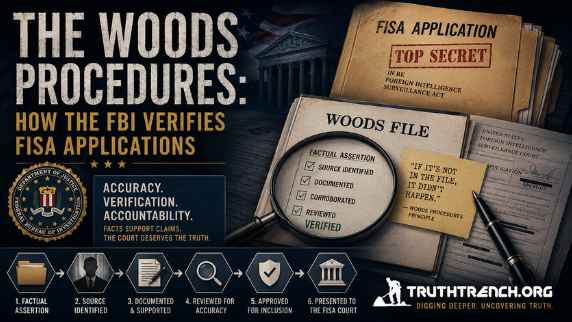
What Are the Woods Procedures?
The Woods Procedures are internal FBI procedures designed to help ensure the factual accuracy of applications submitted to the Foreign Intelligence Surveillance Court.
They take their name from Michael Woods, an FBI official associated with their development.
The procedures were established in 2001 following concerns involving inaccuracies in FISA applications.
Their basic purpose is to require FBI personnel to identify and maintain documentation supporting factual assertions contained in a FISA application.
That supporting documentation is maintained in what is commonly called a Woods File.
The Foreign Intelligence Surveillance Court has described the purpose clearly: the FBI creates a Woods File to document, in one location, the basis for factual assertions made in an application seeking FISA authorization. (Foreign Intelligence Surveillance Court)
In simple terms, imagine a FISA application contains the statement:
The target met with Individual X on a particular date.
The Woods process should require investigators to identify the underlying information supporting that assertion.
That could potentially be an investigative report, intelligence report, interview record, communication intercept, government database record, or other source material.
The objective is traceability.
A factual assertion should lead backward to supporting information.
Why Does This Matter?
Accuracy matters in every court proceeding.
But it becomes particularly important in FISA proceedings because of their structure.
Traditional litigation generally involves opposing parties.
One side makes an argument.
The other side challenges it.
Evidence can be questioned.
Witnesses can be cross-examined.
Competing interpretations can be presented.
FISA proceedings operate differently.
The government generally presents its application ex parte, meaning the surveillance target is not present to challenge the government’s assertions before surveillance is authorized.
That places an additional burden on the government.
Investigators and attorneys are not merely responsible for presenting information supporting their position.
They are responsible for ensuring that the court receives an accurate factual picture.
The Woods Procedures are one of the internal mechanisms intended to help accomplish that mission.
How Is a Woods File Supposed to Work?
Think of the Woods File as the supporting documentation behind the government’s application.
The application presents the factual narrative.
The Woods File provides the underlying documentation supporting factual claims within that narrative.
The process is intended to allow reviewers to trace assertions backward.
Application says X.
Where did X come from?
Here is the document supporting X.
That creates a chain of accountability.
The case agent knows where the information originated.
Supervisors can review it.
Attorneys can examine it.
Accuracy reviewers can inspect it.
And if questions arise later, investigators and oversight bodies can reconstruct how a particular assertion entered the application.
This is important because intelligence investigations can involve enormous quantities of information.
Sources may include confidential human sources.
Foreign intelligence reporting.
Electronic communications.
Government databases.
Interviews.
Surveillance.
Information provided by other agencies.
Open-source information.
And intelligence from foreign partners.
The more complicated the investigation becomes, the more important it is to maintain a reliable connection between what investigators believe and what the underlying documentation actually supports.
Verification Does Not Necessarily Mean Truth
This is one of the most important distinctions in understanding the Woods Procedures.
Documenting the source of an assertion does not necessarily prove that the underlying assertion is true.
Suppose an intelligence source tells the FBI:
Person A secretly met Person B.
The FBI can accurately document that the source made the statement.
The Woods File might therefore verify that the FBI received the allegation.
But that does not independently prove that the meeting actually occurred.
There are two different questions:
Did the source make the claim?
And:
Was the source’s claim accurate?
Those are not the same thing.
This distinction becomes especially important when FISA applications rely upon human-source reporting or intelligence that has not been independently corroborated.
A Woods File can demonstrate where information came from.
Investigators must still evaluate whether the source itself is reliable and whether the underlying information is accurate.
That is why intelligence verification requires more than paperwork.
Accuracy and Completeness Are Different
The Carter Page FISA controversy exposed another important limitation.
An application can contain individually supported factual statements and still present an incomplete or misleading picture.
Imagine investigators possess ten pieces of information.
Seven support their investigative theory.
Three raise serious questions about that theory.
If the application presents the seven supporting facts but omits the three contradictory facts, the individual statements presented may technically have documentation behind them.
But the judge may still receive an incomplete understanding of the case.
This illustrates the difference between accuracy and completeness.
Accuracy asks:
Is this statement supported?
Completeness asks:
Is the court receiving the material information necessary to properly evaluate that statement?
The Department of Justice Inspector General’s examination of the Carter Page FISA applications demonstrated why both matter.
The Carter Page FISA Applications
Carter Page was a former foreign policy adviser to Donald Trump’s 2016 presidential campaign.
The FBI obtained an initial FISA surveillance order targeting Page and subsequently obtained three renewals.
The Department of Justice Office of Inspector General later examined the four applications as part of its review of the Crossfire Hurricane investigation.
The findings were significant.
The Inspector General identified seven significant inaccuracies and omissions in the initial application and a total of 17 by the final renewal.
Inspector General Michael Horowitz concluded that members of the Crossfire Hurricane team failed to meet their obligation to ensure the Carter Page applications were “scrupulously accurate.” (DOJ Inspector General)
The problems involved more than the existence of supporting documentation.
They included information that was inaccurately characterized and relevant information that was not properly communicated to Department of Justice officials involved in the FISA process.
The Inspector General found that members of the Crossfire Hurricane team failed to share all relevant information with the Justice Department’s National Security Division, meaning Department officials deciding whether to support the applications did not have the complete factual picture. (DOJ Inspector General)
This exposed a fundamental weakness.
A verification process cannot protect the court from information that never enters the review process.
Related Truth Trench Research: The Carter Page FISA Warrants: What the DOJ Inspector General Found
The Steele Reporting Problem
Christopher Steele’s reporting became an important part of the Carter Page FISA applications.
That created another challenge for verification.
Steele was reporting information obtained through sources and sub-sources.
In other words, the FBI was not necessarily dealing with information Steele had personally witnessed.
The intelligence chain could look something like:
Sub-source → Source → Steele → FBI → FISA Application → FISA Court
Every additional layer creates another opportunity for misunderstanding, exaggeration, miscommunication, or loss of context.
The FBI therefore had to evaluate several different questions.
Did Steele accurately report what his sources told him?
Did Steele’s sources accurately report what their sources told them?
Were the underlying sources reliable?
Was the underlying information corroborated?
Did later information strengthen or weaken the original reporting?
And was the FISA Court properly informed when the FBI learned information affecting the reliability of previous claims?
The Woods Procedures alone could not answer all of those questions.
They could help document the reporting chain.
But documentation is not the same as corroboration.
Related Truth Trench Research: The Steele Dossier: What It Claimed—and What Was Later Verified, Disputed, or Unsubstantiated
What Happens When New Information Emerges?
Intelligence investigations evolve.
Information considered credible on Monday may be questioned by Friday.
A source may provide additional context.
A witness may contradict an earlier statement.
Another government agency may possess information investigators did not previously know existed.
An allegation may fail to withstand further investigation.
This creates an important responsibility when surveillance authority is renewed.
A FISA renewal should not simply repeat the factual picture presented in the original application if investigators have since learned information materially affecting that picture.
The Carter Page applications demonstrated why this matters.
The government returned to the FISA Court three times seeking continued surveillance authority.
Each renewal created another opportunity to reassess the available information.
That means verification should not be treated as a one-time event.
It is an ongoing obligation.
The Altered Email
One of the most consequential episodes associated with the Carter Page FISA process involved an email concerning Page’s prior relationship with another U.S. government agency.
Former FBI attorney Kevin Clinesmith altered an email in a way that conveyed that Page was “not a source” for the other agency.
Clinesmith later pleaded guilty to making a false statement.
The incident illustrates an uncomfortable reality about any verification system.
A procedure depends upon the integrity of the information entering it.
A checklist cannot protect against every intentional act.
A database cannot guarantee that someone entering information is being truthful.
A signature does not automatically make the underlying information accurate.
This does not make procedures meaningless.
It demonstrates why procedures must operate alongside supervision, auditing, accountability, and professional integrity.
A durable system requires multiple layers.
But every layer ultimately depends upon people performing their responsibilities.
The Inspector General Asked a Bigger Question
After discovering significant problems in the Carter Page FISA applications, the DOJ Inspector General faced an obvious question:
Was Carter Page an isolated failure?
Or did similar problems exist in other FISA applications?
The OIG therefore expanded its examination.
Investigators reviewed additional FISA applications involving U.S. persons that were unrelated to Crossfire Hurricane.
The initial findings raised serious concerns.
In March 2020, the Inspector General issued a management advisory after reviewing a sample of 29 FISA applications. The review identified noncompliance with Woods Procedures and prompted broader examination by the FBI and DOJ. (DOJ Inspector General)
The Foreign Intelligence Surveillance Court also responded, requiring the government to assess the problems and address applications affected by the accuracy concerns. (Foreign Intelligence Surveillance Court)
The issue had now moved beyond one politically sensitive investigation.
It had become a question about the reliability of the FBI’s broader FISA verification system.
The 2021 Woods Procedures Audit
In September 2021, the DOJ Inspector General released a broader audit examining the FBI’s execution of the Woods Procedures for applications filed with the FISA Court involving U.S. persons.
The audit found widespread noncompliance with the Woods Procedures in the applications reviewed.
The OIG concluded that the problems raised serious questions about the adequacy and execution of the supervisory review process that existed when those applications were prepared. (DOJ Inspector General)
This finding was important because it changed the nature of the debate.
The Carter Page applications had become politically explosive because they involved a former adviser to a presidential campaign.
But the broader audit suggested that Woods Procedure compliance problems were not limited to Crossfire Hurricane.
That does not mean every FISA application was materially wrong.
It does mean the FBI’s execution of its own accuracy procedures required broader institutional attention.
A Missing Woods File Creates Another Problem
A verification system also depends upon maintaining the verification records.
If the purpose of a Woods File is to document the basis for factual assertions, then the FBI must actually preserve and be able to locate the file.
The Inspector General’s broader review encountered instances in which Woods Files could not initially be located for applications selected for examination.
That raised an additional accountability problem.
Even if the original application was accurate, oversight becomes significantly more difficult if investigators cannot reconstruct the documentation used to verify it.
Records matter.
Documentation matters.
Institutional memory matters.
A system designed to operate in secret requires particularly strong internal recordkeeping because outside observers cannot independently reconstruct what happened.
The FISA Court Responded
The Foreign Intelligence Surveillance Court did not treat the Inspector General’s findings as merely an internal FBI matter.
The court required the government to address the accuracy concerns and explain corrective actions.
That response highlights an important institutional relationship.
The FBI conducts investigations.
The Department of Justice presents applications.
The FISA Court evaluates those applications.
If the verification system inside the executive branch fails, the judicial branch may receive inaccurate or incomplete information.
That damages more than one investigation.
It can undermine the court’s ability to perform its oversight function.
The FISA Court’s response therefore reflected a larger concern:
The government must be able to demonstrate that the information it presents to the court is reliable enough for the court to exercise meaningful judicial review.
What Changed Afterward?
The FBI and Department of Justice implemented reforms intended to strengthen the FISA process.
These efforts included changes involving documentation, supervisory review, accuracy procedures, training, accountability, and technological controls.
The FISA Court continued overseeing corrective measures related to the accuracy concerns.
By 2023, government filings described technological improvements intended to strengthen FBI compliance with Woods Procedures in FISA applications targeting U.S. persons. (Foreign Intelligence Surveillance Court)
This reflects an important lesson from the controversy.
Technology can help.
Systems can require fields to be completed.
Software can create audit trails.
Databases can prevent certain actions without approval.
Automated checks can identify missing documentation.
But technology remains an augmentation tool.
It cannot replace professional judgment.
It cannot force an investigator to recognize confirmation bias.
It cannot guarantee that someone will report information contradicting an investigative theory.
It cannot replace integrity.
The human being remains part of the system.
Supporters’ Perspective
Supporters of the Woods Procedures argue that the existence of a formal verification system is itself an important safeguard.
The FBI conducts highly complex national security investigations involving enormous quantities of sensitive information.
Errors can occur.
The appropriate response is to create procedures capable of detecting those errors, audit compliance, strengthen supervision, improve technology, and correct weaknesses when they are discovered.
From this perspective, the Inspector General’s work demonstrates that oversight mechanisms can function.
The OIG examined the Carter Page applications.
It identified failures.
It expanded the review.
The FISA Court responded.
The FBI and DOJ implemented reforms.
The system was forced to examine itself.
Supporters argue that the solution is therefore stronger execution of the verification system—not abandoning legitimate foreign intelligence surveillance capabilities.
Critics’ Perspective
Critics argue that the Woods Procedures controversy demonstrates the limitations of internal government safeguards.
The procedures existed before the Carter Page applications.
Supervisors existed.
Attorneys reviewed the applications.
The Department of Justice reviewed them.
The FISA Court approved the initial surveillance and three renewals.
Yet significant inaccuracies and omissions remained.
The broader Inspector General audit then identified Woods Procedure compliance problems beyond Crossfire Hurricane.
Critics therefore question whether a largely internal verification process can provide sufficient protection when the surveillance target has no attorney present to challenge the government’s assertions.
From this perspective, the solution may require stronger independent oversight, greater involvement of amici or other outside experts in sensitive cases, increased judicial scrutiny, and more significant consequences when government officials fail to meet accuracy requirements.
The Difference Between a Checklist and a Culture
Perhaps the most important lesson of the Woods Procedures is that no checklist can substitute for institutional culture.
A checklist can ask:
Is there documentation supporting this statement?
A capable investigator must also ask:
Is this actually true?
Is the source reliable?
Has the information been independently corroborated?
What evidence contradicts this?
Has anything changed since the original application?
What information would I want to know if I were the judge?
That requires judgment.
It requires intellectual discipline.
It requires investigators to actively search for information that could prove their own theory wrong.
That is difficult in any organization.
People naturally become invested in their conclusions.
Investigators can develop theories.
Analysts can become confident in assessments.
Organizations can develop institutional momentum.
A strong verification culture therefore requires more than proving the case.
It requires challenging the case.
Why the Woods Procedures Still Matter
The Woods Procedures may sound like an obscure internal FBI policy.
They are not.
They represent one of the layers standing between government suspicion and secret government surveillance.
That makes their effectiveness important to everyone.
The United States requires the ability to investigate genuine foreign intelligence threats.
Foreign governments conduct espionage.
Intelligence services recruit assets.
Terrorist organizations communicate across borders.
Cyber actors target American systems.
Those threats are real.
But surveillance authority is also powerful.
When the government seeks to secretly monitor an American citizen, the process must be reliable.
The stronger the authority, the stronger the verification should be.
The greater the secrecy, the greater the responsibility for accuracy.
And when the person being surveilled cannot stand before the court and challenge the government’s claims, someone inside the system must be willing to challenge them first.
Continue Your Research
Timeline of Events and Primary Sources: Crossfire Hurricane, FISA, and the Trump-Russia Investigation
What Are Your Thoughts?
Are the Woods Procedures sufficient to protect Americans from inaccurate government surveillance applications when properly followed?
Should verification require more than documentation supporting individual factual assertions?
Should investigators be required to specifically identify information that contradicts or weakens their own case?
Should particularly sensitive FISA applications receive an independent review outside the investigative team?
And when a secret surveillance system fails its own verification procedures, how should the public determine whether the reforms that follow actually fixed the problem?
Truth Trench Think Tank is collecting public perspectives on FISA, intelligence oversight, government surveillance, civil liberties, institutional accountability, and public trust as part of our continuing research.
As an independent research institute, Truth Trench Think Tank does not engage in lobbying or partisan political activity. Our mission is to improve public understanding through transparent, evidence-based research and encourage informed civic participation grounded in publicly available information.
A system built on secret evidence is only as strong as the people responsible for checking the facts.
Before the government digs into someone’s life, someone needs to make sure the foundation underneath the investigation is solid.
Keep digging.