Understanding the Authority, Responsibilities, and Constitutional Limits of America’s Chief Executive
The President of the United States is one of the most recognizable and influential leaders in the world. Every day, the President makes decisions that affect national security, foreign policy, the federal government, the economy, and millions of Americans.
Because the office is so powerful, many people assume the President can simply do whatever he or she wants. In reality, the Constitution was intentionally written to prevent that from happening.
The Founding Fathers created a government with three separate branches, each designed to limit the others. The President leads the Executive Branch, but Congress writes the laws, and the federal courts determine whether presidential actions comply with the Constitution.
Understanding the President’s constitutional powers—and their limits—is essential to understanding how the United States government works.
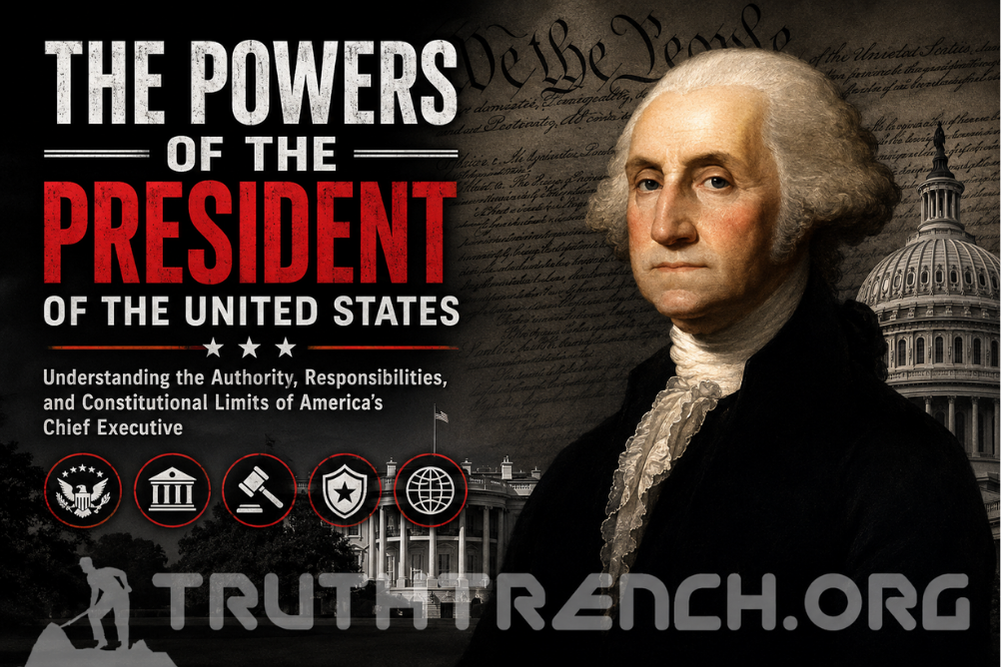
Where Do the President’s Powers Come From?
The powers of the President are established primarily by Article II of the United States Constitution. Unlike Congress, whose responsibilities are listed in great detail under Article I, Article II gives the President broad executive authority while leaving many responsibilities to be defined through federal law, historical practice, and Supreme Court decisions.
Article II establishes the President as:
- Head of the Executive Branch
- Commander in Chief of the Armed Forces
- Chief Executive responsible for enforcing federal law
- Chief Diplomat of the United States
- Head of State
- Leader responsible for appointing many senior federal officials
The Constitution also requires the President to “take Care that the Laws be faithfully executed,” meaning the President is responsible for carrying out laws passed by Congress—not creating new laws independently.
Truth Trench Sources
National Archives — Constitution of the United States (Article II)
Official transcript of Article II establishing the Executive Branch and presidential powers.
https://www.archives.gov/founding-docs/constitution-transcript
The President Leads the Executive Branch
The Executive Branch is responsible for enforcing the laws passed by Congress and managing the daily operations of the federal government.
Today, the Executive Branch includes:
- 15 Cabinet departments
- Hundreds of federal agencies
- Independent commissions
- Executive offices
- Millions of civilian employees
- Active-duty members of the Armed Forces
Some of the departments under presidential leadership include:
- Department of State
- Department of Defense
- Department of Justice
- Department of Homeland Security
- Department of the Treasury
- Department of Agriculture
- Department of Commerce
- Department of Health and Human Services
- Department of Veterans Affairs
Each department is headed by a Cabinet Secretary appointed by the President and generally confirmed by the United States Senate.
Why This Matters
The President does not personally run every agency. Instead, the President appoints leaders who oversee departments responsible for carrying out federal law.
Truth Trench Sources
The White House — The Executive Branch
Overview of the Executive Branch and Cabinet departments.
https://www.whitehouse.gov/about-the-white-house/our-government/the-executive-branch/
USA.gov — Executive Branch
Overview of executive departments and federal agencies.
https://www.usa.gov/branches-of-government
Commander in Chief of the Armed Forces
One of the President’s most significant constitutional roles is serving as Commander in Chief of the United States military.
This authority allows the President to:
- Direct military operations.
- Deploy military forces when authorized by law.
- Appoint senior military leaders (with Senate confirmation where required).
- Respond to national emergencies.
- Exercise authority over the nation’s nuclear command structure.
However, this power is not unlimited.
The Constitution gives Congress the authority to:
- Declare war.
- Raise and support armies.
- Maintain the Navy.
- Appropriate military funding.
This division of authority creates one of the Constitution’s most important checks and balances.
Why This Matters
Although presidents have ordered military operations without formal declarations of war, Congress retains significant constitutional authority over military funding and declarations of war.
Truth Trench Sources
National Archives — Constitution of the United States (Article II)
https://www.archives.gov/founding-docs/constitution-transcript
National Archives — Constitution of the United States (Article I, Section 8)
https://www.archives.gov/founding-docs/constitution-transcript
Congressional Research Service — War Powers Resolution
https://crsreports.congress.gov
Signing or Vetoing Legislation
Congress writes bills.
Once identical legislation passes both the House of Representatives and the Senate, it is sent to the President.
The President may:
- Sign the bill into law.
- Veto the bill.
- Allow it to become law without signing it under certain constitutional circumstances.
If the President vetoes a bill, Congress may override that veto with a two-thirds vote in both chambers.
Why This Matters
The veto gives the President an important check on Congress, but Congress can still enact legislation when there is enough bipartisan support.
Truth Trench Sources
National Archives — Constitution of the United States (Article I, Section 7)
https://www.archives.gov/founding-docs/constitution-transcript
Congress.gov
Official legislative information from the United States Congress.
https://www.congress.gov
Issuing Executive Orders
The President may issue Executive Orders directing how the Executive Branch will administer existing laws and constitutional authority.
Executive Orders:
- Apply primarily to federal agencies.
- Are published in the Federal Register.
- Do not create new Acts of Congress.
- Can be challenged in federal court.
- May be revoked or amended by future presidents.
Executive Orders are one of the President’s most visible tools for directing federal policy.
Why This Matters
Executive Orders help presidents manage the Executive Branch efficiently, but they cannot replace legislation enacted by Congress.
Read More: How Executive Orders Work
Truth Trench Sources
Federal Register — Executive Orders
https://www.federalregister.gov/presidential-documents/executive-orders
The White House — Presidential Actions
https://www.whitehouse.gov/presidential-actions/
Granting Pardons and Clemency
Article II authorizes the President to grant:
- Pardons
- Commutations
- Reprieves
These powers apply only to federal offenses and do not extend to state crimes.
A pardon forgives federal criminal liability but does not erase history or automatically declare someone innocent.
Why This Matters
The pardon power allows presidents to show mercy, correct perceived injustices, and in some cases promote national reconciliation. It is also one of the President’s most debated constitutional authorities.
Read More: Understanding the Presidential Pardon Power
Truth Trench Sources
National Archives — Constitution of the United States (Article II)
https://www.archives.gov/founding-docs/constitution-transcript
U.S. Department of Justice — Office of the Pardon Attorney
https://www.justice.gov/pardon
Conducting Foreign Policy
The President serves as America’s chief diplomat.
Responsibilities include:
- Meeting foreign leaders.
- Negotiating treaties.
- Recognizing foreign governments.
- Representing the United States internationally.
- Responding to international crises.
Most treaties negotiated by the President require approval by a two-thirds vote of the Senate before becoming legally binding.
Why This Matters
The President leads diplomacy, but the Senate shares responsibility for approving formal treaties.
Truth Trench Sources
National Archives — Constitution of the United States (Article II)
https://www.archives.gov/founding-docs/constitution-transcript
U.S. Department of State
https://www.state.gov
Appointing Federal Officials
The President appoints thousands of federal officials during each administration.
Many appointments require Senate confirmation, including:
- Cabinet Secretaries
- Federal judges
- Ambassadors
- U.S. Attorneys
- Agency directors
- Senior military officers
These appointments often influence federal policy long after a President leaves office.
Truth Trench Sources
National Archives — Constitution of the United States (Article II)
https://www.archives.gov/founding-docs/constitution-transcript
United States Senate — Advice and Consent
https://www.senate.gov
The Federal Budget
Each year, the President submits a proposed federal budget outlining spending priorities.
Congress reviews the proposal and decides:
- How much money to appropriate.
- Which programs receive funding.
- Whether to modify the President’s recommendations.
Why This Matters
The President recommends spending priorities, but Congress controls federal spending through the appropriations process.
Truth Trench Sources
Office of Management and Budget
https://www.whitehouse.gov/omb/
House Committee on Appropriations
https://appropriations.house.gov
Emergency Powers
Federal law grants presidents certain emergency authorities during national crises.
Depending on the circumstances, a President may:
- Declare a national emergency.
- Mobilize federal resources.
- Activate emergency response authorities.
- Exercise powers authorized by Congress under specific statutes.
These actions remain subject to congressional oversight and judicial review.
Truth Trench Sources
National Emergencies Act — Congress.gov
https://www.congress.gov
Federal Register — National Emergencies
https://www.federalregister.gov
What the President Cannot Do
Although the office is powerful, the President’s authority has important constitutional limits.
The President cannot:
- Create laws without Congress.
- Raise taxes without congressional approval.
- Spend money Congress has not appropriated.
- Ignore the Constitution.
- Remain in office beyond constitutional limits.
- Cancel federal elections.
- Remove Supreme Court Justices.
- Amend the Constitution.
- Pardon state crimes.
- Override Supreme Court decisions.
- Imprison people without due process.
These limits help ensure that no single branch of government becomes too powerful.
Truth Trench Sources
National Archives — Constitution of the United States
https://www.archives.gov/founding-docs/constitution-transcript
Checks and Balances
The Constitution divides power among three branches of government.
Congress
- Writes laws.
- Controls federal spending.
- Declares war.
- Conducts oversight.
- Confirms many presidential appointments.
- Can impeach federal officials.
The President
- Enforces laws.
- Leads the Executive Branch.
- Commands the Armed Forces.
- Conducts foreign policy.
- Issues Executive Orders.
- Grants pardons.
- Appoints federal officials.
Federal Courts
- Interpret the law.
- Review executive actions.
- Determine constitutionality.
- Resolve legal disputes.
No branch operates independently. Each serves as a check on the others.
Truth Trench Sources
National Archives — Constitution of the United States
https://www.archives.gov/founding-docs/constitution-transcript
Administrative Office of the U.S. Courts
https://www.uscourts.gov
Why This Matters
Every election has consequences because the President influences nearly every area of the federal government. At the same time, the Constitution ensures that presidential authority is balanced by Congress and the courts. Understanding those constitutional limits helps citizens better evaluate executive actions, legislation, court decisions, and the ongoing debates surrounding presidential power.
Key Takeaways
- The President’s powers come primarily from Article II of the Constitution.
- The President leads the Executive Branch and enforces federal law.
- The President serves as Commander in Chief but does not have unlimited war powers.
- Congress writes laws; the President signs or vetoes them.
- Executive Orders direct the Executive Branch but are not Acts of Congress.
- The President may grant pardons for federal offenses only.
- Most senior federal appointments require Senate confirmation.
- Congress controls federal spending.
- The courts may review presidential actions for constitutionality.
- The Constitution’s system of checks and balances prevents any one branch from exercising unlimited power.
Continue Learning
- How Executive Orders Work
- Understanding the Presidential Pardon Power
- How Congress Makes Laws
- Who Decides If America Goes to War? Congress, the President, and the Constitutional Balance of Power
- The Constitution: America’s Framework for Government
- Checks and Balances: How the Three Branches of Government Limit Each Other
Weigh In
Do you think the President of the United States has too much power, too little power, or about the right amount under the Constitution?
Share your thoughts in the comments below. Truth Trench Think Tank researches constitutional government, executive authority, and public sentiment to better understand how Americans view the balance of power established by the Founding Fathers.