Understanding One of the President’s Most Powerful Executive Tools
Every time a new president takes office, headlines often announce that the President has signed dozens of executive orders.
Some people believe executive orders are “laws.”
Others believe a president can simply sign an executive order to do anything they want.
Neither is true.
Executive orders are powerful tools that help the President manage the Executive Branch of the federal government, but they are limited by the Constitution, federal law, and the courts.
Understanding how executive orders work is essential to understanding how the federal government functions.
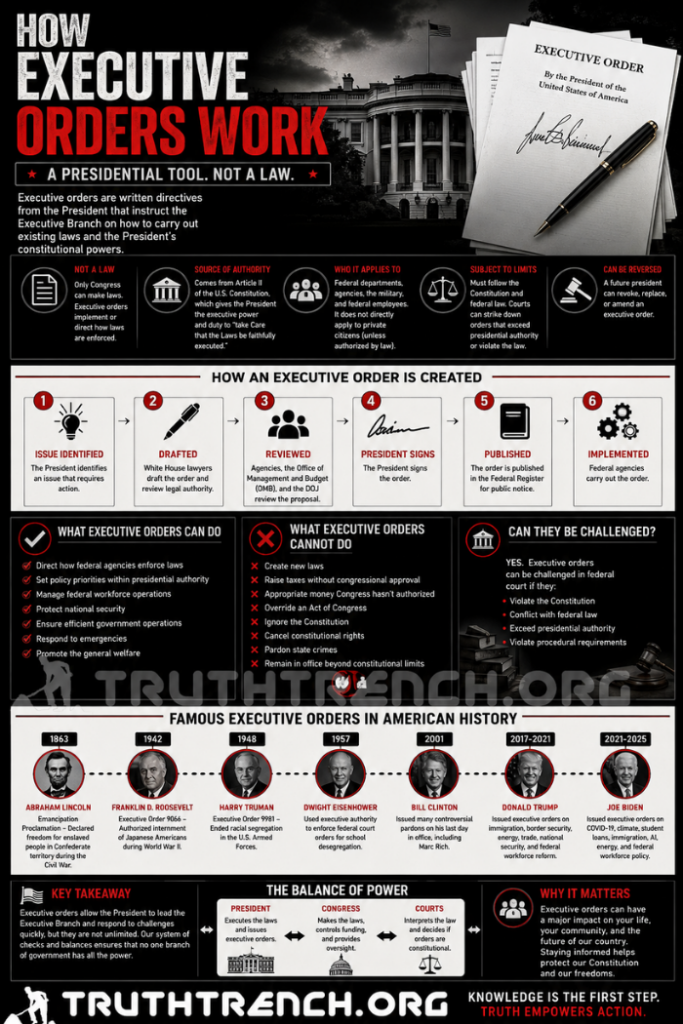
What Is an Executive Order?
An executive order is a written directive issued by the President of the United States that tells the Executive Branch how to carry out existing federal law.
Think of an executive order as instructions from the President to the federal agencies that work for the Executive Branch.
Executive orders do not create new laws.
Only Congress has the constitutional authority to pass laws.
Instead, executive orders explain how the Executive Branch will enforce or administer laws that Congress has already passed or how the President will exercise powers granted by the Constitution.
Where Does the Authority Come From?
The Constitution never specifically uses the words “Executive Order.”
Instead, presidential authority comes primarily from Article II of the U.S. Constitution, which states:
“The executive Power shall be vested in a President of the United States of America.”
It also requires the President to:
“take Care that the Laws be faithfully executed.”
These constitutional responsibilities give the President authority to direct the Executive Branch.
Who Must Follow Executive Orders?
Executive orders generally apply to:
- Federal departments
- Federal agencies
- Military organizations
- Independent executive offices
- Federal employees
Examples include:
- Department of Justice
- Department of Homeland Security
- Department of Defense
- Department of Education
- Department of Health and Human Services
- FBI
- ICE
- Customs and Border Protection
- Environmental Protection Agency
Executive orders generally do not directly order private citizens to do something unless Congress has already provided legal authority allowing the Executive Branch to regulate that activity.
How Is an Executive Order Created?
The process usually looks like this:
Step 1
The President identifies an issue.
Example:
Border security.
Artificial intelligence.
Energy production.
Government efficiency.
National security.
Step 2
White House lawyers draft the order.
Attorneys review whether the proposed order falls within presidential authority.
Step 3
Federal agencies review the proposal.
The Office of Management and Budget (OMB), Department of Justice, and affected agencies often provide input.
Step 4
The President signs the Executive Order.
Step 5
The order is published in the Federal Register so the public can read it.
Step 6
Federal agencies begin carrying it out.
Are Executive Orders Laws?
No.
This is one of the biggest misconceptions.
Congress writes laws.
The President signs or vetoes laws.
Executive orders implement or direct the enforcement of existing laws or constitutional powers.
An executive order cannot simply replace an Act of Congress.
If Congress has clearly spoken through legislation, a President generally cannot override that law with an executive order.
Can Executive Orders Be Challenged?
Yes.
Executive orders can be challenged in court.
Federal judges may decide that an executive order:
- Violates the Constitution.
- Conflicts with federal law.
- Exceeds presidential authority.
- Violates procedural requirements.
When that happens, courts can temporarily block or permanently strike down all or part of an executive order.
Many executive orders issued by presidents of both political parties have faced legal challenges.
Can Congress Stop an Executive Order?
Sometimes.
Congress has several options.
It can:
Pass new legislation.
Refuse funding.
Hold oversight hearings.
Conduct investigations.
Override certain presidential actions when authorized by law.
However, Congress generally cannot simply “vote away” an executive order unless legislation or constitutional authority allows it.
Can One President Undo Another President’s Executive Orders?
Yes.
This happens frequently.
Because executive orders are presidential directives—not permanent laws—a new president may:
Revoke an executive order.
Replace it.
Amend it.
Issue an entirely new executive order covering the same subject.
That is why executive orders often change after presidential elections.
One administration may issue an executive order expanding environmental regulations.
The next administration may reverse that policy.
This is one reason executive orders can produce significant policy swings between administrations.
(Read more:
Trump Reverses Biden Executive Orders: How One President Can Undo Another’s Executive Actions)
What Executive Orders Cannot Do
Although powerful, executive orders have important limits.
A President generally cannot:
Create new criminal laws.
Raise taxes without congressional authority.
Appropriate money Congress has not authorized.
Ignore the Constitution.
Override Supreme Court decisions.
Cancel constitutional rights.
Rewrite Acts of Congress.
Pardon state crimes.
Remain in office beyond constitutional limits.
The President’s authority remains subject to the Constitution and judicial review.
Famous Executive Orders in American History
Abraham Lincoln
Emancipation Proclamation (1863)
Declared freedom for enslaved people in Confederate-controlled territory during the Civil War.
Franklin D. Roosevelt
Executive Order 9066 (1942)
Authorized military commanders to establish exclusion zones during World War II, leading to the internment of many Japanese Americans.
Today, this order is widely criticized as one of the most controversial executive actions in American history.
Harry Truman
Executive Order 9981 (1948)
Ended racial segregation in the U.S. Armed Forces.
Dwight Eisenhower
Used executive authority to enforce federal court orders during school desegregation in Little Rock, Arkansas.
Barack Obama
Issued executive actions expanding protections for certain undocumented immigrants under DACA.
These actions generated years of legal challenges.
Donald Trump
Issued executive orders involving:
Border security.
Immigration.
Energy production.
Federal workforce reform.
Military policy.
Trade.
National emergency declarations.
Several became the subject of major court cases.
Joe Biden
Issued executive orders involving:
COVID-19 response.
Climate policy.
Student loan policy.
Federal workforce requirements.
Immigration.
Energy policy.
Artificial intelligence.
Many were later challenged in federal court or modified by subsequent executive actions.
Why Are Executive Orders So Controversial?
Supporters often argue executive orders allow presidents to act quickly during emergencies or when Congress cannot agree.
Critics argue presidents sometimes rely too heavily on executive orders to achieve policy goals that Congress has not approved.
Because executive orders can dramatically affect immigration, national security, environmental regulation, healthcare, education, and federal spending priorities, they often become major political issues.
Why This Matters
Executive orders allow the President to lead the Executive Branch efficiently.
But they also illustrate one of the central principles of the U.S. Constitution:
No branch of government has unlimited power.
The President may issue executive orders.
Congress writes the laws.
The courts decide whether executive actions comply with the Constitution.
Each branch checks the others.
That system of checks and balances is designed to prevent any one branch from becoming too powerful.
Key Takeaways
- Executive orders are not laws.
- They direct how the Executive Branch carries out existing law.
- Executive orders come from presidential constitutional authority.
- They apply primarily to federal agencies and employees.
- Courts can strike them down.
- Congress can respond through legislation and oversight.
- Future presidents may revoke or replace them.
- Executive orders are one of the most powerful—but also one of the most misunderstood—tools available to the President.
Continue Learning
Interested in learning more? Explore these related Truth Trench articles:
- Trump Reverses Biden Executive Orders: How One President Can Undo Another’s Executive Actions
- Understanding the Presidential Pardon Power
- The Powers of the President of the United States
- How Congress Makes Laws
- Checks and Balances: How the Three Branches of Government Limit Each Other
Together, these articles explain how presidential authority fits within the broader framework of the U.S. Constitution.
Weigh In
Should presidents rely more on Congress to enact major policy changes, or are executive orders an appropriate way to respond quickly when immediate action is needed?
Share your thoughts in the comments below. Truth Trench Think Tank welcomes civil discussion and uses public feedback to better understand how Americans view constitutional powers, executive authority, and government accountability.