Understanding the Legislative Process That Shapes Federal Policy
Every federal law in the United States begins as an idea.
Sometimes that idea comes from a member of Congress. Other times it comes from the President, a federal agency, a state government, a business, a nonprofit organization, or even ordinary citizens contacting their elected representatives.
But no matter where the idea starts, the Constitution requires a deliberate process before it becomes federal law.
That process was designed by the Founding Fathers to encourage debate, prevent rushed decisions, and ensure that multiple elected representatives agree before a law affects the American people.
Understanding how Congress makes laws helps explain why legislation can sometimes move quickly—and why other bills may take years or never become law at all.
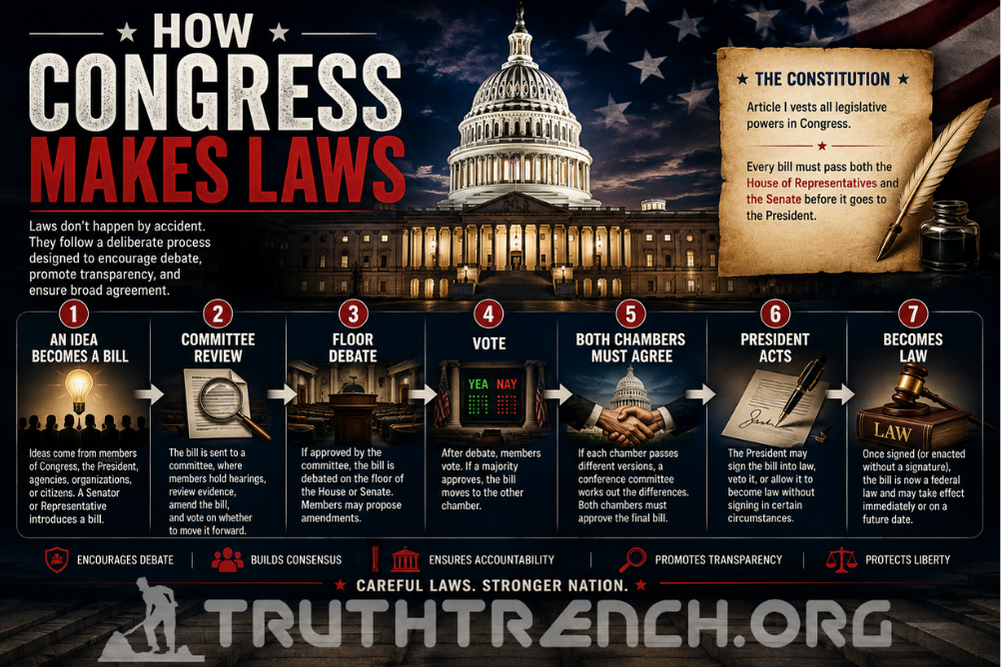
Congress: America’s Legislative Branch
Article I of the United States Constitution establishes Congress as the Legislative Branch of the federal government.
Congress is made up of two chambers:
- The House of Representatives
- The United States Senate
For most legislation to become law, both chambers must approve the exact same bill before it is sent to the President.
Why This Matters
The two-chamber system was designed to ensure that legislation receives broad support before becoming federal law.
Truth Trench Sources
National Archives — Constitution of the United States (Article I)
Official transcript establishing the Legislative Branch.
https://www.archives.gov/founding-docs/constitution-transcript
U.S. House of Representatives
https://www.house.gov
United States Senate
https://www.senate.gov
Step 1: An Idea Becomes a Bill
Every law begins as an idea.
Ideas may come from:
- Members of Congress
- The President
- Federal agencies
- State governments
- Advocacy organizations
- Businesses
- Citizens
- Court decisions requiring legislative action
A Senator may introduce a bill in the Senate.
A Representative introduces a bill in the House.
Once introduced, the proposal officially becomes a bill.
Each bill receives a number.
Examples:
- H.R. 123 (House Bill)
- S. 456 (Senate Bill)
Why This Matters
Anyone can suggest an idea for legislation, but only a member of Congress can formally introduce a bill.
Truth Trench Sources
Congress.gov — Legislative Process
Official explanation of how bills are introduced and tracked.
https://www.congress.gov
Step 2: Committee Review
After introduction, the bill is referred to a congressional committee.
Committees specialize in different subjects such as:
- Agriculture
- Armed Services
- Judiciary
- Homeland Security
- Intelligence
- Energy
- Education
- Transportation
- Veterans’ Affairs
Most bills never leave committee.
Committee members may:
- Hold hearings.
- Receive expert testimony.
- Request government reports.
- Debate the proposal.
- Amend the bill.
- Vote whether to move it forward.
Why This Matters
Committees do much of Congress’s detailed work. They allow lawmakers to study complicated issues before the entire House or Senate debates them.
Truth Trench Sources
U.S. House of Representatives — Committees
https://www.house.gov/committees
United States Senate — Committees
https://www.senate.gov/committees
Step 3: Floor Debate
If the committee approves the bill, it moves to the floor of the House or Senate.
Lawmakers debate:
- The purpose of the bill.
- Costs.
- Benefits.
- Constitutional questions.
- Possible amendments.
Members may propose changes before voting.
Why This Matters
Floor debate allows elected representatives to publicly explain their positions and propose improvements.
Truth Trench Sources
Congress.gov
Official legislative information and bill tracking.
https://www.congress.gov
Step 4: Vote
After debate ends, members vote.
Most legislation requires a simple majority.
If the bill passes one chamber, it moves to the other chamber, where the entire process begins again.
Why This Matters
Both the House and Senate must independently approve legislation.
Truth Trench Sources
U.S. House Clerk
https://clerk.house.gov
United States Senate
https://www.senate.gov
Step 5: Both Chambers Must Agree
The House and Senate often pass different versions of the same bill.
When that happens, lawmakers work to produce one identical version.
This may occur through:
- Negotiations
- Amendments
- Conference Committees
Both chambers must approve the final version before it goes to the President.
Why This Matters
This requirement prevents one chamber from rewriting legislation without the other’s approval.
Truth Trench Sources
Congress.gov — Legislative Process
https://www.congress.gov
Step 6: The President Acts
Once Congress passes the final bill, it goes to the President.
The President may:
- Sign it into law.
- Veto it.
- Allow it to become law without signing under certain constitutional circumstances.
If the President vetoes the bill, it returns to Congress.
Congress may override the veto with a two-thirds vote in both chambers.
Why This Matters
The President participates in the legislative process, but Congress can override a veto when sufficient support exists.
Read More: The Powers of the President of the United States
Truth Trench Sources
National Archives — Constitution (Article I, Section 7)
https://www.archives.gov/founding-docs/constitution-transcript
When Does a Law Take Effect?
Not every law becomes effective immediately.
Some laws:
- Take effect immediately.
- Become effective on a specific future date.
- Require agencies to write regulations before implementation.
Federal agencies often develop rules explaining how the law will operate in practice.
Why This Matters
Passing a law is often only the beginning. Agencies frequently have significant responsibilities in implementing legislation.
Truth Trench Sources
Federal Register
Official publication of federal rules and regulations.
https://www.federalregister.gov
What Happens If Congress Does Nothing?
Most proposed bills never become law.
Bills may fail because:
- Committee rejects them.
- Leadership never schedules a vote.
- One chamber votes them down.
- House and Senate cannot agree.
- The President vetoes them.
- Congress adjourns before final passage.
Thousands of bills are introduced during every Congress, but only a small percentage become federal law.
Why This Matters
The legislative process is intentionally difficult. The Constitution favors careful deliberation over rapid lawmaking.
Truth Trench Sources
Congress.gov
Official legislative statistics and bill tracking.
https://www.congress.gov
Special Types of Legislation
Congress also considers specialized legislation, including:
- Budget bills
- Appropriations bills
- Continuing resolutions
- Reconciliation bills
- Joint resolutions
- Constitutional amendments
Each follows slightly different procedural rules.
Truth Trench Sources
Congressional Research Service
https://crsreports.congress.gov
Why Is It So Difficult to Pass Laws?
The Founding Fathers intentionally designed Congress to move carefully.
Before becoming law, legislation often requires agreement from:
- House committees
- House leadership
- A majority of the House
- Senate committees
- Senate leadership
- A majority of the Senate
- The President
Each step creates another opportunity for review, debate, compromise, or rejection.
Why This Matters
The Constitution favors stability over speed. While this can sometimes frustrate citizens, it also prevents sudden changes in federal law without broad support.
Truth Trench Sources
Federalist No. 62 — James Madison
Library of Congress.
https://guides.loc.gov/federalist-papers/text-61-70
National Archives — Constitution
https://www.archives.gov/founding-docs/constitution-transcript
Why This Matters
Every federal law that affects taxes, immigration, healthcare, education, national defense, veterans’ benefits, civil rights, and countless other issues must pass through Congress.
Understanding how laws are made helps citizens better follow legislation, evaluate elected officials, and participate in the democratic process.
The process is intentionally designed to encourage debate, compromise, transparency, and accountability.
Key Takeaways
- Congress is the Legislative Branch established by Article I of the Constitution.
- A bill may begin in either the House or Senate (except certain revenue bills, which must originate in the House).
- Committees review most legislation before it reaches the full chamber.
- Both the House and Senate must pass identical versions of a bill.
- The President may sign or veto legislation.
- Congress may override a veto with a two-thirds vote in both chambers.
- Most proposed bills never become federal law.
- The process is intentionally designed to prevent rushed legislation.
Continue Learning
- The Constitution: America’s Framework for Government
- The Powers of the President of the United States
- How Executive Orders Work
- Checks and Balances: How the Three Branches of Government Limit Each Other
- Government Funding and the Federal Budget
- Congressional Oversight Explained
Weigh In
Do you think Congress makes laws too slowly, too quickly, or about the right pace? What changes, if any, would you make to the legislative process?
Share your thoughts in the comments below. Truth Trench Think Tank encourages respectful discussion and studies public sentiment to better understand how Americans view representative government, lawmaking, and constitutional accountability.