Understanding the Document That Defines the United States
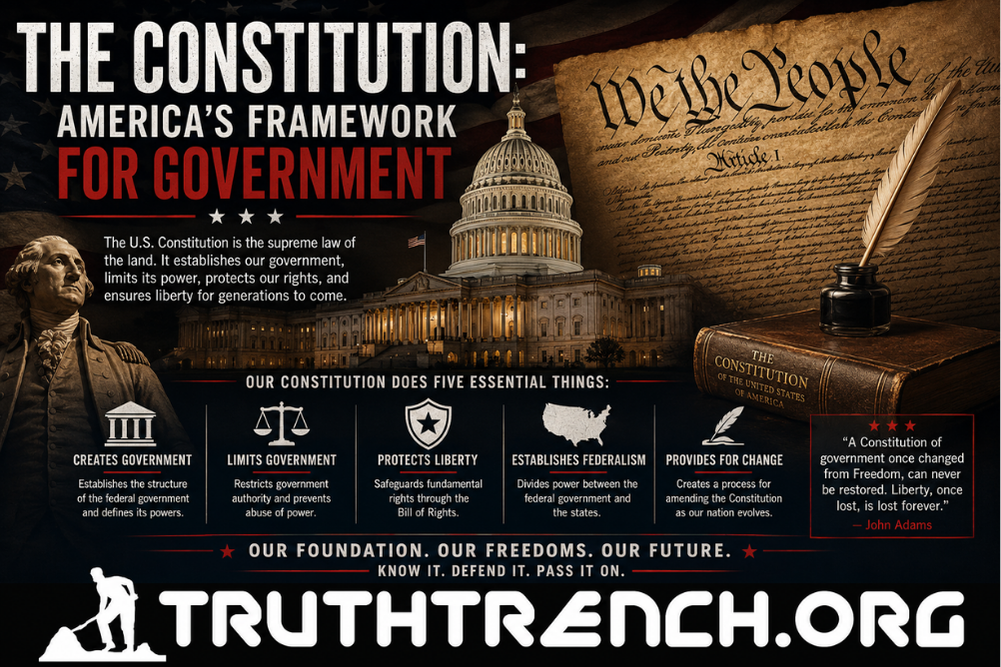
The United States Constitution is the foundation of the American system of government. It establishes how the federal government is organized, defines the powers of each branch, protects individual rights, and limits the government’s authority over its citizens.
Although it was written more than 235 years ago, the Constitution remains the supreme law of the United States. Every federal law, presidential action, executive order, and court decision must ultimately comply with it.
Whether the issue is free speech, gun rights, immigration, taxes, elections, or national security, the Constitution serves as the framework for resolving many of America’s most important legal and political questions.
Understanding the Constitution is one of the best ways to understand how the United States government works.
Why Was the Constitution Written?
After winning the Revolutionary War, the United States was governed by the Articles of Confederation. While the Articles helped unite the former colonies during the war, they created a national government that was too weak to effectively govern the growing nation.
Among the problems were:
- Congress could not effectively collect taxes.
- The federal government struggled to pay its debts.
- There was no President to enforce national laws.
- There was no national court system.
- States often acted independently rather than as one nation.
Recognizing these weaknesses, delegates from the states met in Philadelphia in 1787 to draft a new Constitution that would create a stronger federal government while protecting liberty and preventing tyranny.
The Constitution they produced remains in effect today.
Why This Matters
The Constitution was designed to create a government strong enough to govern the nation, but limited enough to protect individual freedom.
Truth Trench Sources
National Archives — America’s Founding Documents
Overview of the Constitution, Declaration of Independence, and Bill of Rights.
https://www.archives.gov/founding-docs
National Archives — Constitution of the United States
Official transcript of the Constitution.
https://www.archives.gov/founding-docs/constitution-transcript
What Does the Constitution Do?
The Constitution serves several major purposes.
It:
- Creates the federal government.
- Divides power among three branches.
- Limits government authority.
- Protects individual liberty.
- Establishes the relationship between the federal government and the states.
- Provides a process for amending the Constitution.
- Declares itself the supreme law of the land.
Rather than explaining every possible situation, the Constitution establishes the basic framework that government must follow.
Truth Trench Sources
National Archives — Constitution Transcript
https://www.archives.gov/founding-docs/constitution-transcript
“We the People”
The Constitution begins with one of the most recognizable sentences in American history:
“We the People of the United States…”
These opening words, known as the Preamble, explain the overall purpose of the Constitution.
The Preamble states that the Constitution was established to:
- Form a more perfect Union.
- Establish justice.
- Ensure domestic tranquility.
- Provide for the common defense.
- Promote the general welfare.
- Secure the blessings of liberty for future generations.
Unlike the Articles of Confederation, the Constitution derives its authority from the people, not the individual states.
Why This Matters
The Preamble expresses the goals of the Constitution and reflects the principle that government exists to serve the people.
Truth Trench Sources
National Archives — Constitution Preamble
https://www.archives.gov/founding-docs/constitution-transcript
The Three Branches of Government
One of the Constitution’s most important features is the separation of powers.
Rather than concentrating authority in one person or institution, the Constitution divides power among three branches.
Legislative Branch
Congress writes federal laws.
Congress consists of:
- House of Representatives
- United States Senate
Read More: How Congress Makes Laws
Executive Branch
The President carries out and enforces federal laws.
The Executive Branch also manages federal agencies and conducts foreign policy.
Read More: The Powers of the President of the United States
Judicial Branch
Federal courts interpret laws and resolve disputes.
The Supreme Court serves as the nation’s highest court.
Why This Matters
Separating powers helps prevent any one branch from becoming too powerful.
Truth Trench Sources
National Archives — Constitution (Articles I–III)
https://www.archives.gov/founding-docs/constitution-transcript
U.S. Courts
https://www.uscourts.gov
Checks and Balances
The Constitution gives each branch powers that limit the others.
Examples include:
Congress can:
- Pass laws.
- Override presidential vetoes.
- Confirm presidential appointments.
- Impeach federal officials.
The President can:
- Veto legislation.
- Issue executive orders.
- Appoint federal judges.
- Grant pardons for federal crimes.
The Courts can:
- Declare laws unconstitutional.
- Strike down executive actions.
- Resolve constitutional disputes.
Why This Matters
The Constitution intentionally prevents any branch from exercising unlimited authority.
Truth Trench Sources
National Archives — Constitution
https://www.archives.gov/founding-docs/constitution-transcript
Federalism
The Constitution divides power between:
- The federal government
- State governments
Some powers belong only to the federal government.
Others belong to the states.
Some powers are shared.
For example:
Federal government:
- National defense
- Foreign affairs
- Immigration
- Currency
States:
- Most criminal law
- Public education
- Driver licensing
- Local elections
- Property law
Why This Matters
Federalism allows states to govern many local issues while maintaining one national government.
Truth Trench Sources
Tenth Amendment
National Archives.
https://www.archives.gov/founding-docs/amendments-11-27
The Bill of Rights
When the Constitution was ratified, many Americans worried that the federal government could become too powerful.
In response, Congress proposed the first ten amendments.
These became known as the Bill of Rights.
They protect freedoms including:
- Religion
- Speech
- Press
- Assembly
- Petition
- Keeping and bearing arms
- Protection from unreasonable searches
- Due process
- Trial by jury
- Protection against cruel and unusual punishment
Why This Matters
The Bill of Rights limits government power and protects individual liberty.
Truth Trench Sources
National Archives — Bill of Rights
https://www.archives.gov/founding-docs/bill-of-rights-transcript
Amending the Constitution
The Constitution was designed to endure, but also to adapt.
Article V establishes the amendment process.
An amendment may be proposed by:
- Two-thirds of both houses of Congress, or
- A constitutional convention called by two-thirds of the states.
An amendment generally becomes part of the Constitution only after ratification by three-fourths of the states.
Since 1789, the Constitution has been amended 27 times.
Why This Matters
The amendment process allows the Constitution to evolve while making changes difficult enough to require broad national agreement.
Truth Trench Sources
National Archives — Amendment Process
https://www.archives.gov/federal-register/constitution
The Supremacy Clause
Article VI declares that:
The Constitution, federal laws made pursuant to it, and treaties made under its authority are the “supreme Law of the Land.”
This means that when federal and state laws conflict, federal law generally controls—provided the federal law itself is constitutional.
Why This Matters
The Supremacy Clause helps ensure consistency across the nation while preserving constitutional limits on federal power.
Truth Trench Sources
National Archives — Constitution (Article VI)
https://www.archives.gov/founding-docs/constitution-transcript
Why the Constitution Still Matters Today
Although written in 1787, the Constitution continues to shape nearly every major issue facing the country.
Questions involving:
- Elections
- Immigration
- Free speech
- Gun rights
- Executive Orders
- Presidential pardons
- Artificial intelligence
- Federal agencies
- Privacy
- National security
- Healthcare
- Religious liberty
often become constitutional questions.
The Constitution remains the foundation upon which all federal authority rests.
Why This Matters
The Constitution is more than a historical document.
It is the operating manual for the federal government.
Understanding its principles helps citizens better evaluate government actions, participate in public debate, and hold elected officials accountable to the rule of law.
Key Takeaways
- The Constitution is the supreme law of the United States.
- It replaced the Articles of Confederation in 1789.
- It creates the Legislative, Executive, and Judicial Branches.
- It divides power through checks and balances.
- It establishes federalism between the national and state governments.
- The Bill of Rights protects individual freedoms.
- Article V provides a process for amendments.
- Every federal law and presidential action must comply with the Constitution.
Continue Learning
Explore these related Truth Trench articles:
- The Powers of the President of the United States
- How Congress Makes Laws
- How Executive Orders Work
- Understanding the Presidential Pardon Power
- Checks and Balances: How the Three Branches of Government Limit Each Other
Weigh In
The Constitution has guided the United States for more than two centuries, yet Americans continue to debate how it should be interpreted in a changing world.
Do you believe the Constitution should be interpreted primarily according to its original public meaning, or should its principles evolve as society changes? Why?
Share your thoughts in the comments below. Truth Trench Think Tank welcomes respectful discussion and uses public feedback to better understand how Americans view constitutional government, individual liberty, and the rule of law.