Understanding the Constitutional System That Prevents Any One Branch from Becoming Too Powerful
When the Founding Fathers wrote the United States Constitution, they faced a difficult challenge.
They wanted a national government strong enough to govern the country, defend the nation, and maintain order—but they also wanted to prevent any one person or branch of government from becoming too powerful.
Having just fought a revolution against a king, the Founders were deeply concerned about concentrated power.
Their solution was a constitutional system known as checks and balances.
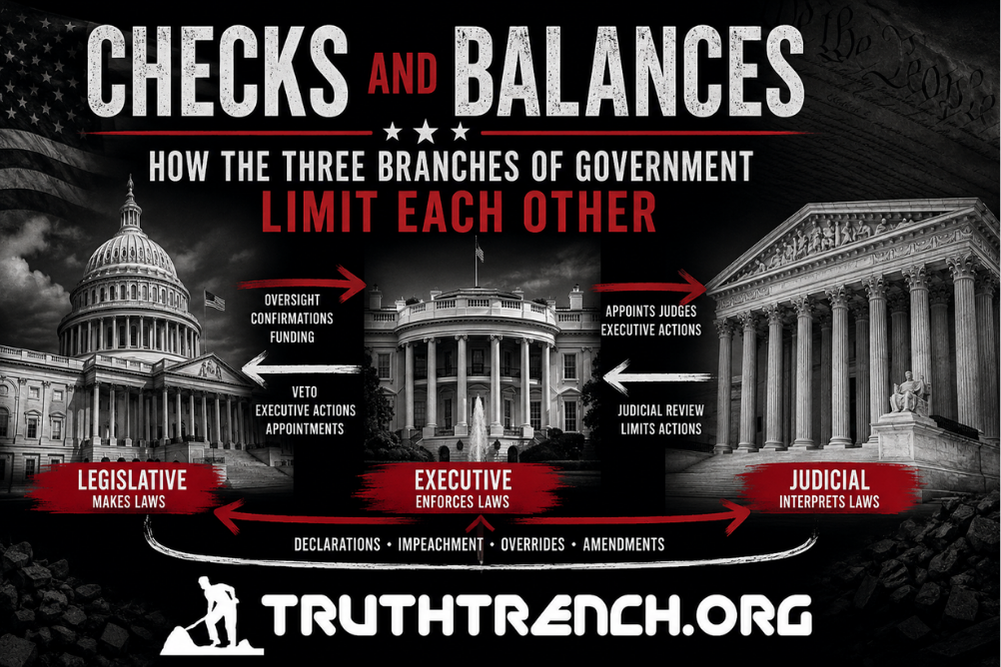
Rather than placing all authority in one branch of government, the Constitution divides power among the Legislative, Executive, and Judicial Branches. Each branch has its own responsibilities while also possessing constitutional powers that limit the others.
This system has helped preserve American constitutional government for more than two centuries.
What Are Checks and Balances?
Checks and balances are constitutional mechanisms that allow each branch of government to limit the authority of the other branches.
No branch can exercise unlimited power.
Instead, each must operate within constitutional limits while remaining accountable to the others.
This system works alongside the principle of separation of powers, which assigns different responsibilities to each branch of government.
Why This Matters
Checks and balances help prevent abuses of power and encourage cooperation among the branches of government before major national decisions are made.
Truth Trench Sources
National Archives — Constitution of the United States
Official transcript of the Constitution establishing the three branches of government.
https://www.archives.gov/founding-docs/constitution-transcript
The Federalist Papers No. 51 (James Madison)
Explains why separating power among multiple branches protects liberty.
https://guides.loc.gov/federalist-papers/full-text
The Three Branches of Government
The Constitution establishes three separate branches, each with its own responsibilities.
Legislative Branch (Congress)
Congress is responsible for making federal laws.
Congress consists of:
- House of Representatives
- United States Senate
Primary responsibilities include:
- Passing legislation
- Approving the federal budget
- Declaring war
- Conducting oversight investigations
- Confirming many presidential appointments
- Ratifying treaties (Senate)
- Impeaching federal officials
Read More: How Congress Makes Laws
Executive Branch (The President)
The President leads the Executive Branch.
Primary responsibilities include:
- Enforcing federal laws
- Serving as Commander in Chief
- Conducting foreign policy
- Signing or vetoing legislation
- Issuing Executive Orders
- Appointing federal officials
- Granting pardons for federal offenses
Read More: The Powers of the President of the United States
Judicial Branch (Federal Courts)
The Judicial Branch interprets laws and resolves legal disputes.
The Supreme Court is the highest court in the nation.
Federal courts determine whether laws and executive actions comply with the Constitution.
Why This Matters
Each branch performs different functions, preventing one institution from controlling every aspect of government.
Truth Trench Sources
National Archives — Constitution (Articles I, II, and III)
https://www.archives.gov/founding-docs/constitution-transcript
United States Courts
https://www.uscourts.gov
How Congress Checks the President
Although the President leads the Executive Branch, Congress has several constitutional tools that limit presidential authority.
Congress may:
- Pass laws that limit executive authority.
- Override a presidential veto with a two-thirds vote.
- Confirm or reject Cabinet nominees.
- Confirm or reject federal judges.
- Confirm ambassadors.
- Conduct oversight hearings.
- Issue subpoenas.
- Control federal spending.
- Declare war.
- Impeach and remove federal officials, including the President.
Example
A President may propose a large new federal program.
Congress may refuse to fund it.
Without congressional appropriations, many executive initiatives cannot move forward.
Why This Matters
Congress represents the Legislative Branch and serves as one of the Constitution’s primary checks on executive power.
Truth Trench Sources
National Archives — Constitution (Articles I & II)
https://www.archives.gov/founding-docs/constitution-transcript
Congress.gov
Official legislative information.
https://www.congress.gov
How the President Checks Congress
The Constitution also gives the President powers that limit Congress.
The President may:
- Veto legislation.
- Recommend legislation.
- Call Congress into special session under certain circumstances.
- Sign bills into law.
- Direct the Executive Branch in enforcing federal law.
- Issue Executive Orders within constitutional and statutory authority.
Example
Congress passes a bill.
If the President believes it is unconstitutional, unwise, or contrary to administration policy, the President may veto it.
Congress must then decide whether it has enough votes to override the veto.
Why This Matters
The presidential veto encourages Congress to build broad support before passing major legislation.
Truth Trench Sources
National Archives — Constitution (Article I, Section 7)
https://www.archives.gov/founding-docs/constitution-transcript
The White House — Presidential Actions
https://www.whitehouse.gov/presidential-actions/
How the Courts Check Congress
Federal courts review laws passed by Congress.
If a law violates the Constitution, courts may declare it unconstitutional.
This authority is commonly known as judicial review.
Although judicial review is not explicitly named in the Constitution, it was established by the Supreme Court in the landmark 1803 case Marbury v. Madison.
Example
Congress passes a law restricting certain speech.
If challenged, the Supreme Court may determine whether the law violates the First Amendment.
Why This Matters
Judicial review ensures that Congress remains subject to the Constitution.
Truth Trench Sources
Marbury v. Madison (1803)
Library of Congress.
https://guides.loc.gov/federalist-papers/full-text
Supreme Court of the United States
https://www.supremecourt.gov
How the Courts Check the President
The courts also review presidential actions.
Federal judges may determine whether:
- Executive Orders comply with the Constitution.
- Agency actions exceed statutory authority.
- Presidential actions violate federal law.
- Emergency declarations comply with applicable law.
If a court finds an executive action unconstitutional, it may block or invalidate that action.
Example
Numerous Executive Orders issued by presidents of both political parties have been challenged—and sometimes blocked—in federal court.
Why This Matters
The President must exercise executive authority within constitutional limits.
Truth Trench Sources
United States Courts
https://www.uscourts.gov
Supreme Court of the United States
https://www.supremecourt.gov
How Congress Checks the Courts
Congress cannot simply overturn court decisions.
However, Congress may:
- Create or eliminate lower federal courts (within constitutional limits).
- Change federal law.
- Propose constitutional amendments.
- Control judicial budgets.
- Impeach federal judges for misconduct.
The Senate also confirms federal judges nominated by the President.
Why This Matters
Although judges serve independently, they remain part of the constitutional system of checks and balances.
Truth Trench Sources
National Archives — Constitution (Article III)
https://www.archives.gov/founding-docs/constitution-transcript
Why Separation of Powers Matters
Checks and balances work because government power is divided.
Imagine if one branch could:
- Write laws.
- Enforce laws.
- Decide whether those laws were constitutional.
That branch could effectively control every aspect of government.
Instead, the Constitution intentionally separates those responsibilities.
This makes government slower—but it also makes it more accountable.
Why This Matters
The Constitution values careful decision-making over concentrated power.
The system was designed to protect liberty, not maximize speed.
Truth Trench Sources
The Federalist No. 51 (James Madison)
Library of Congress.
https://guides.loc.gov/federalist-papers/full-text
Checks and Balances in Action
Throughout American history, checks and balances have shaped major national events.
Examples include:
- Congress overriding presidential vetoes.
- Presidents vetoing legislation.
- The Supreme Court striking down unconstitutional laws.
- Federal courts blocking Executive Orders.
- Senate confirmation hearings for Cabinet officials and Supreme Court nominees.
- Presidential impeachments.
- Congressional investigations into Executive Branch activities.
- Judicial review of major federal legislation.
These examples demonstrate that no branch operates without constitutional limits.
Common Misconceptions
“The President can do whatever he wants.”
False.
Presidential actions remain subject to congressional oversight and judicial review.
“Congress can simply remove the President.”
False.
The House may impeach, but the Senate must convict by a two-thirds vote before removing a President from office.
“The Supreme Court makes laws.”
False.
Courts interpret laws.
Congress writes laws.
“Executive Orders are laws.”
False.
Executive Orders direct the Executive Branch but cannot replace Acts of Congress or override the Constitution.
Why This Matters
The Constitution does not rely on one person to protect American liberty.
Instead, it distributes power among three separate branches, each accountable to the others.
That structure helps prevent abuse, encourages compromise, and protects the rule of law.
While disagreements between the branches can sometimes slow government action, those disagreements are often a feature of the constitutional system—not a flaw.
Key Takeaways
- The Constitution divides federal power among three branches.
- Checks and balances prevent any branch from exercising unlimited authority.
- Congress checks the President through legislation, funding, oversight, confirmations, and impeachment.
- The President checks Congress through the veto power and executive authority.
- Federal courts review both laws and executive actions for constitutionality.
- Congress and the President influence the federal judiciary through appointments, legislation, and constitutional amendments.
- Separation of powers and checks and balances work together to protect individual liberty and preserve constitutional government.
Continue Learning
- The Constitution: America’s Framework for Government
- The Powers of the President of the United States
- How Congress Makes Laws
- How Executive Orders Work
- Understanding the Presidential Pardon Power
- The Federal Court System
- Judicial Review Explained
Weigh In
Do you think the current system of checks and balances still provides the right balance of power among the three branches of government, or should Congress, the President, or the courts have more or less authority?
Share your thoughts in the comments below. Truth Trench Think Tank welcomes respectful discussion and studies public sentiment to better understand how Americans view constitutional government, accountability, and the separation of powers.