Examining congressional war powers, presidential authority, appropriations, and the debate surrounding military action involving Iran.
Why This Matters
Questions surrounding U.S. military action against Iran have renewed a longstanding constitutional debate:
Who has the authority to take the United States to war?
The Constitution assigns Congress the power to declare war while designating the President as Commander in Chief of the Armed Forces. Over more than two centuries, Congress and the Executive Branch have debated where one authority ends and the other begins.
Recent military operations involving Iran have again focused attention on these constitutional questions, as lawmakers have debated both war powers resolutions and funding for ongoing military operations.
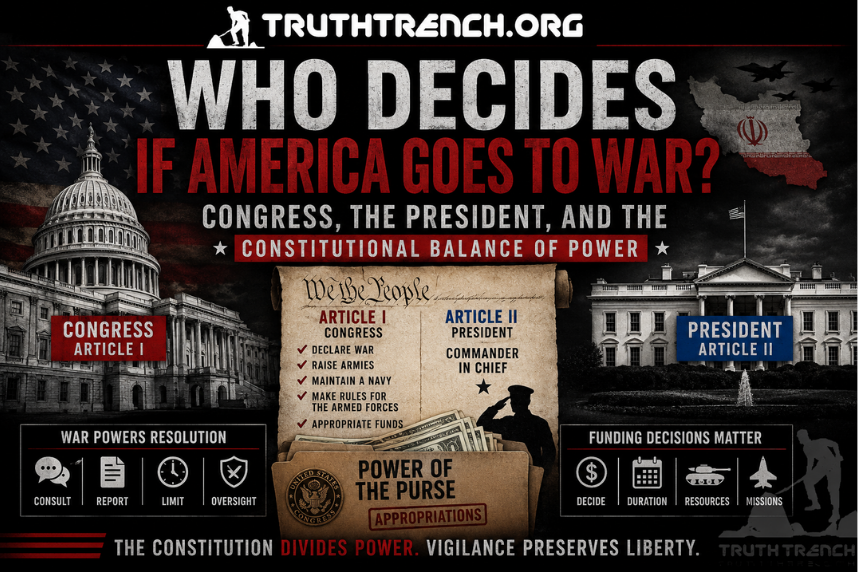
What Does the Constitution Say?
Article I, Section 8 of the Constitution grants Congress several military powers, including the authority to:
- Declare War
- Raise and support Armies
- Provide and maintain a Navy
- Make rules governing the armed forces
- Appropriate funding for military operations
Meanwhile, Article II names the President:
“Commander in Chief of the Army and Navy of the United States.”
The Constitution intentionally divides military authority between the legislative and executive branches, creating a system of checks and balances rather than concentrating war-making authority in a single office.
Congress Controls More Than Declarations of War
One common misconception is that Congress only influences military action by issuing a formal declaration of war.
In practice, Congress exercises significant authority through its constitutional control over appropriations.
Congress decides:
- Whether military operations receive funding.
- How much funding is available.
- Which programs are funded.
- How long appropriated funds remain available.
Without congressional appropriations, long-term military operations become difficult to sustain.
This constitutional “power of the purse” remains one of Congress’s most significant checks on executive military action.
The War Powers Resolution
Following the Vietnam War, Congress enacted the War Powers Resolution of 1973.
The law attempts to establish procedures governing presidential use of military force by requiring consultation with Congress, reporting after introducing U.S. forces into hostilities, and limiting the duration of military action absent congressional authorization.
Since its enactment, presidents of both political parties have questioned portions of the Resolution’s constitutionality while generally complying with many of its reporting requirements. The resulting constitutional debate has persisted for decades.
Iran and Today’s Debate
Military operations involving Iran have renewed congressional debate over both constitutional authority and funding.
In recent months, lawmakers have introduced and debated measures seeking to:
- Authorize or restrict continued military operations.
- Invoke the War Powers Resolution.
- Approve or deny additional appropriations for military activities.
- Require greater congressional oversight.
Separately, Congress has considered substantial appropriations proposals to fund military operations related to Iran, illustrating how funding decisions can become central to the constitutional debate even when no formal declaration of war has been issued.
Why Funding Matters
Appropriations bills often receive less public attention than military operations themselves.
Yet funding legislation can determine:
- Whether operations continue.
- How long they continue.
- What resources are available.
- Whether additional missions may be supported.
As a practical matter, congressional appropriations represent one of the primary ways Congress exercises its constitutional role in national defense.
Historical Perspective
The United States has formally declared war only a handful of times in its history, with the last formal declaration occurring during World War II.
Since then, presidents have relied on a combination of:
- Congressional Authorizations for Use of Military Force (AUMFs),
- Existing statutory authorities,
- Commander-in-Chief authority,
- International obligations,
- Emergency powers,
to justify various military operations.
Congress has continued to debate whether this modern practice aligns with the Constitution’s allocation of war powers.
The Continuing Constitutional Question
Legal scholars, members of Congress, presidents, and federal courts have long disagreed about the precise limits of presidential military authority.
Some argue that modern threats require rapid executive action.
Others contend that sustained military operations should receive explicit congressional authorization to preserve the constitutional separation of powers.
These debates have accompanied nearly every major U.S. military engagement since the mid-twentieth century.
Continue the Research
Related Truth Trench articles:
- What Is FISA?
- Crossfire Hurricane
- The Steele Dossier
- From the Steele Dossier to the Mueller Report
- Election Integrity Research Series
Weigh In
The Constitution divides military authority between Congress and the President.
How should that balance operate during modern military conflicts involving rapidly developing international threats? We encourage readers to review the constitutional text, relevant statutes, and historical practice before forming their own conclusions.