One of the Most Powerful Authorities Granted to the President of the United States
The President of the United States has many important constitutional powers. The President serves as Commander in Chief of the military, signs or vetoes legislation, appoints federal judges, negotiates treaties, and leads the Executive Branch.
One of the least understood—but most powerful—of those authorities is the power to grant presidential pardons.
Every president has used this power. Some pardons have helped correct injustices. Others have sparked national controversy. Regardless of political party, understanding how the pardon power works is essential to understanding the American system of government.
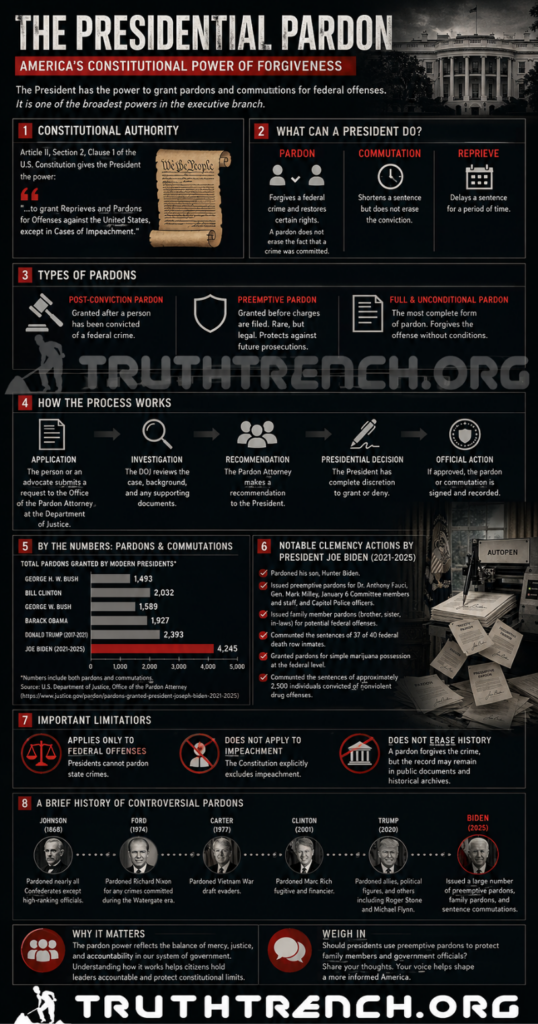
Where Does the Pardon Power Come From?
The presidential pardon power comes directly from the U.S. Constitution.
Article II, Section 2, Clause 1 states:
“The President… shall have Power to grant Reprieves and Pardons for Offenses against the United States, except in Cases of Impeachment.”
In simple terms, the Constitution gives the President the authority to forgive certain federal crimes.
Unlike many presidential powers, Congress does not have to approve a pardon before it takes effect.
What Is a Presidential Pardon?
A presidential pardon is an official act of executive clemency.
A pardon forgives the legal consequences of a federal crime, but it does not erase history or rewrite the facts.
Many people mistakenly believe a pardon means someone has been declared innocent.
That is not how pardons work.
A pardon generally:
- Forgives federal criminal liability.
- Restores certain civil rights that may have been lost after a conviction.
- Eliminates or reduces remaining legal penalties for the covered federal offense.
A pardon generally does not:
- Declare someone innocent.
- Erase the historical record.
- Remove news coverage.
- Prevent civil lawsuits.
- Apply to state crimes.
- Automatically restore security clearances or professional licenses.
What Crimes Can a President Pardon?
The Constitution limits presidential pardons to federal offenses.
That means a president cannot pardon someone convicted under state law.
For example:
A president could pardon someone convicted in federal court for a federal tax crime.
A president cannot pardon someone convicted of murder in a state court.
Only governors or other state authorities have that power.
What Is a Commutation?
People often confuse pardons with commutations.
They are different.
Pardon
Forgives a federal offense.
Commutation
Reduces or eliminates a criminal sentence but does not erase the conviction.
Someone whose prison sentence is commuted is still considered convicted unless they later receive a pardon.
What Is a Reprieve?
A reprieve temporarily delays punishment.
Historically, reprieves have most commonly delayed executions to allow additional legal review.
Unlike a pardon, a reprieve does not forgive the offense.
Can Someone Be Pardoned Before Being Charged?
Yes.
This is called a preemptive pardon.
The Constitution does not require someone to be convicted—or even charged—before receiving a presidential pardon.
The Supreme Court recognized this principle in Ex parte Garland (1866), holding that the pardon power may be exercised “at any time after [an offense’s] commission, either before legal proceedings are taken, or during their pendency, or after conviction and judgment.”
Because preemptive pardons are relatively uncommon, they often generate significant public debate.
Can Someone Refuse a Pardon?
Surprisingly, yes.
The Supreme Court held in Burdick v. United States (1915) that a pardon can be rejected.
A person may decide not to accept a pardon if they believe accepting it could carry legal or reputational consequences.
In practice, however, most pardons are accepted.
Does Accepting a Pardon Mean Someone Is Guilty?
Not necessarily.
One reason this question is debated is the Supreme Court’s 1915 decision in Burdick v. United States, which stated that a pardon “carries an imputation of guilt; acceptance a confession of it.”
That language has led many people to believe accepting a pardon is legally equivalent to admitting guilt.
In practice, modern presidents have issued pardons for many reasons—including mercy, correcting perceived injustices, promoting national reconciliation, or preventing future prosecutions. Recipients often accept pardons without making any admission of criminal conduct.
As a result, whether acceptance of a pardon should be viewed as an admission of guilt remains a subject of legal and historical debate.
How Does Someone Apply for a Pardon?
Most people seeking a pardon submit an application through the Office of the Pardon Attorney within the U.S. Department of Justice.
The general process includes:
- Application submitted.
- Background investigation.
- Review by the Office of the Pardon Attorney.
- Recommendation sent to the President.
- Final decision made by the President.
However, the President is not required to follow this process.
The Constitution allows the President to issue a pardon directly without waiting for a recommendation from the Department of Justice.
Are There Any Limits?
Yes.
Although the pardon power is broad, it is not unlimited.
The President cannot:
- Pardon state crimes.
- Prevent impeachment.
- Issue pardons for future crimes that have not yet been committed.
- Override civil lawsuits.
- Cancel congressional impeachment proceedings.
Congress also cannot force the President to issue or withdraw a pardon.
Some of the Most Famous Presidential Pardons
Throughout American history, several pardons have become defining moments in presidential history.
George Washington (1795)
Washington pardoned participants in the Whiskey Rebellion after they were convicted of treason-related offenses, hoping to restore national unity.
Andrew Johnson (1868)
Johnson granted broad pardons to many former Confederates following the Civil War as part of Reconstruction.
Gerald Ford (1974)
Ford issued a full pardon to former President Richard Nixon for offenses he “has committed or may have committed” during the Watergate scandal.
Supporters believed the pardon helped the nation move forward.
Critics argued it prevented accountability.
Jimmy Carter (1977)
Carter granted amnesty to many Vietnam War draft evaders, saying the country needed healing after years of division.
Bill Clinton (2001)
On his final day in office, Clinton issued numerous controversial pardons, including financier Marc Rich, whose ex-wife had made significant political donations to Democratic causes.
The decision generated bipartisan criticism.
Donald Trump (2020–2021)
President Trump granted clemency to several political allies, including Roger Stone, Michael Flynn, and Steve Bannon (before Bannon’s state prosecution). Supporters argued the recipients had been treated unfairly. Critics claimed the pardons rewarded political loyalty.
Joe Biden (2021–2025)
President Biden issued one of the largest sets of clemency actions in American history, including:
- Broad marijuana possession pardons.
- Commutations for thousands of nonviolent drug offenders.
- Commutations for 37 federal death-row inmates.
- A pardon for his son, Hunter Biden.
- Preemptive pardons for Dr. Anthony Fauci, General Mark Milley, members and staff of the House January 6 Committee, certain law enforcement officers who testified before the committee, and several members of his family.
These actions sparked debate over the use of preemptive pardons and the scope of presidential clemency.
Why Are Presidential Pardons So Controversial?
The pardon power exists because the justice system is not perfect.
Sometimes people are wrongly convicted.
Sometimes punishments are excessive.
Sometimes national healing requires mercy.
But pardons can also become controversial when they involve:
- Political allies.
- Family members.
- Government officials.
- Individuals connected to ongoing investigations.
- High-profile public figures.
Critics often argue that such pardons shield people from accountability.
Supporters argue they protect individuals from politically motivated prosecutions.
Because the Constitution gives presidents broad discretion, reasonable people often disagree about whether a particular pardon was appropriate.
Why This Matters
The presidential pardon power is one of the clearest examples of the Constitution balancing justice with mercy.
It gives one elected official extraordinary authority to forgive federal crimes, correct perceived injustices, and sometimes help the nation move beyond divisive events.
At the same time, every pardon raises important questions about accountability, fairness, and public trust.
Understanding how this power works helps Americans better evaluate the decisions made by every president—regardless of political party.
Key Takeaways
- The President’s pardon power comes directly from the Constitution.
- Pardons apply only to federal offenses.
- A pardon forgives legal consequences but does not erase history.
- A commutation reduces punishment without removing a conviction.
- Presidents may issue pardons before or after criminal charges.
- Congress cannot veto a presidential pardon.
- Every modern president has used the pardon power.
- Some of the most controversial pardons in history involved presidents, political allies, family members, and major national events.
Continue Learning
Interested in learning more? Explore these related Truth Trench articles:
- President Joe Biden’s Most Controversial Pardons: Who Was Pardoned and Why?
- Fauci Held in Contempt: Who Else Could Face Congressional Scrutiny Over the COVID-19 Response?
- Trump Reverses Biden Executive Orders: How One President Can Undo Another’s Executive Actions
- How Executive Orders Work
- The Powers of the President of the United States
Weigh In
Should the Constitution place additional limits on the President’s pardon power, or is the current system an important safeguard that allows presidents to correct injustices and extend mercy when appropriate?
Share your thoughts in the comments below. Truth Trench Think Tank welcomes civil discussion and uses public feedback to better understand how Americans view constitutional powers, government accountability, and executive authority.