The integrity of voter registration systems depends on one fundamental principle: only individuals who meet the legal qualifications established by federal and state law may register to vote. Among those qualifications, United States citizenship remains a requirement for voting in federal elections, with states responsible for administering voter registration and maintaining accurate voter rolls.
Public discussions surrounding noncitizens on state voter rolls have generated significant debate in recent years. Questions have centered on how voter registration systems verify citizenship, how registration errors occur, what safeguards exist to identify ineligible registrations, and how election officials investigate and resolve discrepancies when they are discovered.
As part of our Election Integrity Research Series, Truth Trench Think Tank encourages readers to examine publicly available government reports, official investigations, legislation, court decisions, and policy documents to better understand both the legal framework and the administrative processes surrounding this issue.
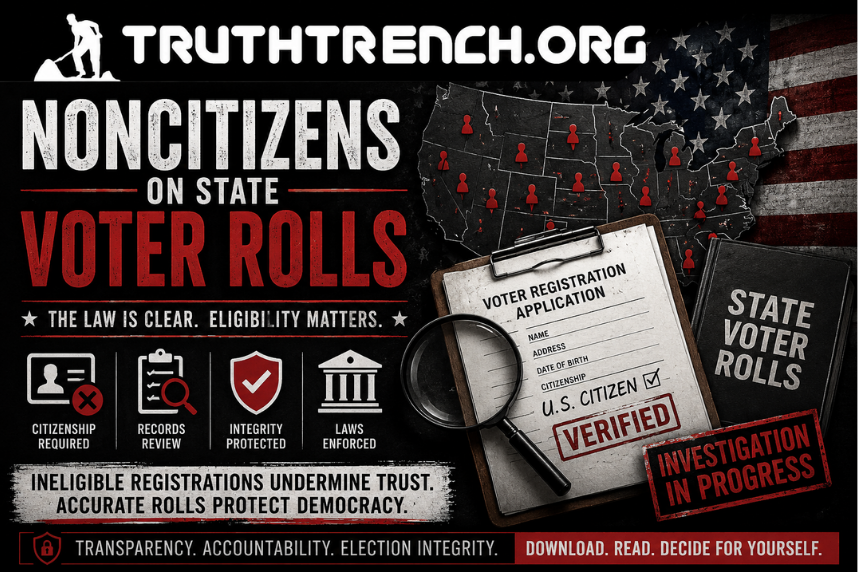
Citizenship and Voting Eligibility
Federal law generally limits voting in federal elections to United States citizens. States establish voter registration procedures within the framework of federal law while also administering their own state and local elections.
To register to vote, applicants are generally required to affirm under penalty of perjury that they meet all legal qualifications established by their state, including citizenship requirements where applicable.
Election officials rely upon documentation, database verification, self-attestation, and other legally authorized procedures to process voter registration applications.
Why This Issue Receives Public Attention
Voter registration databases contain millions of records that are continuously updated throughout the year. Because these systems process large volumes of information from multiple sources, questions occasionally arise regarding registration accuracy.
Public concern often focuses on several issues:
- Whether noncitizens have been improperly registered.
- How registration errors occur.
- Whether ineligible registrations result in ballots being cast.
- How election officials identify and correct inaccurate records.
- What safeguards exist to prevent future errors.
Investigations into these questions may be conducted by state election officials, attorneys general, inspectors general, law enforcement agencies, legislative committees, or the courts depending upon the circumstances.
Registration Errors and Administrative Challenges
Election administration involves maintaining complex databases that are constantly changing. Individuals relocate, become naturalized citizens, change their names, or update identification records throughout the year.
Administrative errors can occur for many reasons, including:
- Incomplete application information.
- Data entry mistakes.
- Delayed updates between government databases.
- Clerical errors.
- Changes in citizenship status after prior interactions with government agencies.
- Inconsistent records among agencies.
When discrepancies are identified, election officials generally follow procedures established under state and federal law to investigate, verify eligibility, and correct registration records where necessary.
Safeguards Used by Election Officials
States employ numerous safeguards designed to maintain accurate voter registration databases while protecting eligible voters’ rights.
These safeguards may include:
- Identity verification.
- Citizenship affirmations required during registration.
- Driver’s license and identification verification.
- Social Security verification where authorized.
- Interstate data-sharing agreements.
- Routine voter roll maintenance.
- Public challenge procedures authorized by state law.
- Criminal penalties for knowingly providing false information on voter registration applications.
The specific safeguards vary by state because election administration is primarily conducted at the state level.
Why Primary Source Documents Matter
Questions regarding noncitizens on voter rolls often become part of broader public debates surrounding election integrity. Headlines and political commentary frequently summarize complex investigations that may span hundreds or thousands of pages.
Reviewing original government documents allows readers to understand:
- What specific allegations were investigated.
- What evidence investigators examined.
- What legal standards were applied.
- What findings were ultimately reached.
- What recommendations, if any, were made.
Examining primary source material provides valuable context that may not be captured in abbreviated news coverage or public commentary.
Access the Original Documents
The official documents referenced in this research series are available through WhiteHouse.gov and other official government sources.
Because many of these files are exceptionally large, Truth Trench Think Tank does not host copies of every document. Readers are encouraged to obtain the official versions directly from their original source to ensure access to the complete materials and any future updates.
Election Integrity Research Series
Continue exploring the series:
Table of contents: Election Integrity Research Series: Truth Trench Think Tank
- Vulnerabilities in Electronic Voting & Ballot-Counting Systems
- China’s Acquisition and Exploitation of American Voter Data
- Michigan Voter-Registration Investigation
- Noncitizens on State Voter Rolls
Research Transparency
Truth Trench Think Tank is committed to publishing source-based research built upon publicly available government documents, court records, legislation, official reports, and other primary source materials. Our mission is to improve public understanding by providing factual context and encouraging readers to examine original sources before reaching their own conclusions.
The government documents referenced in this article remain the work of their original publishers. Truth Trench Think Tank references these materials solely for educational, research, and archival purposes in furtherance of its mission to advance civic understanding through transparent, source-based research.