Understanding executive orders, presidential authority, and why many executive actions can change from one administration to the next.
Why This Matters
One of the first actions many new presidents take after entering office is reviewing the executive orders issued by their predecessor.
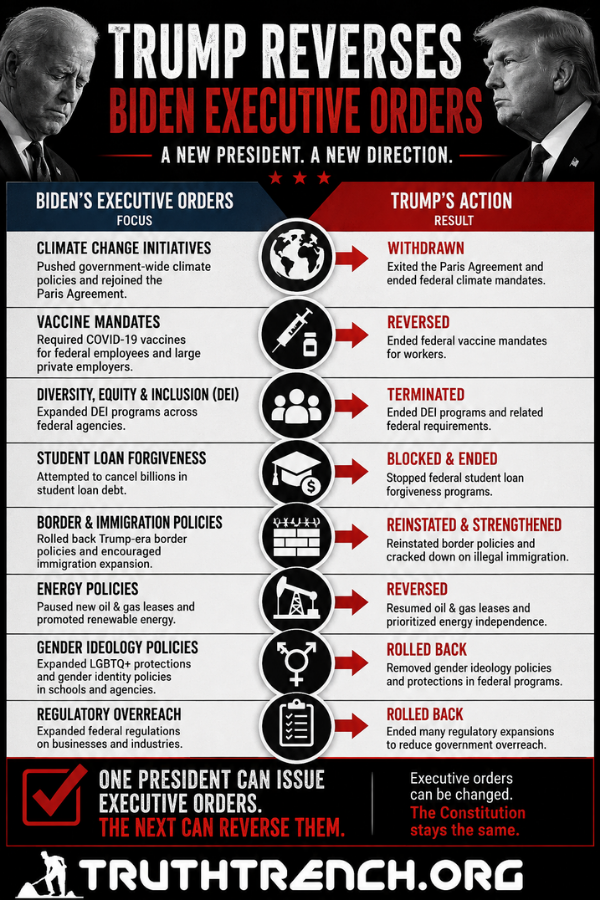
Following his return to office, President Donald Trump signed a series of executive orders rescinding dozens of executive actions issued during President Joe Biden’s administration, continuing a pattern seen during presidential transitions for decades. On his first day back in office, Trump rescinded 78 Biden-era executive orders and presidential memoranda, later issuing additional rescissions targeting other Biden actions.
The announcements generated headlines across the country.
But they also raised an important constitutional question:
Can one president simply erase another president’s executive orders?
In many cases, the answer is yes—but only because executive orders operate differently than laws passed by Congress.
What Is an Executive Order?
An executive order is a written directive issued by the President that instructs executive branch departments and agencies on how to carry out existing federal law.
Executive orders do not create the Constitution.
They do not amend statutes passed by Congress.
They do not override court decisions.
Instead, they direct how the Executive Branch will exercise authorities already granted by the Constitution or federal law.
That is why executive orders are often one of the first tools used by incoming presidents to change administrative priorities.
Why Can They Be Reversed?
Because executive orders are presidential directives—not acts of Congress—a future president generally has the authority to modify or revoke many of them.
This has happened repeatedly under administrations of both major political parties.
Examples include:
- President Biden revoked numerous Trump executive orders after taking office in 2021.
- President Trump rescinded dozens of Biden executive orders upon returning to office in 2025 and later revoked additional Biden-era directives.
This pattern reflects a broader constitutional principle:
Presidential administrations often change executive policy through executive orders, while permanent legal change generally requires legislation enacted by Congress.
What Did President Trump Reverse?
Since returning to office, President Trump has revoked executive actions across a number of policy areas.
Examples include:
- Certain artificial intelligence governance directives.
- Competition policy initiatives.
- Various labor and workforce policies.
- Environmental and energy-related directives.
- Diversity, equity, and inclusion initiatives within the federal government.
- Additional executive orders identified by the administration as inconsistent with its policy priorities.
Supporters argue these rescissions reduce regulation, restore executive priorities, and reverse policies they believe exceeded appropriate federal involvement.
Critics argue some reversals eliminate consumer protections, labor standards, or other initiatives they believe served important public interests.
What Cannot Be Changed With an Executive Order?
This is where executive authority reaches its limits.
A President generally cannot use an executive order to:
- Amend the Constitution.
- Repeal federal statutes enacted by Congress.
- Appropriate federal funding without congressional authorization.
- Ignore binding court orders.
- Exercise powers not granted by the Constitution or federal law.
When executive orders are challenged, federal courts may review whether they exceed presidential authority.
Executive Orders vs. Federal Law
One reason executive orders receive significant attention is that they can often take effect quickly.
However, they are generally less durable than legislation.
Executive Orders
- Issued by the President.
- Direct executive agencies.
- May often be modified or revoked by future presidents.
- Subject to judicial review.
Federal Laws
- Passed by Congress.
- Signed by the President (or enacted over a veto).
- Remain in force until amended or repealed through the legislative process or declared unconstitutional by the courts.
This distinction helps explain why major policy debates often shift between executive action and congressional legislation.
Historical Perspective
Presidents of both political parties have used executive orders extensively.
Franklin D. Roosevelt issued more than 3,700 executive orders during his presidency.
More recent presidents have generally issued far fewer, but executive orders remain an important tool for directing executive branch policy.
At the same time, changes in administration often bring changes in executive priorities, resulting in the modification or rescission of earlier executive actions.
Why This Matters
Executive orders allow presidents to act quickly within the scope of their constitutional and statutory authority.
At the same time, their reversibility demonstrates one of their limitations.
Policies established solely through executive action may be changed by a future administration, whereas legislation enacted by Congress generally provides greater long-term stability.
Understanding that distinction helps explain why many major national policy debates eventually return to Congress.
Continue the Research
Related Truth Trench articles:
- Who Decides If America Goes to War? Congress, the President, and the Constitutional Balance of Power
- Who Controls ICE? Government Funding, Congressional Oversight, and Immigration Enforcement
- Understanding the Foreign Intelligence Surveillance Court (FISC)
- The Steele Dossier to the Mueller Report: The Full Story
- Election Integrity Research Series
Weigh In
Executive orders have become an increasingly visible tool of presidential governance. Some view them as an efficient way for presidents to manage the Executive Branch, while others argue that lasting national policy should primarily be established through legislation enacted by Congress.
How do you think the balance should be struck between executive action and congressional lawmaking? We encourage readers to review the Constitution, relevant statutes, and historical examples before reaching their own conclusions.