On August 6, 2026, the Senate Homeland Security and Governmental Affairs Committee voted along party lines to hold Dr. Anthony Fauci in contempt of Congress after he repeatedly invoked the Fifth Amendment and declined to answer questions about the federal government’s handling of COVID-19.
The committee’s action does not convict Fauci of a crime. It sends the dispute into a complicated legal and constitutional process involving Congress, the Department of Justice, presidential pardon authority, and the Fifth Amendment’s protection against compelled self-incrimination.
The more important public-accountability question is larger than Fauci himself:
If Congress continues investigating the decisions, funding, communications, recordkeeping, and public representations surrounding the COVID-19 crisis, who else may be called to answer questions?
The answer could extend across several layers of the federal government, the National Institutes of Health, private research organizations, scientific advisers, grant recipients, and former White House officials.
What Happened at the Fauci Hearing?
Fauci appeared under subpoena before the Senate Homeland Security and Governmental Affairs Committee on July 29. During the hearing, he repeatedly invoked his Fifth Amendment rights rather than answer questions concerning the origins of COVID-19, federally supported research, NIH oversight, pandemic policies, and his previous statements to Congress.
Committee Chairman Rand Paul subsequently introduced a contempt resolution. On August 6, the committee approved it by an 8–7 party-line vote. Paul has indicated that he wants the matter referred to the Department of Justice for possible prosecution.
Fauci and his attorney argue that the investigation is politically motivated and that answering could expose him to prosecution outside the protection of his federal pardon, including possible state proceedings or charges based on conduct occurring after the pardon’s effective period.
The controversy therefore presents two competing positions.
Fauci’s critics argue that his broad federal pardon removes any reasonable fear of federal prosecution for the conduct covered by it, weakening his basis for invoking the Fifth Amendment.
Fauci’s defenders argue that a pardon does not necessarily eliminate every conceivable legal exposure, particularly where state law, later conduct, false statements made after the pardon, or disputes over the pardon’s validity could be involved.
Those questions may ultimately have to be resolved by a court.
Fauci’s Pardon and the Autopen Controversy
Before leaving office, President Joe Biden granted Fauci a broad pardon covering possible federal offenses committed between January 1, 2014, and January 19, 2025, arising from Fauci’s service at the National Institute of Allergy and Infectious Diseases, the White House Coronavirus Task Force, the White House COVID-19 Response Team, and his position as chief medical adviser. The Department of Justice continues to list that pardon as granted.
Republican lawmakers have challenged whether Biden personally authorized every pardon and executive action reportedly signed through an autopen. Senator Paul previously asked the Justice Department to investigate whether Fauci’s pardon reflected Biden’s direct decision or was executed by staff without sufficient presidential authorization.
That controversy relates to the broader question examined in our earlier report:
Trump Reverses Biden Executive Orders: How One President Can Undo Another’s Executive Actions
Executive orders and pardons, however, are legally different.
A president may generally revoke, replace, or supersede a predecessor’s executive orders. A completed presidential pardon is not ordinarily treated as an executive policy that the next president can simply cancel.
No controlling court decision has established that a pardon is invalid solely because an autopen placed the president’s signature on the document. The decisive constitutional question would likely be whether the president actually authorized the pardon—not whether the signature was physically written by hand.
Therefore, claims that Fauci’s pardon has already been “removed,” “revoked,” or declared invalid are premature. It remains officially listed by the Justice Department and would likely require litigation to determine whether evidence of unauthorized execution could invalidate it.
Contempt Does Not Automatically Mean Prosecution
Congress has several methods for pursuing contempt, but a committee vote alone does not send anyone to prison.
The matter could proceed through a full Senate vote, a criminal referral to the Justice Department, a civil lawsuit seeking an order compelling testimony, or an attempted use of Congress’s rarely invoked inherent-contempt authority.
The Justice Department is not automatically required to prosecute every contempt referral. It may review the legal sufficiency of the subpoena, the witness’s constitutional defenses, the scope of the pardon, and whether the referral followed required congressional procedures.
Fauci could therefore face a lengthy legal dispute before any criminal case begins.
Even so, the contempt vote substantially increases pressure for Congress to investigate the wider network of officials and organizations involved in pandemic-era decisions.
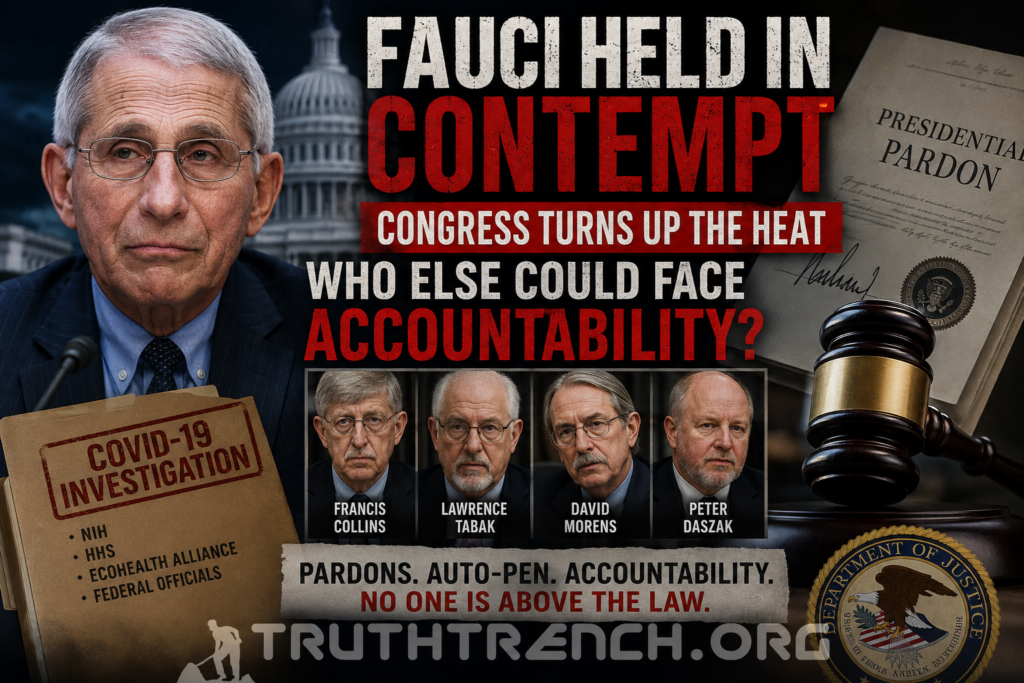
Who Else Could Be Called to Account?
Being called as a witness or becoming an investigative subject does not establish criminal wrongdoing. Congress may question individuals to determine what happened, who possessed decision-making authority, whether federal rules were followed, and whether legislation should be changed.
Based on the existing congressional record, the following people and organizations would be among the most likely to receive additional scrutiny.
1. Dr. Francis Collins
Dr. Francis Collins served as director of the National Institutes of Health from 2009 through 2021 and was therefore Fauci’s institutional superior during the earliest and most consequential period of the pandemic.
Congress could examine Collins’s involvement in:
- NIH funding and oversight decisions.
- Communications concerning the possibility of a laboratory origin.
- Internal discussions about the definition of gain-of-function research.
- Federal responses to scientists who questioned the dominant public account.
- Coordination among NIH, NIAID, HHS, the White House, and outside researchers.
- Decisions concerning the EcoHealth Alliance grant.
Previous congressional investigations have examined communications involving Collins, Fauci, and scientists who participated in discussions about the virus’s origin.
Collins would not necessarily face criminal exposure. His immediate risk is more likely to involve additional subpoenas, compelled testimony, document production, or referrals if Congress concludes that earlier testimony materially conflicted with documentary evidence.
2. Dr. Lawrence Tabak
Dr. Lawrence Tabak served in senior NIH leadership and later became acting NIH director.
During earlier congressional testimony, Tabak discussed NIH-funded research conducted through EcoHealth Alliance and the Wuhan Institute of Virology. House investigators characterized portions of his testimony as confirming serious weaknesses in federal grant oversight.
Congress could question Tabak about:
- What NIH understood about the experiments conducted in Wuhan.
- Whether grant recipients complied with reporting requirements.
- When NIH officials learned that certain experimental results exceeded expected thresholds.
- Whether the agency accurately described the research to Congress and the public.
- What corrective actions were taken once compliance concerns emerged.
As with Collins, scrutiny does not prove misconduct. Tabak’s role makes him a likely institutional witness because he can explain what NIH formally knew and how the agency interpreted its own grant rules.
3. Dr. David Morens
Dr. David Morens served as a senior adviser to Fauci.
House investigators previously alleged that Morens used personal email, deleted federal records, and communicated in ways intended to avoid Freedom of Information Act disclosure. The House Oversight Committee also examined whether he provided inside information to EcoHealth Alliance President Peter Daszak.
Morens may face some of the most direct exposure because the questions extend beyond disputed scientific judgments into federal records law and congressional obstruction.
Congress could investigate whether:
- Official communications were intentionally moved to private accounts.
- Federal records were deleted or improperly withheld.
- Outside grant recipients received privileged information.
- NIH officials coordinated responses to congressional or public-records requests.
- Other officials knew of or participated in record-avoidance practices.
If documentary evidence supports deliberate destruction or concealment of federal records, the matter could potentially produce referrals to the Justice Department or an inspector general.
4. Dr. Peter Daszak and EcoHealth Alliance
Peter Daszak served as president of EcoHealth Alliance, which received federal funding and worked with the Wuhan Institute of Virology.
House investigators previously recommended that Daszak be considered for criminal investigation and that EcoHealth Alliance face formal debarment based on alleged discrepancies, reporting failures, and inadequate oversight of taxpayer-funded research.
Future accountability proceedings could examine:
- Whether EcoHealth accurately described the proposed research.
- Whether the organization properly monitored its foreign subrecipient.
- Whether required reports were submitted on time.
- Whether experimental results triggered additional federal reporting obligations.
- Whether communications with NIH officials contradicted later testimony.
- Whether federal money was used outside approved grant conditions.
EcoHealth and Daszak have disputed allegations that they caused or concealed the COVID-19 pandemic. Any criminal case would still require prosecutors to establish specific statutory violations and criminal intent beyond a reasonable doubt.
5. Officials Responsible for NIH Grant Oversight
The investigation may move beyond prominent personalities and into the federal grant-management system.
Program officers, contracting officers, scientific-review personnel, compliance officials, and senior administrators could be asked:
- Who approved the grants and renewals?
- What warnings were received?
- Who reviewed progress reports?
- Were reporting deadlines enforced?
- Were risky experiments adequately described?
- Why were corrective actions delayed?
- Did political or institutional concerns affect enforcement?
This level of review is important because institutional failures rarely result from one person acting alone. Responsibility may be divided among officials who approved funding, reviewed results, interpreted rules, handled records, and communicated with Congress.
6. Department of Health and Human Services Officials
HHS officials could face questions about department-wide supervision of NIH, NIAID, the Centers for Disease Control and Prevention, the Food and Drug Administration, and the public-health emergency response.
Possible subjects include:
- How scientific uncertainty was communicated.
- Whether agencies coordinated public messaging.
- Whether dissenting scientific assessments were considered.
- How masking, distancing, vaccination, school, workplace, and travel policies were developed.
- What evidence supported changing federal recommendations.
- Whether officials overstated certainty when communicating with the public.
Bad policy, changing guidance, or scientific error does not automatically constitute criminal conduct. Accountability may instead involve administrative reform, inspector-general findings, employment consequences, or congressional legislation.
7. CDC Leadership and Guidance Officials
Former CDC leaders and guidance-development teams could be questioned about the evidentiary basis for major recommendations.
Congress may examine:
- School closure and reopening guidance.
- Mask recommendations.
- Isolation and quarantine periods.
- Data collection and reporting.
- Communications with teachers’ unions, businesses, technology companies, and advocacy organizations.
- The distinction between scientific recommendations and political decisions.
The central question would be whether outside organizations improperly shaped federal guidance or whether consultation was part of ordinary policymaking.
8. FDA Officials Involved in Emergency Authorizations
FDA officials responsible for vaccines, treatments, diagnostic tests, and emergency-use authorizations may also face renewed scrutiny.
Possible questions include:
- What data supported each authorization?
- How were adverse events monitored?
- What did regulators know about transmission, infection, hospitalization, and mortality at different stages?
- Were uncertainties communicated clearly?
- Did political pressure affect regulatory timing?
- Were competing treatments evaluated consistently?
Regulatory decisions made during an emergency are judged on the evidence available at the time—not solely through hindsight. Accountability would require distinguishing reasonable emergency judgment from negligence, concealment, regulatory favoritism, or misrepresentation.
9. White House COVID-19 Response Officials
Former White House officials may be questioned about the line between scientific advice and presidential policy.
Congress could examine:
- Who approved major public-health messaging.
- Whether officials pressured agencies to modify recommendations.
- How vaccine and mandate policies were developed.
- Whether the White House coordinated with social-media companies regarding disputed COVID-19 claims.
- Whether political concerns influenced public statements about the virus’s origin, treatments, or vaccine performance.
Responsibility would likely span both the Trump and Biden administrations because the federal response crossed administrations and changed over time.
10. Federal Records and Freedom of Information Officials
The alleged use of private accounts, deleted communications, messaging applications, and informal channels may create a separate accountability track.
Records officers, agency counsel, FOIA personnel, information-technology administrators, and supervisors could be asked whether:
- Federal records were properly preserved.
- Searches for responsive documents were complete.
- Officials were warned against private-account use.
- Deleted communications were recoverable.
- Congress or the public received incomplete productions.
- Litigation holds were obeyed.
This may ultimately become more legally consequential than disputes over scientific interpretation because records obligations are governed by established procedures.
Could Fauci’s Pardon Protect Other People?
No.
A presidential pardon is personal to the individual or group identified. Fauci’s pardon does not protect Collins, Tabak, Morens, Daszak, EcoHealth Alliance, NIH employees, HHS officials, CDC personnel, FDA officials, or White House advisers.
Each person’s exposure would depend on:
- What conduct allegedly occurred.
- Whether it violated federal or state law.
- When it occurred.
- The applicable statute of limitations.
- Whether the person received separate clemency.
- Whether the evidence proves knowledge and intent.
- Whether testimony or records contradict prior sworn statements.
A witness may also invoke the Fifth Amendment independently, even where Fauci’s pardon has no bearing on that person.
What Types of Accountability Are Realistically Possible?
Public discussion often treats “accountability” as synonymous with prison. Federal accountability actually has several possible forms.
Congressional accountability
Congress may issue subpoenas, compel testimony, demand documents, hold hearings, vote on contempt, publish investigative reports, and refer suspected violations to prosecutors.
Criminal accountability
The Justice Department or state prosecutors could investigate specific allegations such as false statements, perjury, obstruction, destruction of federal records, grant fraud, conspiracy, or other offenses.
A criminal charge would require admissible evidence supporting each statutory element. Political disagreement, scientific error, or unpopular policy would not be enough.
Civil accountability
Grant recipients or contractors could face lawsuits, repayment demands, False Claims Act proceedings, or other financial remedies.
Administrative accountability
Agencies may suspend or debar organizations, terminate grants, discipline employees, revise procedures, or refer matters to inspectors general and professional-licensing bodies.
Political and institutional accountability
Congress may rewrite grant rules, laboratory-safety standards, emergency powers, records requirements, agency oversight procedures, and protections for scientific dissent.
This may ultimately have the greatest lasting effect, regardless of whether any individual is convicted.
The Constitutional Problem Congress Must Address
The Fauci dispute creates a difficult constitutional question.
Congress possesses broad authority to investigate the federal government and inform legislation. Witnesses, however, retain constitutional rights—including the Fifth Amendment.
A pardon can reduce a witness’s risk of prosecution, but it may not eliminate:
- State criminal exposure.
- Federal exposure outside the pardon’s timeframe or subject matter.
- Liability for false statements made after the pardon.
- Contempt or obstruction based on later conduct.
- Exposure created if the pardon itself is successfully challenged.
Congress cannot eliminate the Fifth Amendment merely by asserting that a witness has nothing to fear. At the same time, a witness cannot use the Fifth Amendment as a universal refusal to answer every question regardless of whether a truthful response could reasonably create criminal exposure.
That conflict may require judicial review.
Accountability Must Follow Evidence, Not Political Preference
The American people deserve a complete factual record concerning the federal response to COVID-19.
That record should include:
- What federal officials knew.
- When they knew it.
- What research taxpayers funded.
- Whether grant rules were followed.
- Whether records were preserved.
- Whether Congress received accurate testimony.
- Whether public claims matched internal communications.
- Whether emergency powers were supported by evidence.
- What reforms are necessary before the next national emergency.
Fauci may be the most recognizable person associated with the federal pandemic response, but the government’s actions involved thousands of officials, contractors, advisers, institutions, and recipients of federal money.
Any serious investigation must therefore extend beyond one person.
Francis Collins, Lawrence Tabak, David Morens, Peter Daszak, EcoHealth Alliance, NIH grant officials, HHS leadership, CDC and FDA decision-makers, White House response officials, and federal records personnel could all become important witnesses or investigative subjects.
That does not mean they are guilty of crimes.
It means the public cannot understand what happened by treating the COVID-19 response as the work of one man.
The Bottom Line
The Senate committee’s contempt vote against Anthony Fauci is the beginning of another legal and political confrontation—not the end of the investigation.
Fauci’s pardon remains officially recognized, and no court has invalidated it because of an autopen. The contempt resolution is not a conviction. His invocation of the Fifth Amendment is not proof of guilt.
Nevertheless, Congress now appears determined to test the boundaries of that pardon, Fauci’s constitutional protections, and the government’s account of its pandemic-era decisions.
If lawmakers follow the documentary record rather than predetermined political conclusions, the next stage will likely include officials throughout NIH, HHS, CDC, FDA, the White House, EcoHealth Alliance, and the federal grant and records systems.
The public interest is not served by declaring everyone guilty in advance.
It is served by recovering the records, identifying the decision-makers, compelling lawful testimony, distinguishing policy failure from criminal conduct, and ensuring that no federal official or private recipient of taxpayer money is placed beyond legitimate oversight.
Weigh In
Do you believe Congress should expand its investigation beyond Dr. Fauci to include NIH leadership, EcoHealth Alliance, federal grant officials, public-health agencies, and former White House decision-makers?
Share your thoughts, concerns, and questions below. Truth Trench Think Tank gathers public sentiment to better understand how Americans view federal accountability, institutional trust, and the use of emergency government authority.