TAs elections become increasingly digital, the information surrounding them has become as valuable as the votes themselves. Voter registration databases contain millions of records that, while often public in varying degrees under state law, can become far more powerful when aggregated, analyzed, and combined with commercial, social media, and other publicly available information.
For intelligence services operating on behalf of foreign governments, this data represents far more than a voter list. It provides insight into American demographics, political geography, communication networks, and population trends that can be useful for intelligence collection, cyber operations, and influence campaigns.
Recognizing these concerns, the White House released documents examining China’s acquisition and exploitation of American voter data. Those documents remain publicly available through WhiteHouse.gov and are included as part of the public record for researchers, journalists, policymakers, and citizens interested in election security.
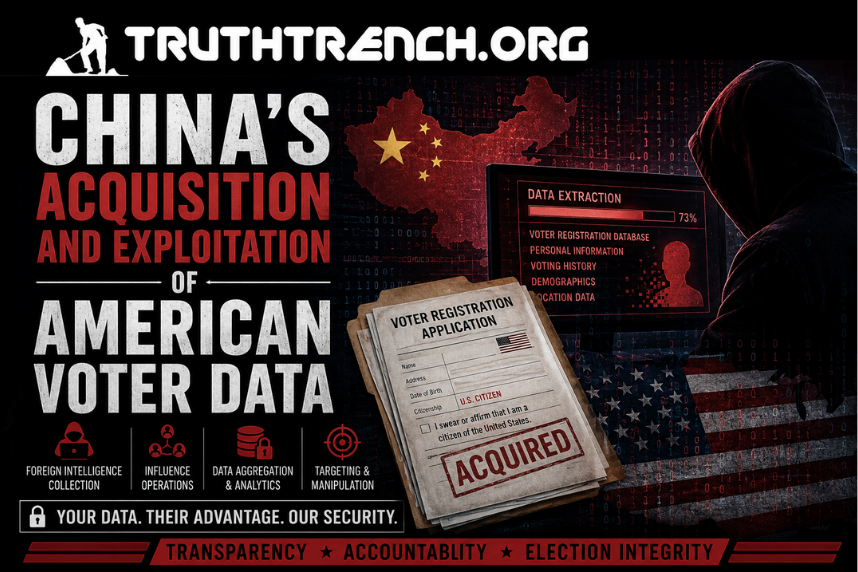
Why Voter Data Matters
Every state maintains voter registration databases to administer elections. While the exact information varies by jurisdiction, these records commonly include a voter’s name, address, voting precinct, registration status, voting history, and other administrative information permitted under state law.
Individually, much of this information may appear routine. Collectively, however, large datasets allow analysts to identify geographic concentrations of voters, migration patterns, demographic trends, and political behavior at a scale impossible through individual records alone.
Modern data analytics make it possible to merge voter registration information with commercially available datasets, social media activity, consumer information, and publicly accessible government records. This creates increasingly detailed profiles that may have value to advertisers, political organizations, researchers, and potentially foreign intelligence services.
Why China Has Drawn Attention
The People’s Republic of China has invested heavily in cyber capabilities, artificial intelligence, data analytics, and open-source intelligence collection over the past two decades. Numerous public reports issued by U.S. government agencies have documented Chinese cyber activities targeting government networks, private industry, universities, and critical infrastructure.
Election-related information represents another category of data that may provide strategic value. While voter registration information alone does not alter election outcomes, large-scale acquisition of American voter data could potentially support broader intelligence objectives by improving an adversary’s understanding of American society and political dynamics.
For that reason, election security discussions increasingly consider not only the protection of voting systems themselves but also the security and stewardship of the data surrounding the electoral process.
Election Security Is More Than Voting Machines
Public discussions about election security often focus on ballot scanners or voting machines, but election infrastructure extends much further.
It includes:
- State voter registration databases
- Electronic poll books
- Election management systems
- County election networks
- Ballot design software
- Election reporting systems
- Vendor infrastructure
- Administrative communications
- Public election data
Protecting these systems requires coordinated efforts among federal agencies, state governments, local election officials, cybersecurity professionals, and private-sector technology providers.
Transparency Through Original Documents
Rather than relying solely on summaries or commentary, Truth Trench Think Tank encourages readers to review the original government materials whenever possible.
The White House documents regarding China’s acquisition and exploitation of American voter data provide insight into the concerns that prompted federal attention to this issue and contribute to the broader discussion surrounding election security and foreign influence.
Readers are encouraged to examine these materials alongside publicly available reports from other government agencies, congressional committees, inspectors general, and independent researchers to develop a comprehensive understanding of the subject.
Access the Original Documents
The complete files are available directly from WhiteHouse.gov.
Because of their size, Truth Trench Think Tank does not host copies of these documents. Instead, we encourage readers to obtain the official versions from their original source whenever possible to ensure access to the complete materials and any future updates.
Election Integrity Research Series
Continue exploring the series:
Table of contents: Election Integrity Research Series: Truth Trench Think Tank
- Vulnerabilities in Electronic Voting & Ballot-Counting Systems
- China’s Acquisition and Exploitation of American Voter Data
- Michigan Voter-Registration Investigation
- Noncitizens on State Voter Rolls
Research Transparency
Truth Trench Think Tank is committed to publishing source-based research built upon publicly available government documents, legislation, court records, official reports, and other primary source materials. Our goal is to improve public understanding by providing factual context and encouraging readers to examine original sources whenever possible.
The White House documents referenced in this article remain the work of their original publisher. Truth Trench Think Tank neither modifies nor endorses those materials but references them for educational, research, and archival purposes as part of its mission to advance civic understanding through transparent, source-based research.