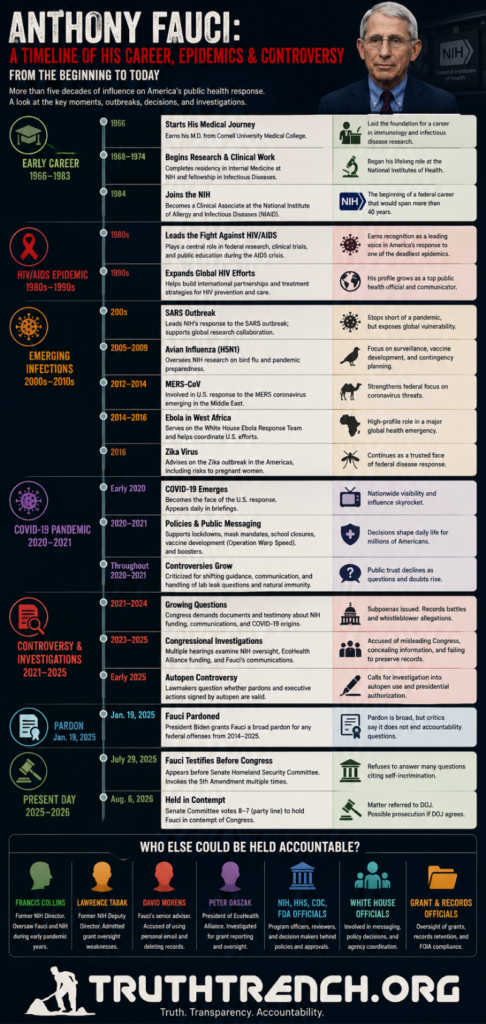
For more than four decades, Dr. Anthony Fauci stood at the center of America’s response to some of the world’s most significant infectious disease outbreaks. Serving as Director of the National Institute of Allergy and Infectious Diseases (NIAID) from 1984 until 2022, Fauci advised seven U.S. presidents, helped shape federal public health policy, and became one of the most recognizable government officials in American history. His career earned praise for advancing medical research and responding to global health emergencies, while also drawing intense criticism over government transparency, scientific decision-making, and the federal response to COVID-19.
Today, Fauci’s legacy remains the subject of congressional investigations, legal disputes, and public debate. Understanding that controversy requires looking at the entirety of his career rather than focusing solely on the COVID-19 pandemic.
Building a Career in Infectious Disease
Anthony Fauci earned his medical degree from Cornell University Medical College in 1966 before completing his residency in internal medicine at New York Hospital-Cornell Medical Center. He joined the National Institutes of Health (NIH) in 1968, where he specialized in infectious diseases and immunology.
In 1984, Fauci was appointed Director of the National Institute of Allergy and Infectious Diseases (NIAID), a position he would hold for nearly four decades. During that time, he oversaw billions of dollars in biomedical research involving infectious diseases, vaccine development, immunology, and global health.
Leading the Fight Against HIV/AIDS
Fauci first rose to national prominence during the HIV/AIDS epidemic of the 1980s and 1990s.
At a time when HIV was poorly understood and highly politicized, NIAID became a central force in researching treatments, supporting clinical trials, and coordinating federal scientific efforts. Fauci worked closely with researchers, pharmaceutical companies, and patient advocacy groups as antiretroviral therapies dramatically improved survival rates for people living with HIV.
Many public health experts credit his leadership with accelerating research that transformed HIV from a nearly certain death sentence into a manageable chronic disease for many patients.
Responding to Emerging Global Diseases
Throughout the following decades, Fauci remained one of the federal government’s leading infectious disease experts.
His institute played major roles in responding to:
- SARS (2003)
- Avian Influenza (H5N1)
- Pandemic Influenza preparedness
- MERS Coronavirus
- Ebola in West Africa
- Zika Virus
During each outbreak, Fauci advised successive presidential administrations on surveillance, vaccine research, antiviral development, emergency preparedness, and international cooperation.
By the late 2010s, he had become one of the government’s most trusted scientific voices during public health emergencies.
COVID-19 Places Fauci at the Center of the Nation
Everything changed in early 2020.
As COVID-19 spread across the globe, Fauci became the public face of the federal government’s scientific response. He appeared regularly alongside President Donald Trump during White House Coronavirus Task Force briefings, explaining evolving scientific understanding while recommending measures intended to slow the virus’s spread.
Americans became familiar with concepts such as:
- “Flatten the curve”
- Social distancing
- Mask guidance
- Vaccine development
- Lockdowns
- Booster doses
- Variants
- Herd immunity
Operation Warp Speed helped accelerate vaccine development at unprecedented speed, while Fauci continued serving as one of the administration’s principal medical advisers.
Growing Criticism
As the pandemic continued, Fauci also became one of the most polarizing public officials in the United States.
Critics questioned:
- Federal mask guidance that changed over time.
- School closure recommendations.
- Vaccine mandates.
- Gain-of-function research oversight.
- NIH grants involving EcoHealth Alliance and the Wuhan Institute of Virology.
- Government transparency regarding the origins of COVID-19.
- Internal government communications obtained through the Freedom of Information Act.
- Statements Fauci made before Congress regarding NIH-funded research.
Supporters argued that scientific guidance evolved because new evidence became available and that changing recommendations reflected the normal process of responding to an unprecedented public health emergency rather than intentional deception.
Congressional Investigations
Following the pandemic, several congressional committees launched investigations into the federal response.
Lawmakers examined:
- NIH grant oversight.
- EcoHealth Alliance funding.
- Federal record preservation.
- Public communications.
- Laboratory-origin questions.
- Pandemic decision-making.
- Compliance with federal transparency laws.
These investigations also examined testimony from current and former NIH officials, grant recipients, and advisers connected to Fauci’s agency.
Retirement and Renewed Scrutiny
Fauci retired from federal service in December 2022 after more than fifty years at the NIH.
Before leaving office, President Joe Biden granted Fauci a broad federal pardon covering potential federal offenses arising from his official service during a specified period. The pardon itself has become controversial, with some lawmakers questioning whether it was personally authorized by President Biden following reports that an autopen was used for numerous executive documents.
No court has ruled that Fauci’s pardon is invalid, and the Department of Justice continues to recognize it.
Returning Before Congress
In 2026, Fauci again appeared before Congress under subpoena as lawmakers continued examining the government’s handling of COVID-19.
During questioning, Fauci repeatedly invoked his Fifth Amendment right against self-incrimination rather than answer numerous questions concerning his actions, communications, and decisions during the pandemic.
Following that testimony, the Senate Homeland Security and Governmental Affairs Committee voted to hold Fauci in contempt of Congress and announced plans to refer the matter to the Department of Justice for review. The contempt vote does not itself establish criminal liability, and any further legal action would depend on subsequent congressional procedures, prosecutorial decisions, and potential judicial review.
A Legacy Still Being Written
Few federal officials have had as much influence over American public health policy as Anthony Fauci.
Supporters view him as a physician-scientist who dedicated decades to combating infectious diseases and helping save millions of lives through research and medical innovation.
Critics argue that his role during COVID-19 exposed serious weaknesses in federal transparency, grant oversight, scientific accountability, and the relationship between government experts and the American public.
As Congress continues its investigations, Fauci’s legacy is likely to remain the subject of historical, legal, scientific, and political debate for years to come.
Weigh In
How should history remember Dr. Anthony Fauci? Was he primarily a public servant who guided the nation through multiple health crises, a government official whose decisions deserve greater accountability, or some combination of both?
Share your thoughts below. Truth Trench Think Tank welcomes civil discussion as we continue researching the historical record surrounding America’s response to modern public health emergencies.