Examining how Congress funds Immigration and Customs Enforcement, the Executive Branch administers immigration law, and the constitutional checks that shape federal enforcement policy.
Few federal agencies receive as much public attention as U.S. Immigration and Customs Enforcement (ICE). Questions surrounding immigration enforcement, detention capacity, deportations, border security, and congressional appropriations frequently dominate national debate.
Yet one important constitutional question often receives less attention:
Who actually controls ICE?
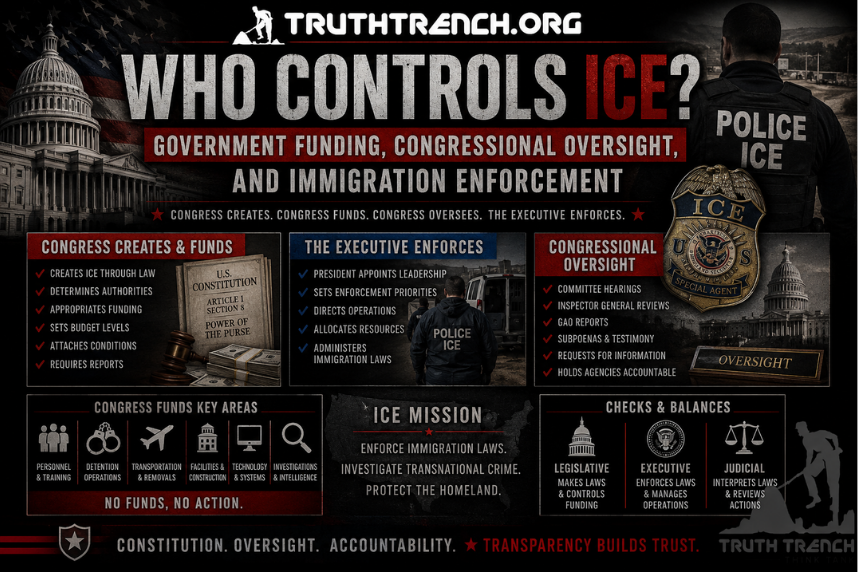
Many Americans assume that either Congress or the President alone determines immigration enforcement policy. In reality, ICE operates within a constitutional framework in which Congress creates the agency, appropriates its funding, conducts oversight, and writes immigration law, while the Executive Branch administers and enforces those laws.
Understanding that division of authority provides important context for current debates surrounding immigration enforcement and federal spending.
What Is ICE?
ICE was created in 2003 following the Homeland Security Act of 2002, which reorganized portions of the federal government after the September 11 terrorist attacks.
The agency became part of the newly established Department of Homeland Security (DHS).
ICE has two principal operational components:
- Enforcement and Removal Operations (ERO) – responsible for identifying, detaining, and removing individuals who are subject to immigration enforcement under federal law.
- Homeland Security Investigations (HSI) – responsible for investigating transnational crime, human trafficking, narcotics smuggling, financial crimes, child exploitation, intellectual property theft, export violations, and other federal offenses.
Although public discussion often focuses on immigration enforcement, HSI investigates a broad range of criminal activity extending well beyond immigration matters.
Congress Created ICE
ICE does not exist because of an executive order.
Congress created the Department of Homeland Security through legislation and authorized the functions that became ICE.
Congress also continues to determine:
- Agency authorities
- Organizational structure
- Statutory responsibilities
- Budget authority
- Oversight requirements
If Congress amended federal law, ICE’s authorities could likewise change.
Congress Controls the Funding
Congress exercises one of its greatest constitutional powers through appropriations.
Every fiscal year, lawmakers determine:
- Personnel funding
- Detention funding
- Technology investments
- Facility construction
- Transportation funding
- Border security resources
- Investigative operations
Congress may:
- Increase funding
- Reduce funding
- Redirect funding
- Attach conditions
- Require reports
- Restrict spending for certain purposes
This constitutional “power of the purse” gives Congress significant influence over how ICE operates.
The President Directs Enforcement
While Congress establishes funding and legal authorities, the Executive Branch determines how those resources are deployed.
The President appoints:
- Secretary of Homeland Security
- ICE Director (or Acting Director)
- Senior departmental leadership
Executive officials establish operational priorities consistent with federal law.
Examples include:
- Criminal priority removals
- Human trafficking investigations
- Employer enforcement
- Fugitive operations
- Border-related enforcement
- National security investigations
Different administrations often emphasize different enforcement priorities while operating under many of the same statutory authorities.
Congressional Oversight
Congress does more than appropriate money.
It also oversees executive agencies through:
- Committee hearings
- Inspector General reports
- Government Accountability Office reviews
- Budget justifications
- Subpoenas
- Testimony from agency officials
- Requests for information
Oversight allows Congress to evaluate whether agencies are implementing federal law as intended.
Can Congress Defund ICE?
Congress possesses authority over federal appropriations.
As a result, lawmakers may propose legislation to:
- Increase ICE funding
- Reduce funding
- Eliminate certain programs
- Expand detention capacity
- Restrict detention capacity
- Increase investigative resources
- Limit spending for specified purposes
Whether such proposals become law depends upon the ordinary legislative process, including passage by Congress and presidential approval or other constitutional procedures.
What Happens During Continuing Resolutions?
If Congress has not enacted regular appropriations before the fiscal year begins, it often passes a Continuing Resolution (CR).
A CR generally continues agency funding at existing levels for a limited period while lawmakers negotiate appropriations legislation.
ICE, like many federal agencies, has frequently operated under continuing resolutions.
The Role of the Courts
Federal courts also play an important role.
Judges review questions involving:
- Statutory interpretation
- Constitutional claims
- Administrative procedures
- Individual due process rights
- Agency authority
Court decisions may affect how immigration laws are interpreted and enforced.
Checks and Balances
ICE illustrates the constitutional separation of powers.
Congress:
- Writes immigration law.
- Creates agencies.
- Controls appropriations.
- Conducts oversight.
The Executive Branch:
- Administers the laws.
- Sets enforcement priorities.
- Directs agency operations.
The Judiciary:
- Interprets statutes.
- Resolves constitutional disputes.
- Reviews agency actions when challenged.
No single branch possesses complete control over immigration enforcement.
Why This Matters
Current debates surrounding immigration often focus on policy outcomes.
Equally important is understanding how those outcomes are produced.
Funding decisions, statutory authorities, executive discretion, judicial review, and congressional oversight all shape how federal immigration law is implemented.
Regardless of one’s policy views, understanding these constitutional relationships helps explain why immigration enforcement can change from one administration to the next while many underlying laws remain the same.
Continue the Research
Related Truth Trench Think Tank articles:
- Election Integrity Research Series
- Who Decides If America Goes to War?
- From the Steele Dossier to the Mueller Report
- Two Flags, One Vote? The Debate Over Foreign-Born Citizens, Dual Citizenship, and Public Office
Weigh In
Congress creates agencies, appropriates funding, and conducts oversight. The Executive Branch administers federal law. The Judiciary reviews legal disputes.
How should these constitutional responsibilities be balanced when it comes to immigration enforcement? We encourage readers to review the relevant statutes, appropriations, oversight hearings, and court decisions before forming their own conclusions.