The United States has long been a nation of immigrants. From the Founding Fathers to modern America, millions of foreign-born individuals have become citizens and contributed to every aspect of national life. Yet questions continue to arise concerning citizenship, loyalty, and political participation.
Should foreign-born citizens have the same voting rights as native-born citizens?
Should naturalized citizens be eligible to hold public office?
Should dual citizens—those who voluntarily maintain allegiance to another nation—have the right to vote or hold elected office?
These questions have been debated throughout American history and remain subjects of ongoing public discussion.
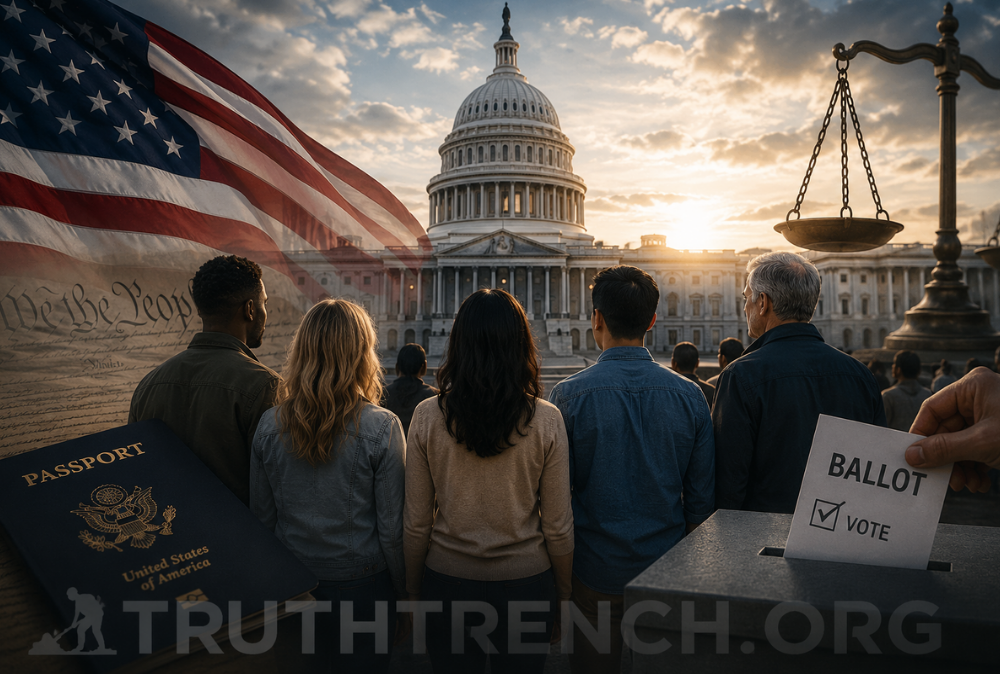
Understanding the Issue
Under current law, American citizens—whether born in the United States or naturalized—generally possess the same voting rights. Citizenship, not place of birth, determines eligibility to vote in federal elections. Noncitizens are prohibited from voting in federal elections. (USAGov)
Dual citizenship is also legal under current U.S. policy. A person may simultaneously hold citizenship in the United States and another nation. The State Department recognizes that dual nationals owe obligations to both countries and are subject to the laws of both. (Travel.state.gov)
The Constitution places relatively few restrictions on holding office. Members of the House and Senate may be naturalized citizens provided they meet age and citizenship duration requirements. However, the President and Vice President must be “natural born citizens.” (U.S. Senate)
Historical Background
The Fourteenth Amendment states:
“All persons born or naturalized in the United States… are citizens of the United States.”
This constitutional provision established that naturalized citizens possess the rights and protections afforded to citizens generally. (Congress.gov)
The Supreme Court has also held that citizenship cannot be involuntarily revoked absent voluntary relinquishment. In Afroyim v. Rusk (1967), the Court reinforced protections associated with citizenship under the Fourteenth Amendment. (Justia Law)
Arguments Supporting Equal Political Rights
Supporters of the current framework argue that naturalized Americans are Americans in every meaningful sense and that citizenship carries equal rights and responsibilities regardless of birthplace.
They note that:
- Millions of Americans are foreign-born.
- Naturalized citizens swear allegiance to the United States.
- Equal treatment under the law strengthens national unity.
- Immigrants have served honorably in the military, business, and public life.
- Restricting voting rights based on birthplace could create multiple classes of citizenship.
Supporters of dual citizenship also argue that maintaining family ties or legal relationships with another country does not necessarily diminish loyalty to the United States.
Arguments Raised by Critics
Others argue that voting and public office involve questions of allegiance and national sovereignty.
Some critics believe:
- Citizenship should imply exclusive allegiance.
- Dual citizens may face conflicting obligations.
- Holding citizenship in another country creates divided loyalties.
- High offices involving national security warrant stricter standards.
- Voluntarily retaining foreign citizenship may raise concerns regarding foreign influence.
Some advocates have proposed requiring Americans to choose one nationality or limiting certain offices to sole U.S. citizens. Such proposals have periodically surfaced but are not currently law. (Greenback Expat Tax Services)
Potential Benefits
Supporters of equal political rights argue that inclusiveness encourages civic participation and strengthens social cohesion. They note that naturalized citizens contribute economically, culturally, and militarily to the nation.
Critics counter that stronger allegiance requirements could enhance public confidence and reduce concerns regarding foreign influence.
Both perspectives are ultimately concerned with preserving the integrity of American self-government.
Broader Implications
The debate touches larger questions:
- What does citizenship mean?
- Is allegiance exclusive or can it be shared?
- Should rights and responsibilities be identical for all citizens?
- How should America balance openness with national sovereignty?
These questions affect voting rights, national identity, immigration policy, and the qualifications for public service.
Legal Considerations and Resources
Constitutional Framework
Fourteenth Amendment
The Constitution recognizes persons born or naturalized in the United States as citizens. (Congress.gov)
Voting
Federal law limits voting in federal elections to U.S. citizens. Noncitizen voting in federal elections is illegal. (Brennan Center for Justice)
Public Office
Article I establishes qualifications for Members of Congress. Foreign-born citizens may serve in Congress after satisfying citizenship requirements. Presidents and Vice Presidents must be natural-born citizens. (U.S. Senate)
Dual Citizenship
Current U.S. policy recognizes dual nationality and does not require citizens to choose one allegiance. (Travel.state.gov)
Resources
Readers interested in learning more may consult:
- National Archives Constitution Center
- U.S. State Department
- USA.gov Voting Information
- Congressional Constitution Annotated
- Federal Election Commission
- State election offices
- State constitutions and election laws
Truth Trench encourages readers to exercise independent judgment and verify information from multiple sources.
Questions Worth Considering
- Does citizenship imply exclusive allegiance?
- Should naturalized citizens possess identical political rights?
- Should dual citizens face additional restrictions for certain offices?
- Are current constitutional standards sufficient?
- How should America balance national sovereignty with equal citizenship?
Conclusion
For nearly 250 years, America has wrestled with questions of citizenship, loyalty, and self-government. The Constitution currently places foreign-born citizens and naturalized citizens within the political community while reserving only the presidency and vice presidency to natural-born citizens.
Whether dual citizenship should affect voting rights or eligibility for office remains an ongoing debate. Reasonable people continue to disagree.
About Think Tanks and the Role of Truth Trench
Think tanks exist to study complex issues, evaluate competing viewpoints, and transform information into practical recommendations. Truth Trench Think Tank is a research institute for societal benefit operating under Section 501(c)(3) of the Internal Revenue Code. Pursuant to 26 U.S.C. §501(c)(3), organizations recognized under this section may not participate or intervene in political campaigns and are limited in lobbying activities. Truth Trench Think Tank does not engage in partisan political activity or propaganda and conducts its work through independent, evidence-based research, education, and public dialogue.
Public comments and experiences help inform independent reports that contribute to broader policy discussions at the federal level. Through the Truth Trench Accelerator, entrepreneurs and innovators can develop practical solutions to challenges identified through research and public input.
Research → Awareness → Public Input → Reports → Policy Discussions → Innovation → Real-World Solutions
Truth Trench Think Tank believes informed citizens, effective institutions, and innovative entrepreneurs working together can create meaningful and lasting improvements in society.
Weigh In On The Subject
Your opinion matters.
Should foreign-born citizens have the same voting rights as native-born citizens?
Should dual citizens who voluntarily maintain another nationality have the right to vote or hold public office?
Should exclusive allegiance be a requirement for certain positions?
Truth Trench Think Tank is collecting public input for independent research reports that help inform policy discussions at the federal level.
Share your thoughts, concerns, experiences, or recommendations through the form below.
Mission success and beyond.