A camera bought by your city council may be answering questions from federal agencies you never voted on.
In June, Truth Trench examined the national debate over Automated License Plate Readers (ALPRs), the cameras sold by companies such as Flock Safety that photograph passing vehicles and log plate numbers, times and locations. Since then, the debate has shifted from whether communities should use these cameras to a narrower and more pointed question: who else gets to search the data?
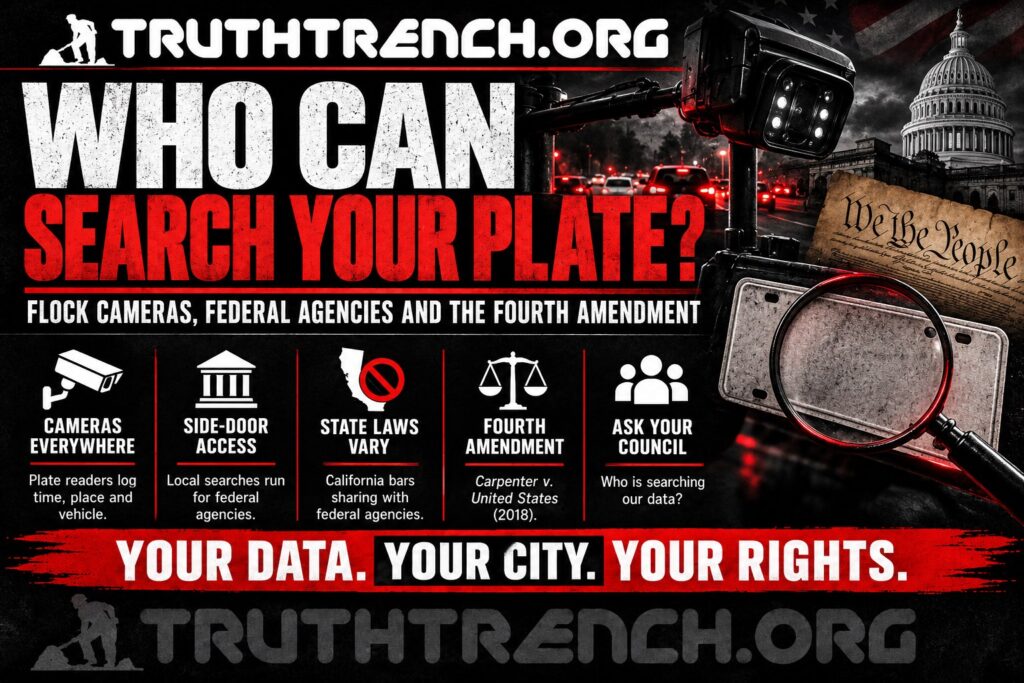
How Federal Agencies Reach Local Camera Data
Flock states that federal agencies do not have direct access to its platform and that any federal access must be explicitly granted by a local customer and comply with applicable law. In February 2026, NPR reported Flock’s statement that its pilot programs with Customs and Border Protection and Homeland Security Investigations had ended.
Audit logs tell a more complicated story. Journalists and researchers reviewing those logs found local police searches listing reasons such as “ICE,” “CBP” or “immigration,” which suggests local officers running searches on behalf of federal agencies. 404 Media reported more than 4,000 such lookups. Critics call this “side-door” access: no federal contract, but federal questions answered through a local account.
Examples have surfaced across the country:
- California: State law (SB 34) bars local agencies from sharing ALPR data with federal or out-of-state agencies. The state Attorney General sued the El Cajon Police Department over alleged sharing, and an amended class action filed April 3, 2026 alleges federal agencies accessed San Francisco camera data more than 1.6 million times. Those are allegations, not findings.
- Virginia: An ATF analyst reportedly improperly accessed Richmond’s Flock system to assist an immigration investigation.
- Idaho: In September 2026, reporting found an ICE employee had logged into the Nampa Police Department’s plate reader system, which is a different vendor, showing the issue is not limited to one company.
Some communities have responded by switching off federal sharing entirely. Wheeling, Illinois, for example, states publicly that its Flock data cannot be accessed by federal agencies. Other cities have canceled their contracts.
What the Constitution Says, and Doesn’t Yet Say
The Fourth Amendment protects against unreasonable searches and seizures. Courts have traditionally held that a license plate driving on a public road carries no reasonable expectation of privacy. But in Carpenter v. United States (2018), the Supreme Court held that the government generally needs a warrant to obtain long-term cell phone location records, recognizing that a detailed record of someone’s movements reveals far more than a single observation.
The open question is whether a dense network of plate cameras, retaining weeks of location history, starts to resemble the tracking the Court addressed in Carpenter. Courts have not settled that question, and there is no comprehensive federal statute governing ALPR data collection, retention or sharing. For now, the rules are mostly written by states, cities and vendor contracts.
Questions Every Citizen Can Ask Their City Council
- Is our ALPR system set to share data with federal agencies or agencies outside our state? Who approved that setting?
- How long is data retained? Thirty days? A year?
- Are search audit logs public, and does every search require a case number and stated reason?
- Has our department ever run a search on behalf of a federal agency? How many?
- Who audits compliance, and what happens when an officer misuses the system?
These are not partisan questions. Supporters of the cameras credit them with recovering stolen vehicles and locating missing persons. Critics worry about mass location tracking. Both sides should be able to agree that citizens deserve to know who is searching the data their tax dollars paid to collect.
Keep Digging With Truth Agent
This article is a starting point. Truth Agent puts the public record at your fingertips, including the Constitution, federal law, regulations, court opinions and oversight reports, so you can track surveillance legislation, Fourth Amendment case law and your own state’s ALPR rules without relying on anyone’s summary, including ours.
Read Next on Truth Trench
- Why Some Cities Are Canceling Their Flock License Plate Camera Contracts
- Surveillance or Security? The Growing National Debate Over Automated License Plate Readers
- Is Your Phone Really Listening? What the FTC’s “Active Listening” Case Means for Consumers
Sources
- NPR: Why some cities are canceling Flock license plate reader contracts
- Flock Safety: Does Flock Share Data With ICE?
- Gibbs Mura: Flock Safety class action
- East Idaho News: ICE, other federal agencies had access to Idaho city’s license plate readers
- 10News: Sen. Schiff questions Flock Safety over ICE access
- Village of Wheeling, IL: Flock Safety policy
- Carpenter v. United States, 585 U.S. 296 (2018)