Every generation faces a question that tests the balance between liberty and security.
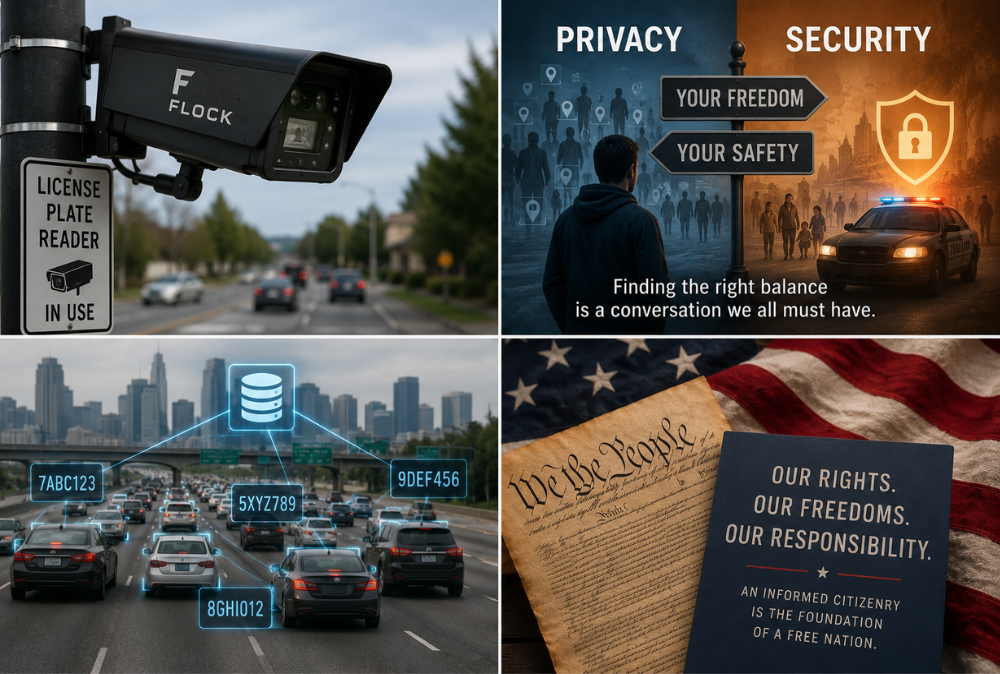
Today, one of those questions is arriving at city councils, county commissions, and state legislatures across America through the rapid expansion of Automated License Plate Reader (ALPR) technology, commonly known through systems such as Flock Safety.
These cameras are designed to scan passing vehicles, recording license plate numbers while identifying characteristics such as make, model, color, and other distinguishing features. The information can then be searched by authorized users to assist in criminal investigations and public safety operations.
To some Americans, this technology represents a common-sense tool that helps law enforcement solve crimes more efficiently. To others, it represents the creation of a nationwide surveillance network that records the daily movements of millions of law-abiding citizens.
The discussion is becoming one of the most significant public policy debates of the digital age.
The Case for Public Safety
Supporters argue that automated license plate readers are simply another evolution in policing technology, much like fingerprint databases, security cameras, or DNA analysis.
Law enforcement agencies have credited ALPR systems with locating stolen vehicles, recovering abducted children, identifying suspects involved in violent crimes, and finding missing persons. Because the cameras operate continuously, they can provide investigative leads that would otherwise require hundreds of officer hours or might never exist at all.
Many citizens who support the technology also point out that modern Americans voluntarily generate enormous amounts of location data through smartphones, navigation systems, online shopping, toll roads, and private security cameras.
From this perspective, automated license plate readers are simply one more tool designed to make communities safer.
As one concerned citizen summarized the argument, if technology can prevent a tragedy or help solve a serious crime, many believe it deserves careful consideration rather than outright rejection.
The Case for Privacy
Opponents view the issue through a different constitutional lens.
Their concern is not necessarily the camera itself but the creation of searchable databases capable of reconstructing a person’s movements over time without individualized suspicion.
Civil liberties advocates argue that Americans should not have to sacrifice privacy simply because they travel on public roads. They question whether collecting location information on millions of innocent drivers is consistent with the principles of limited government and the protections embodied in the Fourth Amendment.
Many citizens also express concern about the potential for misuse.
Across the country, documented incidents have involved unauthorized database access, mistaken vehicle identifications, and law enforcement personnel using surveillance systems for personal purposes. Others worry about cybersecurity risks, private company data governance, or the possibility that future technological capabilities could expand beyond their original intent.
Another recurring question focuses on transparency.
Who owns the data?
How long is it stored?
Who can access it?
Can it be shared with other government agencies or private organizations?
What independent oversight exists to ensure accountability?
For many Americans, these questions deserve clear answers before surveillance technologies become an accepted part of everyday life.
The Constitutional Conversation
The debate extends beyond technology and into fundamental questions about the relationship between citizens and government.
Supporters emphasize the government’s responsibility to protect public safety and argue that investigative tools should evolve alongside criminal activity.
Critics emphasize that constitutional rights exist precisely because governments possess significant power and that safeguards should evolve alongside technology as well.
Neither perspective is inherently unreasonable.
Most Americans value both safety and liberty. The challenge is determining where those interests should meet and what guardrails should exist to preserve public trust.
The Role of Think Tanks

Public policy benefits when difficult questions are examined through evidence rather than emotion.
Traditional think tanks gather information, analyze competing viewpoints, identify trends, and publish research that informs policymakers, academics, journalists, and the public.
Truth Trench Think Tank is a research institute for societal benefit dedicated to maintaining vigilance on the federal government while studying issues that affect everyday Americans. Rather than advocating for political parties or candidates, our mission is to collect data, evaluate evidence, and elevate informed public discussion through research and awareness campaigns.
Organizations recognized under 26 U.S.C. § 501(c)(3) are prohibited from participating or intervening in political campaigns on behalf of or in opposition to candidates for public office and may not devote a substantial part of their activities to lobbying. These federal requirements help ensure that research organizations educate rather than engage in partisan politics or propaganda.
Our objective is not to tell Americans what to think.
Our objective is to understand what Americans think—and why.
Your Voice Matters
The future of surveillance technology will not be shaped by technology companies or government agencies alone. It will also be shaped by informed citizens willing to participate in respectful public dialogue.
Whether you believe automated license plate readers enhance public safety, threaten personal privacy, or represent a reasonable balance between the two, your perspective contributes to a broader understanding of this evolving issue.
We invite you to share your thoughts, concerns, experiences, or questions in the comment form below.
Every submission becomes part of an ongoing body of research used to identify national trends and produce evidence-based reports that help inform policy discussions at the federal level.
The goal is simple: better information, better decisions, and a stronger America built on an informed and engaged citizenry.