For years, Americans have shared a common experience.
You mention a product in conversation, and hours later an advertisement for that exact product appears on your phone or social media feed.
The experience has fueled a persistent question:
Are our devices actually listening to us?
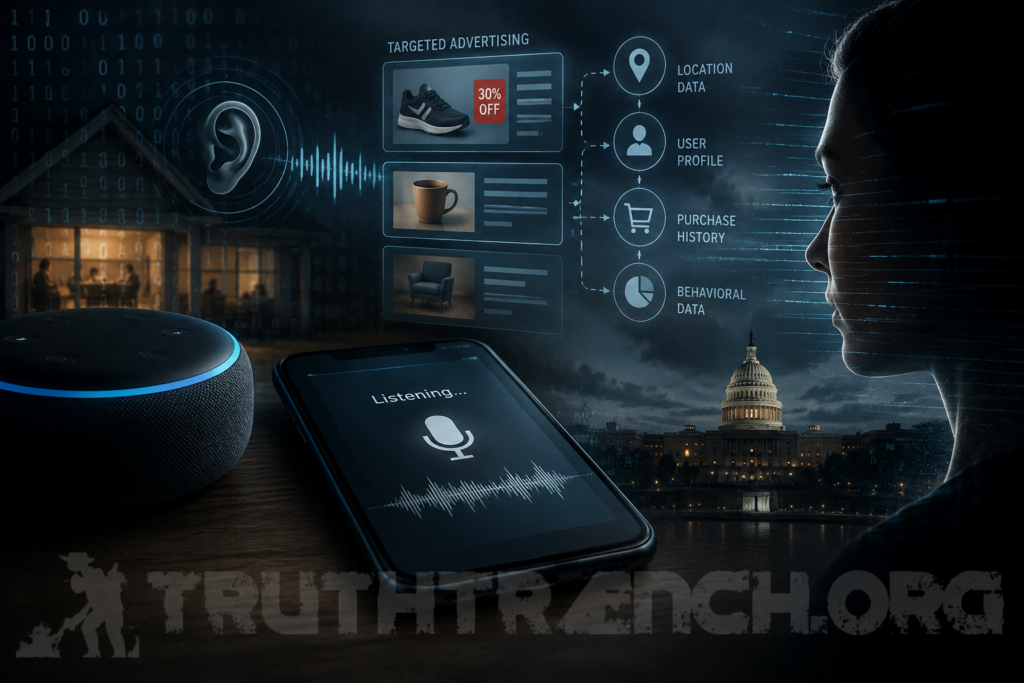
A recent action by the Federal Trade Commission (FTC) provides an important piece of that conversation—not by proving that smart devices secretly record consumers for advertising, but by alleging that several marketing companies falsely claimed they could do exactly that.
What Happened?
On May 21, 2026, the FTC announced proposed settlements totaling $930,000 involving Cox Media Group, MindSift LLC, and 1010 Digital Works LLC. The agency alleged the companies marketed an AI-powered advertising product called “Active Listening” that supposedly identified consumer interest by listening to conversations occurring near smart devices.
According to the FTC, the product did not function as advertised.
Rather than analyzing voice data, the companies allegedly resold email lists obtained from third-party data brokers while representing the service as sophisticated AI-powered voice targeting. The FTC also alleged the companies falsely claimed consumers had “opted in” to the service when they had not.
Under the proposed settlements:
- Cox Media Group will pay $880,000.
- MindSift LLC will pay $25,000.
- 1010 Digital Works LLC will pay $25,000.
The agreements also prohibit future misrepresentations regarding advertising capabilities, voice data collection, consumer consent, and geographic targeting.
What the FTC Did—and Did Not—Say
This distinction is important.
The FTC did not announce that smartphones or smart speakers are secretly recording private conversations for advertising purposes.
Instead, the agency alleged that the companies falsely claimed to possess that capability and used those claims to market their services to businesses. According to the complaints, the advertised technology never actually listened to consumer conversations or analyzed voice data.
For consumers, that may be reassuring.
For businesses, it serves as a reminder that AI claims are subject to the same truth-in-advertising standards as any other product.
Why Do Ads Feel So Personal?
Even without microphones, modern advertising is remarkably sophisticated.
Advertising platforms may combine information from:
- Search history
- Website visits
- Online purchases
- Mobile applications
- Device identifiers
- Location history
- Social interactions
- Data purchased from third-party brokers
Artificial intelligence can then identify patterns and predict purchasing behavior with surprising accuracy.
What feels like “someone must have heard me” may actually be the result of extensive behavioral data collected over months or years.
The Bigger Conversation
This case highlights a broader question that extends well beyond one marketing campaign.
As AI becomes more integrated into everyday life, consumers increasingly want to know:
- What information is being collected?
- Who owns that information?
- How is it being used?
- Did I actually consent?
- Are companies accurately describing their technology?
Those questions affect advertising, social media, smart homes, connected vehicles, wearable technology, and countless other digital services.
The FTC’s action demonstrates that regulators are paying close attention not only to privacy practices but also to exaggerated or misleading claims surrounding artificial intelligence.
Why Truth Trench Think Tank Is Following This Story
Truth Trench Think Tank is a research institute for societal benefit dedicated to examining emerging technologies, consumer privacy, government oversight, and issues affecting everyday Americans.
Unlike advocacy organizations or political campaigns, our mission is to gather information, analyze competing viewpoints, and promote informed public discussion through independent research.
Organizations recognized under 26 U.S.C. § 501(c)(3) are prohibited from participating in political campaigns and are limited in lobbying activities, allowing research institutes to focus on education and evidence-based analysis rather than partisan advocacy.
Read the Source Material
We encourage readers to review the FTC announcement directly rather than relying solely on news headlines or social media discussions.
Official FTC Press Release:
FTC: Active Listening AI-Powered Marketing Service Settlement

Join the Conversation
Have you ever experienced an advertisement that seemed too perfectly timed?
Do you believe AI already knows more about us than most people realize, or do you think concerns about “active listening” are largely misconceptions fueled by sophisticated data analytics?
Share your thoughts in the comment section below.
Your perspective helps Truth Trench Think Tank identify emerging public concerns and contributes to independent research reports that encourage informed discussion about technology, privacy, and consumer protection.