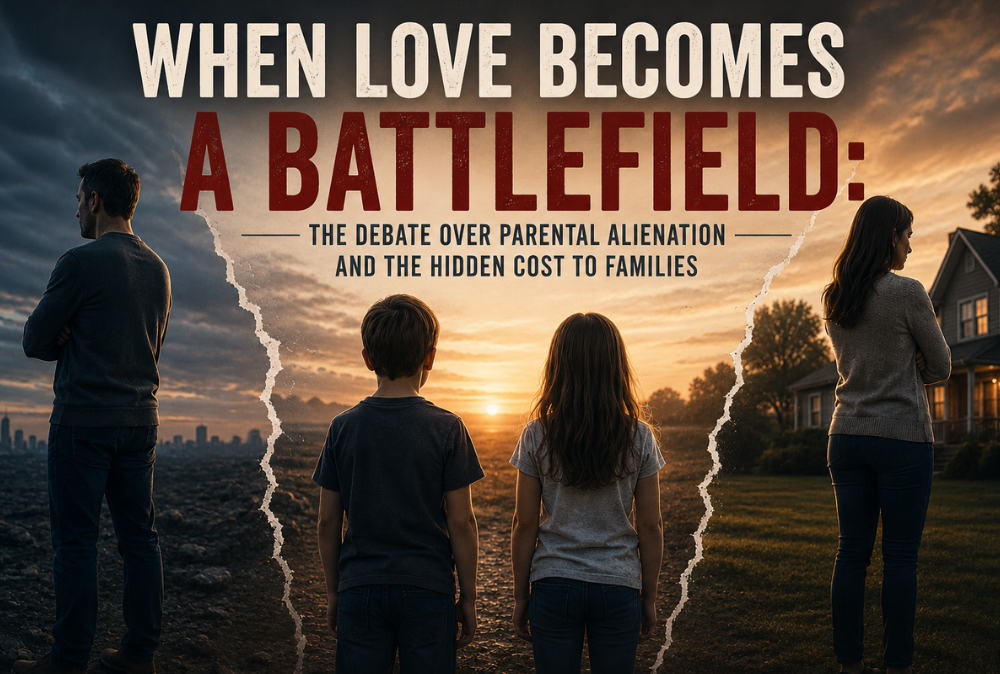
Divorce and custody disputes are among the most emotionally difficult experiences families can endure. While courts and legal systems are designed to protect children and ensure their well-being, some parents, mental health professionals, and family advocates argue that these systems can occasionally become battlegrounds where relationships between children and loving parents are damaged or destroyed. At the center of this debate is the controversial and often misunderstood issue known as parental alienation.
For some, parental alienation represents a form of emotional abuse that separates children from a healthy relationship with one parent and an entire branch of their family tree. Critics, however, caution that the concept itself can be misused and may obscure legitimate concerns involving abuse or neglect. Regardless of where one stands, few disagree that prolonged family conflict can leave lasting scars on children and future generations.
Understanding the Issue
Parental alienation generally refers to circumstances in which a child becomes estranged from one parent while strongly identifying with the other. Those who believe parental alienation is a serious problem argue that repeated negative messages, manipulation, or efforts to interfere with a child’s relationship with the other parent can create powerful emotional barriers.
Parents who describe themselves as victims often explain that the separation extends beyond the child. Grandparents, siblings, cousins, aunts, uncles, and lifelong family traditions may disappear from a child’s life. Supporters of parental alienation awareness argue that the resulting loss of identity and family connections can have consequences that last well into adulthood.
Others caution against viewing every instance of estrangement through the same lens. Critics note that children may withdraw from a parent for many reasons, including exposure to conflict, inconsistent parenting, neglect, or abuse. They argue that courts and professionals must carefully evaluate each situation individually rather than assume manipulation is always responsible.
Historical Background
The concept of parental alienation gained attention during the 1980s and has remained a subject of ongoing debate in psychology and family law. While many practitioners recognize behaviors associated with alienation, the concept itself remains controversial. It does not appear as a formal diagnosis in the Diagnostic and Statistical Manual of Mental Disorders (DSM-5), though many of its associated behaviors are studied within broader child and family psychology.
Today, family courts throughout the United States encounter allegations involving parental alienation, yet no universally accepted legal or clinical standard exists for evaluating these claims.
Competing Perspectives
Supporters argue that emotional manipulation intended to damage a child’s relationship with a fit parent should be recognized as a form of psychological abuse. They contend that family courts and professionals sometimes fail to recognize these behaviors and unintentionally reinforce harmful dynamics.
Critics warn that parental alienation claims can themselves become weapons in high-conflict custody disputes. They emphasize that allegations of abuse or safety concerns must never be dismissed simply because a parent claims alienation. Critics advocate for thorough investigations and caution against simplistic explanations in complex family situations.
Despite their differences, both perspectives share a common objective: protecting children.
Potential Benefits of Greater Awareness
Advocates believe greater awareness may encourage earlier intervention, improved counseling resources, and more informed decision-making by courts and professionals. Increased understanding could help preserve healthy family relationships and reduce long-term emotional harm.
Awareness may also encourage parents to recognize unhealthy behaviors before they become entrenched and provide children with access to support services that promote emotional well-being.
Concerns and Risks
At the same time, concerns remain regarding inconsistent standards, conflicting expert opinions, and the difficulty of distinguishing manipulation from legitimate estrangement. Some observers worry that poorly understood concepts can increase litigation and deepen family conflict.
Others emphasize that children should never be forced into relationships that compromise their safety or emotional health. These concerns underscore the need for individualized evaluations and evidence-based approaches.
Broader Implications
Family conflict affects more than parents and children. Entire support systems may be fractured. Communities bear the long-term consequences when unresolved trauma contributes to depression, anxiety, substance abuse, and difficulties in future relationships.
Questions surrounding parental alienation also raise broader concerns about family courts, mental health practices, and the challenge of balancing child safety with preserving healthy parental relationships.
Legal Considerations
Family law in the United States generally recognizes that children benefit from maintaining relationships with both parents whenever possible. Most states apply a “best interests of the child” standard when determining custody arrangements.
Courts commonly consider:
- Emotional bonds between parent and child.
- History of caregiving.
- Stability of the home environment.
- Mental and physical health of the parties.
- Evidence of abuse or neglect.
- Each parent’s willingness to encourage a relationship with the other parent.
Arguments Supporting Recognition
Supporters argue that intentionally interfering with a child’s relationship with a fit parent may constitute emotional or psychological abuse.
They often point to:
Troxel v. Granville, 530 U.S. 57 (2000)
In this case, the United States Supreme Court recognized that parents possess a fundamental liberty interest in the care, custody, and control of their children.
Supporters argue that preserving healthy parent-child relationships is consistent with these constitutional protections.
Arguments Raised by Critics
Critics emphasize that parental alienation is not recognized as a formal DSM-5 diagnosis and caution that alienation claims may sometimes overshadow legitimate concerns involving abuse or neglect.
They argue that every case deserves careful, evidence-based evaluation and that the child’s safety and well-being must remain paramount.
Resources for Families
Parents and families experiencing conflict may find assistance through:
Mental Health Support
- Licensed family therapists.
- Child psychologists.
- Marriage and family counselors.
- Parenting coordinators and mediators.
Legal Assistance
- Family law attorneys.
- State Bar Association referral services.
- Legal Aid organizations.
- Court-appointed guardians ad litem where available.
Mediation and Conflict Resolution
- Community mediation centers.
- Court-sponsored mediation programs.
- Parenting education programs.
Crisis and Child Safety Resources
If abuse or immediate safety concerns exist:
National Domestic Violence Hotline
1-800-799-SAFE (7233)
Educational Resources
American Psychological Association
Association of Family and Conciliation Courts
American Academy of Matrimonial Lawyers
State Bar Associations and Family Court websites.
Questions Worth Considering
- How can courts distinguish between parental alienation and legitimate safety concerns?
- What role should mental health professionals play in custody disputes?
- Are current legal standards sufficient to address emotional harm within families?
- How can children be protected from adult conflicts while preserving healthy family relationships?
- What interventions are most effective in reducing long-term trauma?
Conclusion
Parental alienation remains one of the most emotionally charged and debated subjects in family law. While experts and advocates disagree on its causes, prevalence, and treatment, most agree on one principle: children deserve environments that promote safety, stability, and healthy relationships.
Finding solutions requires thoughtful discussion, careful evaluation, and a commitment to placing the interests of children above the conflicts of adults.
About Think Tanks and the Role of Truth Trench
Think tanks exist to study complex issues, evaluate competing viewpoints, and transform information into practical recommendations. They bridge the gap between ideas and implementation through research, analysis, and education.
Truth Trench Think Tank is a research institute for societal benefit operating under Section 501(c)(3) of the Internal Revenue Code. Pursuant to 26 U.S.C. §501(c)(3), organizations recognized under this section may not participate or intervene in political campaigns and are limited in lobbying activities. Truth Trench Think Tank does not engage in partisan political activity or propaganda and conducts its work through independent, evidence-based research, education, and public dialogue.
Public comments and experiences help inform independent reports that contribute to broader policy discussions at the federal level. Through the Truth Trench Accelerator, entrepreneurs, operators, and innovators develop practical solutions to challenges identified through research and public input. This creates a continuous cycle:
Research > Awareness > Public Input > Reports > Policy Discussions > Innovation = Real-World Solutions
Truth Trench Think Tank believes informed citizens, effective institutions, and innovative entrepreneurs working together can create meaningful and lasting improvements in society. Truth Trench Think Tank is committed to changing the world for the better.
Your Opinion Matters
Truth Trench Think Tank is collecting public input for independent research reports that help inform policy discussions at the federal level.
We are a research institute for societal benefit operating under Section 501(c)(3) of the Internal Revenue Code and do not engage in political campaign activity, partisan advocacy, lobbying, or propaganda.
Share your thoughts, concerns, experiences, or recommendations through the form below.
Public comments help guide future research, reports, awareness campaigns, and the development of practical solutions that create positive change.
Mission success and beyond.