“FBI Director Kash Patel announced that the Federal Bureau of Investigation would end its longstanding relationships with both the Southern Poverty Law Center (SPLC) and the Anti-Defamation League (ADL)”
Americans donate billions of dollars each year to charitable organizations because they believe in a mission. Whether the cause is disaster relief, medical research, veterans’ services, civil rights, or combating violent extremism, donors generally expect their contributions to be used in a manner consistent with the organization’s publicly stated purpose.
A recent federal indictment has brought those expectations into sharp focus.
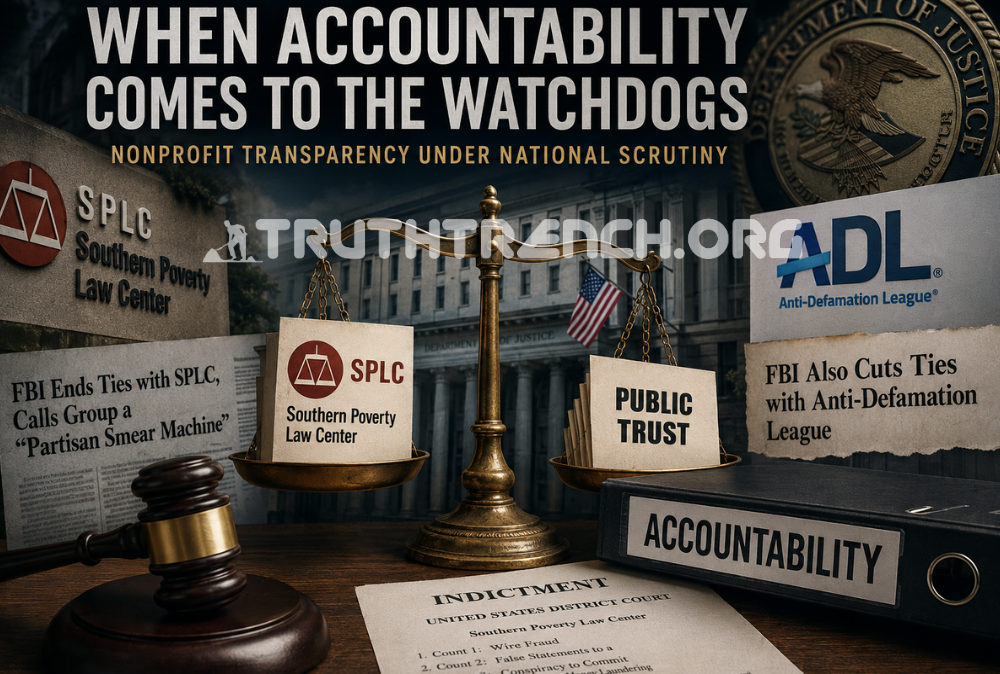
On April 21, 2026, the United States Department of Justice announced that a federal grand jury returned an indictment charging the Southern Poverty Law Center (SPLC) with wire fraud, false statements to a federally insured bank, and conspiracy to commit concealment money laundering. According to the Department of Justice, prosecutors allege that between 2014 and 2023 the organization secretly directed more than $3 million in donor funds to individuals associated with violent extremist organizations while representing to donors that contributions supported efforts to combat those same organizations. The indictment further alleges that fictitious entities and concealed financial arrangements were used to disguise the payments and their true purpose.
The Department of Justice alleges that donors believed they were financially supporting efforts to dismantle violent extremist organizations, while portions of those funds were instead secretly used to compensate confidential sources operating within or associated with those organizations. Prosecutors contend that the alleged deception—not merely the existence of paid informants—is what constitutes the criminal conduct charged in the indictment.
These allegations have not yet been proven in court, and the defendants are presumed innocent unless proven guilty beyond a reasonable doubt. Nevertheless, the indictment has generated national attention because it raises questions that extend far beyond one organization.
The broader issue is not simply whether the allegations are true. It is whether nonprofit organizations entrusted with public donations should be held to a higher standard of transparency, accountability, and oversight.
Why This Case Matters
Organizations that ask for public support occupy a unique position of trust. Unlike commercial businesses, charitable organizations often rely upon donors who contribute because they believe in a stated mission rather than expecting a financial return.
If prosecutors ultimately prove that donor funds were intentionally used in ways materially different from what donors were led to believe, the implications extend well beyond one institution. Public confidence in charitable organizations depends upon honesty, transparency, and faithful stewardship of donated resources.
This case therefore presents a question that citizens, nonprofit leaders, policymakers, and donors alike should consider:
How much transparency should the public reasonably expect from organizations that solicit charitable contributions?
A Broader Shift in Federal Oversight
The indictment did not occur in isolation.
Around the same time, FBI Director Kash Patel announced that the Federal Bureau of Investigation would end its longstanding relationships with both the Southern Poverty Law Center (SPLC) and the Anti-Defamation League (ADL), organizations that for decades have provided research, training, and educational resources related to hate crimes and domestic extremism.
Patel stated that the FBI would no longer partner with the SPLC, describing the organization as having become a “partisan smear machine.” He also criticized its use of the widely known “hate map,” arguing that it had increasingly been used to characterize organizations and viewpoints in ways that many critics considered politically motivated rather than objectively analytical.
The decision came amid growing public criticism from some conservatives following the assassination of conservative activist Charlie Kirk and renewed scrutiny over the SPLC’s inclusion of Turning Point USA in its report The Year in Hate and Extremism 2024, which described the organization as “A Case Study of the Hard Right in 2024.”
The FBI also announced that it would discontinue its relationship with the Anti-Defamation League. While the ADL has worked alongside the FBI for decades by providing research, educational resources, and training concerning antisemitism and extremist violence, it has also received criticism from some conservatives regarding portions of its Glossary of Extremism. Shortly before the FBI’s announcement, the ADL stated that it would discontinue the glossary, explaining that some entries had become outdated and were being intentionally misrepresented and misused.
Former FBI Director James Comey had praised the ADL during a 2017 event, stating:
“For more than 100 years, you have advocated and fought for fairness and equality, for inclusion and acceptance. You never were indifferent or complacent.”
Following the FBI’s decision, Director Patel publicly criticized that longstanding relationship, writing:
“James Comey wrote ‘love letters’ to the ADL and embedded FBI agents with them – a group that ran disgraceful ops spying on Americans.”
He concluded:
“That era is OVER. This FBI won’t partner with political fronts masquerading as watchdogs.”
The ADL responded by reaffirming its respect for the FBI and stating that, in light of increasing antisemitism, it remains committed to protecting Jewish communities and combating hate.
Supporters of Director Patel’s decisions argue that organizations exercising significant influence over public policy discussions, law enforcement training, and public perception should themselves be subject to rigorous public scrutiny. Critics argue that ending partnerships with established civil rights organizations risks reducing valuable expertise in identifying and combating hate crimes and violent extremism.
Regardless of one’s perspective, the decisions represent a significant shift in how the federal government views its relationships with outside advocacy and research organizations.
The Argument for Greater Accountability
Those who support increased accountability argue that organizations benefiting from tax-exempt status and public trust should be held to exceptionally high ethical and legal standards.
From this perspective, donors deserve accurate information about how their contributions are used. If an organization knowingly withholds material information that would influence a reasonable person’s decision to donate, critics argue that public trust has been compromised regardless of the organization’s stated intentions.
Supporters of stronger oversight also contend that nonprofit organizations should maintain robust financial controls, independent audits, transparent governance, and clear disclosure practices. Because these organizations often receive millions of dollars from individuals, foundations, corporations, and government sources, they argue that accountability should be at least as rigorous as it is for publicly traded companies.
Federal law already provides numerous mechanisms to address misconduct when evidence supports criminal charges. Depending upon the facts of a particular case, organizations and individuals may face investigations involving wire fraud, bank fraud, money laundering, false statements, conspiracy, tax violations, or related offenses. Convictions can result in imprisonment, substantial criminal fines, restitution to victims, forfeiture of proceeds derived from unlawful activity, court-ordered compliance measures, and, in certain circumstances, administrative actions affecting tax-exempt status.
Supporters argue these enforcement mechanisms exist not merely to punish wrongdoing, but to preserve public confidence in charitable organizations that legitimately serve the public interest.
The Argument for Operational Confidentiality
Others caution that nonprofit organizations sometimes perform work requiring confidentiality.
Organizations investigating organized crime, terrorism, public corruption, human trafficking, or violent extremist movements may rely upon confidential informants, undercover sources, or other sensitive investigative techniques. Public disclosure of every operational detail could compromise investigations, place confidential sources at risk, or reduce the effectiveness of intelligence gathering.
Supporters of this position argue that compensating confidential sources does not necessarily equate to supporting the criminal or extremist activities of those individuals. Rather, they contend such payments may represent legitimate investigative expenses intended to obtain information that protects communities or assists law enforcement.
From this perspective, the central legal question becomes whether donors were materially deceived—not whether confidential sources existed.
The SPLC has publicly denied wrongdoing and has stated that any payments to confidential informants were intended to gather intelligence regarding violent extremist organizations rather than support those organizations. The organization has indicated that it intends to vigorously defend itself against the charges.
Questions Worth Considering
Regardless of the ultimate outcome of this case, several important questions deserve thoughtful discussion.
Should nonprofit organizations disclose when donor funds may be used to compensate confidential sources?
Where should the line be drawn between protecting operational security and providing meaningful transparency to donors?
Should Congress establish clearer disclosure standards for charitable organizations engaged in sensitive investigative work?
Are current reporting requirements sufficient to maintain public confidence, or should additional safeguards be considered?
Most importantly, how can organizations preserve both public trust and operational effectiveness?
Reasonable people may reach different conclusions. What matters is that those conclusions are based upon evidence, careful analysis, and respect for the legal process.
The Role of Independent Research
Think tanks exist to study important public issues, evaluate competing perspectives, analyze evidence, and contribute informed recommendations to public discussion.
Truth Trench Think Tank is a research institute for societal benefit dedicated to promoting government transparency, civic awareness, and informed public participation. We maintain vigilance regarding the actions of the federal government and conduct independent research intended to help Americans better understand issues affecting their communities and the nation.
What distinguishes our approach is that we actively seek input from citizens across the country. Rather than beginning with predetermined political conclusions, we collect perspectives from people with different experiences, beliefs, and backgrounds, then analyze those perspectives alongside publicly available information to identify emerging trends and areas deserving further research.
Public comments submitted through our awareness campaigns become part of a larger body of independent research that helps us identify patterns, concerns, and opportunities for further study. Those findings are incorporated into reports intended to inform policy discussions at the federal level.
Truth Trench Think Tank is recognized as a tax-exempt organization under 26 U.S.C. § 501(c)(3). Consistent with federal law governing charitable research organizations, we do not participate or intervene in political campaigns on behalf of or in opposition to candidates for public office, and any lobbying activity must remain an insubstantial part of our overall activities. Our mission is independent research, public education, and civic awareness—not partisan advocacy or propaganda.
Share Your Perspective
Questions surrounding nonprofit accountability affect everyone who contributes time, money, or trust to charitable organizations.
What level of transparency should donors reasonably expect?
Should organizations be required to disclose when charitable contributions may support confidential investigative activities?
Do existing federal laws adequately protect donors, or should additional safeguards be considered?
We invite you to share your thoughts, concerns, experiences, or recommendations using the form below.
Every submission is reviewed as part of our ongoing independent research process. Your perspective is analyzed alongside publicly available information to identify emerging trends and viewpoints from citizens across the country. Those findings contribute to research reports intended to help inform policy discussions at the federal level.
An informed republic depends upon informed citizens. Your thoughtful participation strengthens that process.