Updated August 15, 2026
Most Americans can name the President. Many can name a few Cabinet secretaries. Far fewer know the people standing immediately behind those officials — the Deputy Secretaries and other senior officers who help run enormous federal departments every day.
That matters because leadership changes.
A Cabinet secretary can resign, be removed, become incapacitated or leave office for another reason. The person immediately below that secretary may then be positioned to perform the secretary’s duties, depending on the department’s statutory succession rules, presidential designations and federal vacancies law.
That does not mean a Deputy Secretary automatically becomes the next permanent Secretary. Permanent Cabinet appointments generally require presidential nomination and Senate confirmation. But the number-two official is often the most important person to know when trying to understand continuity inside a department.
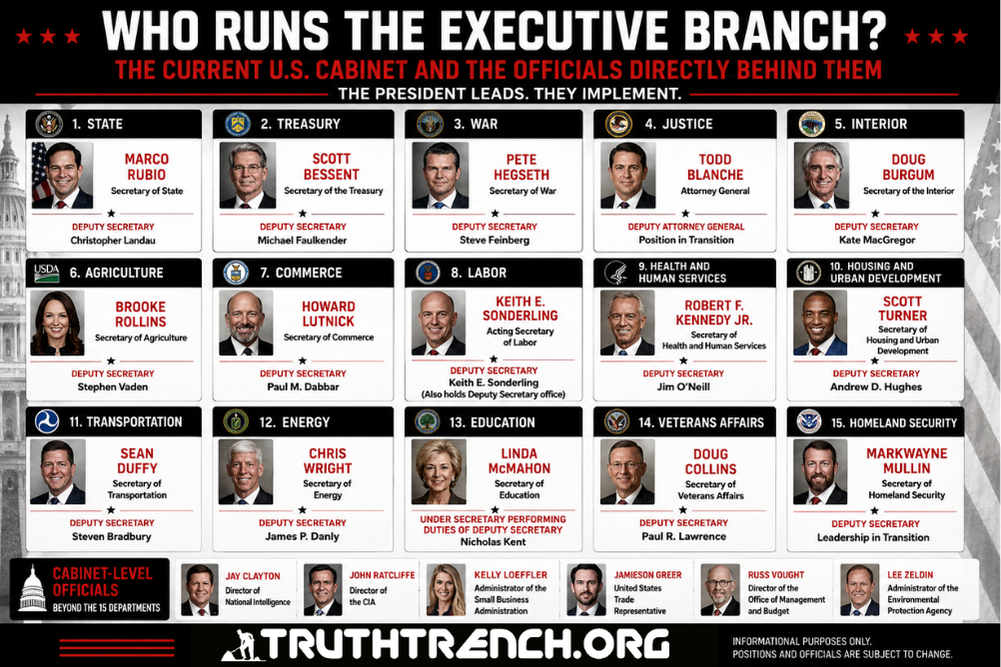
As of August 15, 2026, the White House identifies the following people as the heads of the 15 executive departments. The leadership immediately beneath them is listed below.
Confirm at: https://www.whitehouse.gov/administration/cabinet
1. Department of State
Secretary of State: Marco Rubio
What the department does: The Department of State leads American diplomacy and foreign policy. The Secretary of State serves as the President’s principal adviser on foreign affairs and represents the United States in diplomatic relations around the world.
Deputy Secretary of State: Christopher Landau
Landau is the department’s senior deputy and entered duty as Deputy Secretary on March 25, 2025.
Leadership chain:
President Donald Trump → Secretary Marco Rubio → Deputy Secretary Christopher Landau
2. Department of the Treasury
Secretary of the Treasury: Scott Bessent
What the department does: Treasury manages federal finances and plays a central role in taxation, government debt, economic policy, financial sanctions, financial-system stability and the government’s fiscal operations.
Deputy Secretary of the Treasury: Michael Faulkender
Faulkender was confirmed as the 16th Deputy Secretary of the Treasury in March 2025 and serves directly beneath the Secretary.
Leadership chain:
President Donald Trump → Secretary Scott Bessent → Deputy Secretary Michael Faulkender
3. Department of War
Secretary of War: Pete Hegseth
What the department does: The Department of War oversees the nation’s armed forces and is responsible for providing the military capabilities necessary to deter conflict and defend the United States.
The Secretary is the department’s highest-ranking civilian leader and the President’s principal adviser on war and defense policy.
Deputy Secretary of War: Steve Feinberg
Feinberg is the department’s second-ranking civilian official. The Department describes the Deputy Secretary as responsible for its day-to-day business, including management of the war budget and execution of the Secretary’s priorities.
Leadership chain:
President Donald Trump → Secretary Pete Hegseth → Deputy Secretary Steve Feinberg
4. Department of Justice
Attorney General: Todd Blanche
The Department of Justice is different from the other executive departments because its leader is called the Attorney General, rather than Secretary.
What the department does: The Attorney General is the nation’s chief federal law-enforcement officer and leads the Department of Justice, which includes the FBI, DEA, U.S. Marshals Service, ATF, Bureau of Prisons and the 93 U.S. Attorneys’ Offices.
Todd Blanche was confirmed and sworn in as Attorney General in August 2026 after previously serving as Deputy Attorney General and then Acting Attorney General. The White House now identifies Blanche as the Attorney General.
Deputy Attorney General: Transitioning
This is one of the departments where the normal Secretary-equivalent/deputy structure is currently in transition.
Blanche himself had been the Senate-confirmed Deputy Attorney General before becoming Attorney General. Because of that very recent promotion, readers should not assume that an older DOJ page identifying Blanche as Deputy Attorney General represents the current number-two leadership arrangement. DOJ’s January 2026 Deputy Attorney General page still reflects his former office.
The Todd Blanche nomination for Attorney General was confirmed in the U.S. Senate with a vote on August 8, 2026 (04:17 AM). The vote result was “Nomination Confirmed” (Nomination Number PN1078).
Leadership chain:
President Donald Trump → Attorney General Todd Blanche → Deputy Attorney General position subject to the current DOJ leadership transition
This is precisely the kind of situation that demonstrates why tracking the number-two official matters.
5. Department of the Interior
Secretary of the Interior: Doug Burgum
What the department does: Interior manages much of America’s federal land and natural resources and oversees agencies and programs involving national parks, wildlife, energy and mineral resources, water, public lands and federal responsibilities involving Tribal nations.
Deputy Secretary of the Interior: Kate MacGregor
MacGregor currently serves as Deputy Secretary. She previously held senior positions within Interior and returned to the Deputy Secretary role during President Trump’s second administration.
Leadership chain:
President Donald Trump → Secretary Doug Burgum → Deputy Secretary Kate MacGregor
6. Department of Agriculture
Secretary of Agriculture: Brooke Rollins
What the department does: USDA oversees federal policy involving agriculture, farming, food and nutrition programs, forestry, rural development, agricultural markets and food production.
Deputy Secretary of Agriculture: Stephen Vaden
Vaden was sworn in as Deputy Secretary on July 7, 2025. USDA describes the Secretary and Deputy Secretary as jointly leading departmental operations and implementation of federal agriculture and nutrition policy.
Leadership chain:
President Donald Trump → Secretary Brooke Rollins → Deputy Secretary Stephen Vaden
7. Department of Commerce
Secretary of Commerce: Howard Lutnick
What the department does: Commerce covers an unusually broad portfolio involving economic development, trade, industry, technology, telecommunications, patents, standards, economic statistics, weather and oceanic programs.
Deputy Secretary of Commerce: Paul M. Dabbar
Commerce identifies Dabbar as its Deputy Secretary, chief operating officer and principal deputy to the Secretary. He oversees the department’s day-to-day management.
Leadership chain:
President Donald Trump → Secretary Howard Lutnick → Deputy Secretary Paul M. Dabbar
8. Department of Labor
Acting Secretary of Labor: Keith E. Sonderling
What the department does: Labor administers and enforces federal laws and programs involving workers, wages, workplace safety, employment, benefits, labor statistics and workforce development.
Labor currently has an unusual leadership structure.
Keith Sonderling was confirmed by the Senate as Deputy Secretary of Labor on March 12, 2025. President Trump subsequently designated him Acting Secretary of Labor on April 20, 2026. The White House currently lists Sonderling as the department’s Cabinet head while noting his acting status.
Deputy Secretary of Labor: Keith E. Sonderling
Sonderling continues to hold the Senate-confirmed Deputy Secretary position while performing the duties of Acting Secretary.
Leadership chain:
President Donald Trump → Acting Secretary Keith E. Sonderling → Sonderling also holds the Deputy Secretary office
This is another important example of why a simple static Cabinet chart can sometimes be misleading.
9. Department of Health and Human Services
Secretary of Health and Human Services: Robert F. Kennedy Jr.
What the department does: HHS oversees a vast portion of federal health policy and programs, including agencies responsible for public health, biomedical research, food and drug regulation, Medicare, Medicaid and disease prevention.
Deputy Secretary of Health and Human Services: Jim O’Neill
HHS identifies O’Neill as its 26th Deputy Secretary and the Secretary’s principal deputy and chief adviser.
Leadership chain:
President Donald Trump → Secretary Robert F. Kennedy Jr. → Deputy Secretary Jim O’Neill
10. Department of Housing and Urban Development
Secretary of Housing and Urban Development: Scott Turner
What the department does: HUD administers federal housing and community-development programs involving homeownership, affordable housing, fair housing, housing assistance and community development.
Deputy Secretary of HUD: Andrew D. Hughes
Hughes was confirmed by the Senate in June 2025. HUD identifies him as Deputy Secretary and says he manages the department’s day-to-day operations.
Leadership chain:
President Donald Trump → Secretary Scott Turner → Deputy Secretary Andrew D. Hughes
11. Department of Transportation
Secretary of Transportation: Sean Duffy
What the department does: Transportation oversees national transportation policy involving highways, aviation, railroads, transit, pipelines and other components of America’s transportation infrastructure.
Deputy Secretary of Transportation: Steven Bradbury
Bradbury was confirmed by the Senate as Deputy Secretary on March 11, 2025.
Leadership chain:
President Donald Trump → Secretary Sean Duffy → Deputy Secretary Steven Bradbury
12. Department of Energy
Secretary of Energy: Chris Wright
What the department does: Energy oversees national energy policy, scientific research, the national laboratory system and major nuclear-energy and nuclear-security responsibilities.
Deputy Secretary of Energy: James P. Danly
Danly was sworn in as Deputy Secretary on June 9, 2025 and remains identified by DOE in that position in 2026.
Leadership chain:
President Donald Trump → Secretary Chris Wright → Deputy Secretary James P. Danly
13. Department of Education
Secretary of Education: Linda McMahon
What the department does: Education administers federal education programs involving student aid, education data, civil-rights enforcement, higher education and federal support for schools.
The department currently has an unusual number-two arrangement.
Nicholas Kent — Under Secretary Performing the Duties of Deputy Secretary
Nicholas Kent was sworn in as Under Secretary of Education on August 4, 2025.
Beginning February 5, 2026, Kent was also delegated the duties of Deputy Secretary of Education.
That distinction is important: Kent is the Under Secretary performing the duties of Deputy Secretary rather than simply being described as a Senate-confirmed Deputy Secretary.
Leadership chain:
President Donald Trump → Secretary Linda McMahon → Under Secretary Nicholas Kent, performing the duties of Deputy Secretary
14. Department of Veterans Affairs
Secretary of Veterans Affairs: Doug Collins
What the department does: VA administers federal programs for America’s veterans, including health care, disability compensation, pensions, education benefits, home loans, burial services and other benefits.
Deputy Secretary of Veterans Affairs: Paul R. Lawrence
Lawrence serves as Deputy Secretary and continues to perform senior departmental responsibilities in 2026, including oversight of VA’s federal electronic health-record deployment.
Leadership chain:
President Donald Trump → Secretary Doug Collins → Deputy Secretary Paul R. Lawrence
15. Department of Homeland Security
Secretary of Homeland Security: Markwayne Mullin
This is one of the most significant recent Cabinet changes.
Markwayne Mullin currently serves as the 9th Secretary of Homeland Security. The White House’s current Cabinet roster identifies Mullin — not Kristi Noem — as the head of DHS.
What the department does: DHS oversees a massive homeland-security structure encompassing border and immigration enforcement, transportation security, cybersecurity, disaster response, protection of critical infrastructure, the Secret Service, Coast Guard and other security functions.
Deputy Secretary: Leadership in Transition
Because Mullin’s move into DHS represents a recent Cabinet change, the department’s subordinate leadership and applicable succession structure should be treated as a current-transition matter rather than simply carrying forward the deputy listed under the previous Secretary.
Leadership chain:
President Donald Trump → Secretary Markwayne Mullin → Deputy leadership subject to the current DHS transition
The 15 Executive Departments at a Glance
| Department | Current Department Head | Immediate Deputy / No. 2 |
|---|---|---|
| State | Marco Rubio | Christopher Landau |
| Treasury | Scott Bessent | Michael Faulkender |
| War | Pete Hegseth | Steve Feinberg |
| Justice | Todd Blanche | Transition following Blanche’s promotion |
| Interior | Doug Burgum | Kate MacGregor |
| Agriculture | Brooke Rollins | Stephen Vaden |
| Commerce | Howard Lutnick | Paul M. Dabbar |
| Labor | Keith E. Sonderling, Acting | Sonderling also holds Deputy Secretary office |
| Health and Human Services | Robert F. Kennedy Jr. | Jim O’Neill |
| Housing and Urban Development | Scott Turner | Andrew D. Hughes |
| Transportation | Sean Duffy | Steven Bradbury |
| Energy | Chris Wright | James P. Danly |
| Education | Linda McMahon | Nicholas Kent, performing Deputy Secretary duties |
| Veterans Affairs | Doug Collins | Paul R. Lawrence |
| Homeland Security | Markwayne Mullin | Leadership transition |
Cabinet-Level Officials Beyond the 15 Departments
There is another distinction that is easy to miss.
The Cabinet is larger than the 15 executive departments.
The President can accord Cabinet-level status to leaders of other major executive organizations. The current White House Cabinet roster therefore includes additional officials such as:
- Jay Clayton — Director of National Intelligence
- John Ratcliffe — Director of the Central Intelligence Agency
- Lee Zeldin — Administrator of the Environmental Protection Agency
- Kelly Loeffler — Administrator of the Small Business Administration
- Jamieson Greer — United States Trade Representative
- Russ Vought — Director of the Office of Management and Budget
These officials participate at the Cabinet level but do not lead one of the 15 executive departments listed above. The White House’s current Cabinet roster reflects these positions alongside the department heads.
Why the Number-Two Officials Matter
The Deputy Secretary may not generate headlines, but in many departments that person is effectively the organization’s chief operating officer.
Commerce explicitly describes its Deputy Secretary as the department’s COO and day-to-day manager. HUD says its Deputy Secretary manages day-to-day operations. The Department of War says its Deputy Secretary is responsible for the department’s day-to-day business and execution of the Secretary’s priorities.
That makes these officials worth watching.
If a Secretary suddenly leaves office, however, it is incorrect to simply declare:
“The Deputy Secretary becomes Secretary.”
The actual process can involve the department’s statutory order of succession, the Federal Vacancies Reform Act, another Senate-confirmed official, a presidential designation or a combination of those authorities.
An official serving temporarily as Acting Secretary is also not the same thing as becoming the permanent Secretary.
A permanent replacement normally requires the President to nominate someone and, for these Cabinet offices, the Senate to provide its advice and consent.
The Government Behind the Government
Americans understandably focus on the President and the Cabinet officials whose names appear in the news.
But federal power does not stop with those people.
Immediately underneath the Cabinet sits another layer of officials responsible for budgets, personnel, policy execution, operations and continuity. In several departments, those individuals manage organizations with tens of thousands of employees and billions of dollars under their control.
And when leadership changes suddenly, those previously obscure names can become very important very quickly.
The recent elevation of Todd Blanche from Deputy Attorney General to Attorney General demonstrates exactly why.
So does the current situation at Labor, where Deputy Secretary Keith Sonderling is simultaneously performing the duties of Acting Secretary.
These are not merely names on an organizational chart. They are part of the continuity structure of the Executive Branch.
Understanding who is in charge today — and who is standing immediately behind them — gives citizens a clearer picture of how the federal government actually operates.
Weigh In
How much do Americans really know about the people running the federal government beneath the President?
Should greater public attention be placed on Deputy Secretaries and other senior officials who exercise enormous administrative authority but receive relatively little public scrutiny?
Truth Trench wants to hear what you think.
Leave your thoughts, concerns and observations in the comments. Public response helps Truth Trench identify questions deserving additional research and determine where deeper examination of federal institutions may be useful.
Truth Trench Think Tank provides public-interest research and educational material designed to help citizens better understand government institutions, public records and the operation of the United States government. This article is informational and educational in nature and does not advocate for or against any political party, candidate or public official.
Editorial note: Federal leadership can change rapidly. This article was checked against current White House and departmental information on August 15, 2026. Where a recently changed department does not yet present a sufficiently clear current number-two official, Truth Trench identifies the position as being in transition rather than presenting an outdated official as current.