For most Americans, the term “Q Clearance” is unfamiliar. Those who have heard it often associate it with Hollywood films, Cold War espionage, or recent political movements. In reality, the Q Clearance has a long and significant history rooted in one of the most consequential scientific and military achievements of the twentieth century: the development of the atomic bomb.
Today, a Q Clearance remains one of the highest civilian security authorizations issued by the United States government. It exists not to protect ordinary classified information, but to safeguard the nation’s most sensitive nuclear weapons information, special nuclear materials, and technologies essential to national security.
Understanding its history provides insight into how the United States developed one of the world’s most rigorous personnel security programs.
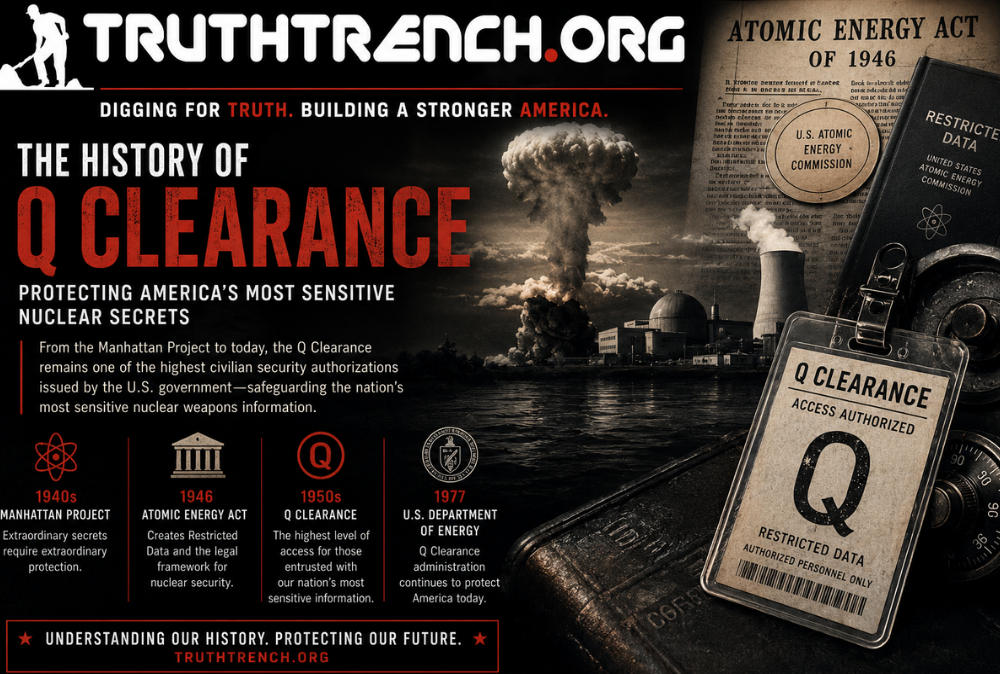
The Manhattan Project Changed Everything
During World War II, the United States launched the Manhattan Project, an unprecedented scientific and military effort to develop the world’s first atomic weapon.
The project brought together thousands of scientists, engineers, military personnel, and contractors across multiple secret facilities, including Los Alamos, Oak Ridge, and Hanford. Because the information involved could fundamentally alter the balance of world power, the government quickly recognized that extraordinary security measures would be required.
Unlike conventional military secrets, nuclear weapons design, uranium enrichment, plutonium production, and reactor technology represented entirely new categories of information. Unauthorized disclosure could threaten not only military operations but the future security of the United States itself.
The security practices developed during the Manhattan Project became the foundation for today’s nuclear security system.
The Atomic Energy Commission
Following World War II, Congress enacted the Atomic Energy Act of 1946, transferring responsibility for the nation’s atomic program from the military to the newly created Atomic Energy Commission (AEC).
The Act also established a unique legal category known as Restricted Data, covering information concerning:
- The design of atomic weapons
- The manufacture of atomic weapons
- The production of special nuclear material
- The use of special nuclear material in the production of energy
Unlike most classified information, Restricted Data was created by statute rather than executive order, reflecting Congress’s determination that nuclear information required special legal protection.
The Birth of the Q Clearance
With responsibility for the nation’s nuclear program came the need for a specialized personnel security system.
The Atomic Energy Commission established the Q Clearance as its highest level of personnel authorization for individuals requiring access to Restricted Data.
Interestingly, the name itself is far less mysterious than many people assume.
Historians have noted that the designation likely originated from the Personnel Security Questionnaire (PSQ) used during background investigations. Early clearance categories were simply labeled using letters associated with that process, eventually resulting in the designation “Q.”
The Atomic Energy Act of 1954
Congress modernized the nation’s nuclear security laws through the Atomic Energy Act of 1954, legislation that continues to govern much of the Restricted Data system today.
The Act introduced another important classification category known as Formerly Restricted Data (FRD).
While Restricted Data generally concerns nuclear weapon design and production, Formerly Restricted Data includes information jointly determined by the Department of Energy and the Department of Defense to relate primarily to the military utilization of nuclear weapons and capable of being protected under the broader national security classification system.
From the AEC to the Department of Energy
The Atomic Energy Commission remained responsible for America’s civilian and military nuclear programs until the mid-1970s.
In 1974, Congress reorganized the nation’s energy agencies, eventually creating the Department of Energy (DOE) in 1977.
Responsibility for administering the Q Clearance transferred to the Department of Energy, where it remains today. Although agencies changed, the underlying mission remained the same: protect America’s most sensitive nuclear information from unauthorized disclosure.
What Does a Q Clearance Allow?
A Q Clearance is generally considered equivalent to a Top Secret security clearance within the Department of Defense, but its scope is different.
Rather than simply granting access to Top Secret information, a Q Clearance authorizes eligible individuals—when they also have a demonstrated need to know—to access specific categories of information under the Atomic Energy Act, including:
- Restricted Data (RD)
- Formerly Restricted Data (FRD)
- National Security Information (NSI)
- Certain categories of Special Nuclear Material
- Critical Nuclear Weapon Design Information (CNWDI), when specifically authorized
Holding a Q Clearance does not automatically grant unrestricted access. Individuals must also have an operational need to know the information required for their official duties.
The Clearance Process
Obtaining a Q Clearance requires an extensive background investigation and adjudication process.
Applicants typically undergo:
- A comprehensive national security questionnaire
- Criminal history reviews
- Employment verification
- Education verification
- Financial and credit reviews
- Interviews with references
- Fingerprint submission
- Drug testing where required
- Additional investigation when security concerns arise
Eligibility is determined using federal national security adjudicative standards that evaluate the applicant’s overall reliability, trustworthiness, judgment, and ability to safeguard classified information.
A Clearance Is Not Permanent
Receiving a Q Clearance is not the end of the process.
Individuals remain subject to continuing security responsibilities throughout the period they hold access authorization.
Security concerns—including criminal conduct, financial issues, substance abuse, unauthorized disclosures, or other matters affecting reliability—may result in suspension, administrative review, or revocation of a clearance.
The Department of Energy maintains formal procedures allowing individuals to respond to security concerns and, where appropriate, appeal adverse decisions.
The Oppenheimer Case
Perhaps the most famous Q Clearance case in American history involved physicist J. Robert Oppenheimer, scientific director of the Los Alamos Laboratory during the Manhattan Project.
In 1954, the Atomic Energy Commission conducted a lengthy security hearing examining Oppenheimer’s past associations, judgment, and positions regarding nuclear weapons policy. At the conclusion of the hearing, his Q Clearance was revoked.
The case remains one of the most debated security clearance decisions in American history, raising enduring questions about national security, scientific freedom, loyalty, and due process.
Why the Q Clearance Still Matters
Although created during the earliest days of the nuclear age, the Q Clearance remains a critical component of America’s national security infrastructure.
Thousands of scientists, engineers, contractors, technicians, and federal employees continue to rely upon the authorization while supporting nuclear deterrence, energy security, scientific research, and national defense.
Its existence reflects a principle that has remained constant since the Manhattan Project:
Some information is so consequential that protecting it requires not only advanced technology, but exceptional trust in the people entrusted with it.
Understanding the Institutions Behind National Security
The history of the Q Clearance illustrates how institutions evolve to address emerging challenges.
As technology advances and new security concerns arise, understanding the legal, historical, and organizational foundations of national security becomes increasingly important for informed citizens.
Truth Trench Think Tank exists to help Americans better understand the institutions, laws, and historical developments that continue to shape public policy and national security today. Through independent research and educational resources, we seek to provide context—not simply headlines—so citizens can engage thoughtfully with the issues affecting the nation.
Share Your Perspective
What role do you believe security clearances play in protecting national security while balancing transparency and accountability?
We invite you to share your thoughts, experiences, or questions using the comment form below. Public participation helps inform our ongoing research and contributes to evidence-based reports designed to support informed public discussion and policy analysis.