As tensions grow between the United States and international judicial institutions, Secretary of State Marco Rubio has renewed criticism of international courts headquartered in The Hague, arguing they have exceeded their intended role and threaten American sovereignty. Supporters of international law strongly disagree, saying these institutions remain essential for resolving disputes between nations and promoting accountability.
The debate surrounding international courts is not new, but it has become increasingly prominent as the United States has expanded sanctions against officials associated with the International Criminal Court (ICC) while continuing to question the authority of international judicial bodies operating in The Hague. Secretary Rubio has described the ICC as politicized, a threat to U.S. sovereignty, and an institution that has attempted to exercise jurisdiction over American personnel and close U.S. allies such as Israel.
Although discussions often reference “The Hague” generally, it is important to distinguish between two separate institutions.
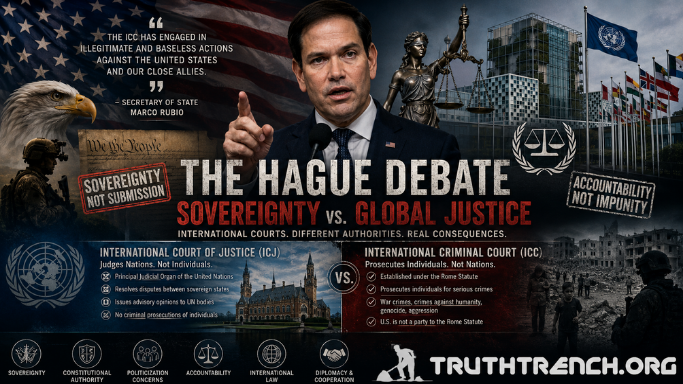
Two Different Courts in The Hague
The International Court of Justice (ICJ) is the principal judicial organ of the United Nations. It settles legal disputes between sovereign states and issues advisory opinions requested by authorized UN bodies. Individuals cannot be prosecuted before the ICJ.
The International Criminal Court (ICC) is a separate institution established under the Rome Statute. It prosecutes individuals—not nations—for alleged war crimes, crimes against humanity, genocide, and the crime of aggression.
Both courts are headquartered in The Hague, Netherlands, leading many public discussions to conflate the two despite their distinct legal authorities.
Much of Secretary Rubio’s recent criticism has focused on the International Criminal Court, particularly its investigations involving U.S. personnel and Israeli officials.
Why Many Americans Object
A significant number of Americans—including many veterans, constitutional scholars, and advocates of national sovereignty—argue that international courts should never possess authority over United States citizens without the consent of the United States government.
Critics argue that:
- The U.S. Constitution establishes American courts—not international tribunals—as the proper venue for judging U.S. citizens.
- Unelected international judges should not exercise jurisdiction over military personnel serving under American command.
- International courts can become politicized when prosecutorial discretion intersects with global conflicts.
- Allowing foreign tribunals to prosecute Americans could weaken national sovereignty and democratic accountability.
Because of these concerns, some American commentators and advocacy groups have adopted the phrase “International Court of Injustice” as a political criticism of the ICC, arguing that the court has become selective in its prosecutions and increasingly influenced by international politics rather than consistent legal standards.
Supporters of that characterization point to investigations involving the United States and Israel while arguing that authoritarian regimes sometimes escape comparable scrutiny.
Why Others Defend International Courts
Supporters of international judicial institutions argue that global accountability is increasingly necessary in a world where atrocities often cross national borders.
They contend that international courts:
- Provide peaceful legal mechanisms for resolving disputes between nations.
- Help investigate genocide, crimes against humanity, and war crimes when national governments cannot or will not prosecute.
- Promote adherence to international humanitarian law.
- Create legal alternatives to military escalation.
- Reinforce treaty obligations voluntarily accepted by participating nations.
Many international legal scholars argue that without institutions such as the ICJ and ICC, powerful nations could operate with fewer legal constraints, reducing accountability for violations of international law.
Supporters also note that dozens of democratic nations voluntarily participate in these legal systems because they believe consistent international rules ultimately contribute to long-term stability.
Rubio’s Position
Secretary Rubio has consistently argued that international judicial bodies—particularly the ICC—have expanded beyond their intended purpose.
In announcing sanctions against ICC officials and judges, Rubio stated that the court had engaged in “illegitimate and baseless actions” against the United States and Israel, describing its assertions of jurisdiction as infringements on national sovereignty. More recently, the administration announced a broader diplomatic effort to isolate or weaken the ICC, including sanctions, visa restrictions, and diplomatic pressure on allied governments.
The administration maintains that Americans should be subject to American law, not the rulings of an international criminal tribunal to which the United States is not a party.
How Other Think Tanks View the Issue
Major policy organizations examine this issue from very different perspectives.
The Center for Strategic and International Studies (CSIS) often analyzes how international legal institutions affect alliance relationships and national security strategy.
The RAND Corporation studies international law within broader discussions of deterrence, military operations, and conflict resolution.
The Council on Foreign Relations (CFR) frequently explores how international courts influence diplomacy, treaty obligations, and U.S. foreign policy.
Organizations such as Human Rights Watch and Amnesty International generally advocate for strengthening international accountability mechanisms, arguing that institutions like the ICC play an important role in addressing atrocities when domestic legal systems fail.
Conversely, organizations emphasizing constitutional governance and national sovereignty often argue that expanding international judicial authority risks undermining democratic self-government and constitutional protections.
Why Truth Trench Think Tank Is Following This Story
Truth Trench Think Tank believes Americans benefit from understanding both the legal framework and the constitutional questions surrounding international institutions.
Whether one views international courts as essential safeguards against atrocities or as organizations that have expanded beyond their proper authority, the issue raises fundamental questions about sovereignty, accountability, treaty obligations, and the balance between national independence and international cooperation.
Our role is not to advocate for a particular policy outcome.
Instead, we collect publicly available information, examine competing viewpoints, and encourage informed civic discussion grounded in facts rather than political slogans.
Understanding the distinction between the International Court of Justice and the International Criminal Court—and understanding why American leaders continue debating their authority—helps citizens evaluate future policy decisions with greater clarity.
Weigh In
Should international courts have authority over citizens of nations that have not accepted their jurisdiction?
Should international institutions play a larger role in enforcing global norms, or should sovereign nations remain solely responsible for judging their own citizens?
Truth Trench Think Tank is collecting public perspectives on international law, constitutional sovereignty, global governance, and judicial accountability as part of our continuing research into emerging issues affecting American policy and national security.
As always, Truth Trench Think Tank is a nonpartisan research institute. We do not engage in lobbying or partisan political activity. Our mission is to inform the public through independent research, transparency, and evidence-based analysis.