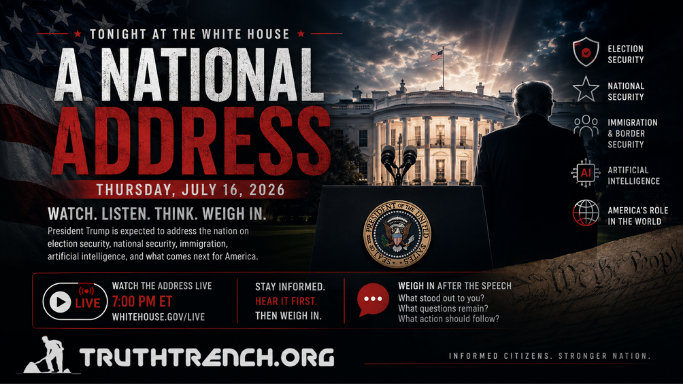
Americans are expected to hear directly from President Donald Trump tonight during a nationally televised address from the White House, an event that comes amid months of significant developments involving election security, foreign policy, national security, immigration, and the role of federal government.
While the White House has not released a full transcript in advance, recent public statements from President Trump and senior administration officials indicate the address is expected to focus heavily on election integrity, voting systems, and recently declassified intelligence related to foreign interference in American elections. Officials have also suggested broader national security themes could be discussed, though the final content of the address remains subject to change.
Truth Trench Think Tank encourages readers to watch the address firsthand before forming conclusions. Understanding the broader context surrounding tonight’s remarks can help citizens evaluate both the President’s message and the public reaction that follows.
Why This Speech Matters
Presidential addresses to the nation are relatively uncommon outside major crises, military operations, or moments of significant national importance.
When presidents speak directly to the American people from the White House, the objective is often larger than announcing a single policy. These speeches frequently attempt to frame ongoing national debates, explain administration priorities, or prepare the public for future policy decisions.
Tonight’s address arrives during a period in which several major issues have dominated national headlines and congressional discussion.
Major Developments Over the Past Three Months
Although the specific focus of tonight’s address remains unknown, several significant developments have shaped the national conversation.
Election Security
Election integrity has become one of the administration’s most frequently discussed domestic priorities.
President Trump has repeatedly stated that additional information regarding election security would be forthcoming, while administration officials have referenced newly declassified intelligence concerning foreign interference and vulnerabilities within election systems. Recent reporting suggests these topics are expected to feature prominently in tonight’s remarks.
Supporters argue greater transparency is necessary to strengthen public confidence in elections.
Critics caution that public officials should avoid making claims that could undermine confidence unless supported by verifiable evidence.
National Security
The United States has continued navigating a challenging international security environment.
Recent months have included ongoing military operations, continued concerns surrounding Iran, expanding great-power competition, cybersecurity threats, artificial intelligence, and growing attention to defense modernization.
Congress has also continued debating future defense spending, military readiness, and emerging technologies ranging from artificial intelligence to missile defense.
Immigration and Border Security
Immigration remains among the administration’s highest-profile policy priorities.
Federal agencies continue implementing new enforcement initiatives while Congress remains divided over long-term legislative reforms.
Supporters argue stronger enforcement improves public safety and restores confidence in immigration law.
Critics contend additional emphasis should be placed on humanitarian protections, immigration reform, and judicial resources.
Artificial Intelligence and Emerging Technology
Artificial intelligence has rapidly moved from a future policy discussion to an immediate national security issue.
Recent legislation, executive actions, and Department of Defense initiatives have increasingly focused on AI, cybersecurity, autonomous systems, and protecting America’s technological advantage.
Questions surrounding regulation, innovation, privacy, and national competitiveness continue to influence discussions across government, industry, and academia.
America’s Role Abroad
Foreign policy has remained highly active throughout the spring and summer.
Congress has debated military partnerships, international institutions, sanctions, aid packages, and America’s strategic relationships around the world.
Whether discussing NATO, Israel, China, Iran, Ukraine, or international courts, policymakers continue debating how the United States should balance national sovereignty with international cooperation.
What Observers Are Watching For
While only the President knows the final content of tonight’s remarks, several topics have been widely discussed by political observers and national media.
Among the questions many Americans will be listening for:
- Will the President announce new election security initiatives?
- Will additional intelligence regarding foreign interference be publicly released?
- Will new executive actions or legislative proposals be announced?
- Will the administration outline additional cybersecurity or artificial intelligence initiatives?
- Will foreign policy or national security developments receive significant attention?
- Will the address focus primarily on informing the public, or will it seek congressional action?
The answers may shape public discussion well beyond tonight’s speech.
How Other Think Tanks Are Viewing the Moment
Public policy organizations are approaching tonight’s address from a variety of perspectives.
Organizations such as the Center for Strategic and International Studies (CSIS) are likely to evaluate any national security or defense implications.
The Council on Foreign Relations (CFR) often analyzes presidential speeches through the lens of diplomacy and international relations.
The Brookings Institution frequently examines constitutional governance, domestic policy, and institutional impacts.
The RAND Corporation typically evaluates issues involving defense strategy, technology, intelligence, and emerging security challenges.
Election-focused organizations are expected to closely examine any claims related to voting systems, election administration, or foreign interference.
Each organization brings its own analytical framework, often emphasizing different aspects of the same speech.
Why Truth Trench Think Tank Is Monitoring Tonight’s Address
Truth Trench Think Tank believes informed citizens are better equipped to evaluate public policy when they examine primary sources directly.
Rather than relying solely on headlines, social media clips, or political commentary, we encourage Americans to watch major presidential addresses in full, compare them against publicly available evidence, and consider multiple perspectives before reaching conclusions.
Whether one agrees or disagrees with the administration’s positions, presidential addresses often provide important insight into future policy priorities, legislative objectives, and national security strategy.
Understanding those priorities helps citizens better participate in informed civic discussion.
Watch First. Then Weigh In.
After you’ve watched tonight’s address, we’d like to hear from you.
- What issue do you believe was the most important?
- Did the President address the questions you expected?
- What claims deserve additional public examination?
- What topics were omitted that you believe should have been discussed?
- What evidence should policymakers provide to support future decisions?
Truth Trench Think Tank is collecting public perspectives to better understand how Americans evaluate presidential leadership, election security, constitutional governance, national security, and government transparency.
As an independent research institute, Truth Trench Think Tank does not engage in lobbying or partisan political activity. Our mission is to improve public understanding through transparent, evidence-based research, encourage informed civic participation, and help Americans evaluate important public issues using publicly available information.