The United States military is narrowing its technological focus.
In November 2025, the Office of the Under Secretary of War for Research and Engineering announced six Critical Technology Areas intended to guide research, investment, testing, and the delivery of new capabilities to American warfighters. The Department describes these areas as priorities for maintaining military dominance amid rapid technological advancement and growing competition from foreign adversaries.
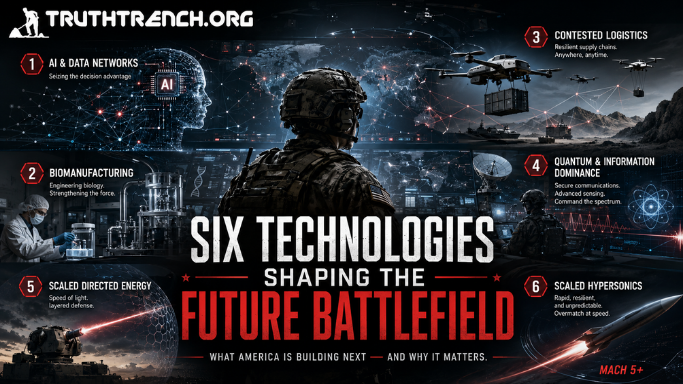
The six Critical Technology Areas are:
Applied Artificial Intelligence: Embedding artificial intelligence into command-and-control systems, intelligence analysis, logistics, planning, targeting, maintenance, and other military workflows. The intended result is faster processing of information and better decision-making.
Biomanufacturing: Using biological systems to manufacture materials, chemicals, fuels, medicines, food products, and other resources that may be difficult to produce or transport through conventional supply chains.
Contested Logistics Technologies: Developing ways to move, produce, protect, repair, and distribute critical supplies when ports, roads, communications networks, airfields, satellites, or traditional supply routes are under attack.
Quantum and Battlefield Information Dominance: Improving communications, sensing, navigation, computing, electronic warfare, and information-sharing capabilities in environments where signals may be jammed, intercepted, manipulated, or denied.
Scaled Directed Energy: Expanding the practical deployment of high-energy lasers and high-powered microwave systems to counter drones, missiles, electronic systems, and other emerging threats at a potentially lower cost per engagement than traditional interceptors.
Scaled Hypersonics: Producing weapons capable of traveling at more than five times the speed of sound in sufficient quantities to provide speed, precision, penetration, and survivability against sophisticated defenses.
The Department has appointed accountable senior officials to direct the individual technology areas and oversee focused development efforts, or “sprints,” intended to move capabilities from research laboratories into operational use.
The Case for Concentrating on Six Technologies
There is a strong argument that the United States must concentrate its resources instead of attempting to pursue every promising technology equally.
Modern military operations depend on far more than ships, aircraft, armored vehicles, and individual weapons. They depend on networks, data, industrial capacity, reliable communications, secure logistics, advanced manufacturing, and the ability to make decisions faster than an opponent.
Artificial intelligence could help commanders process information that no human staff could review quickly enough. Contested logistics could determine whether forces continue fighting after supply routes are disrupted. Directed-energy systems could provide a more economical way to counter large numbers of relatively inexpensive drones. Biomanufacturing could reduce dependence on vulnerable foreign suppliers. Quantum technologies may improve sensing and communications while helping the military operate when satellites or conventional navigation systems are compromised.
Hypersonic systems, meanwhile, may give the United States the ability to strike highly protected or time-sensitive targets before an opponent can reposition or respond.
Supporters of the strategy would argue that adversaries are already investing heavily in many of these capabilities. Failing to develop them would not prevent a technological arms race. It could simply leave American servicemembers facing advanced weapons and systems without equivalent defenses.
Concentrating leadership, funding, testing, and acquisition around six clearly defined priorities may also help address a long-standing government problem: promising technology becoming trapped between successful demonstrations and actual military procurement.
The central argument is straightforward. The battlefield is changing whether the United States is prepared or not. Delayed modernization may eventually cost more in money, military capability, and human lives than disciplined investment today.
The Case Against the Strategy
There are also legitimate reasons for scrutiny.
The first concern is technological overconfidence. Artificial intelligence can process enormous quantities of information, but it can also generate errors, misidentify objects, reproduce biased assumptions, or produce conclusions that human operators cannot adequately explain. Placing AI inside military decision systems creates serious questions about accountability, verification, cybersecurity, and the appropriate level of human control.
The second concern is cost. Hypersonic weapons, quantum research, directed-energy systems, specialized manufacturing facilities, and secure digital infrastructure can require substantial public investment. Experimental programs may exceed budgets, miss deadlines, underperform during realistic testing, or become obsolete before widespread deployment.
A narrow focus may also create blind spots. By designating six areas as critical, the Department could unintentionally reduce attention to less glamorous needs such as basic maintenance, ammunition stockpiles, conventional manufacturing, cybersecurity hygiene, personnel readiness, infrastructure, and the reliability of existing weapons systems.
There are strategic risks as well. Faster weapons and increasingly automated systems may shorten the time available for leaders to evaluate warnings during a crisis. A malfunctioning sensor, corrupted data stream, misunderstood AI recommendation, or false indication of attack could contribute to rapid escalation.
Directed-energy, quantum, biological, and AI-enabled technologies may also create capabilities faster than laws, ethics policies, testing standards, and oversight systems can adapt.
Finally, concentrating investment around technologies associated with military dominance may encourage contractors and agencies to fit existing projects into favored categories. That can produce inflated claims, duplicative programs, or technological solutions searching for operational problems.
The strongest opposing argument is not that the United States should stop innovating. It is that military innovation must remain accountable, testable, strategically necessary, and subject to independent scrutiny.
What Think Tanks Do in This Environment
Think tanks operate between government, academia, industry, the military, and the public.
Some conduct technical research. Others evaluate budgets, military strategy, acquisition policy, emerging threats, industrial capacity, legal authorities, ethics, or the consequences of deploying new technologies. Their work may include reviewing government reports, examining contracts and spending, comparing American capabilities with those of foreign competitors, interviewing subject-matter experts, analyzing public records, and translating complicated programs into information that policymakers and citizens can understand.
At their best, think tanks perform several important functions.
They identify where government claims are supported by evidence. They expose gaps between policy announcements and measurable results. They bring outside expertise into public discussions. They examine second- and third-order consequences that may be overlooked during the rush to field a new capability.
They may also ask questions that government agencies, military commands, contractors, and political organizations have incentives not to ask publicly.
However, think tanks must also be examined critically. Funding sources, institutional relationships, political preferences, contractor ties, and access to government officials may influence what subjects receive attention and what conclusions are emphasized.
The public should not automatically accept a position because it comes from a government agency, defense contractor, university, media organization, or think tank. Claims should be evaluated against evidence.
What Truth Trench Think Tank Is Doing
Truth Trench Think Tank approaches these issues as an independent research institute dedicated to societal benefit.
Our role is not to develop hypersonic weapons, direct military programs, promote a political party, or act as a public-relations operation for the government or defense industry.
Our role is to examine the information available to the public, identify the questions that deserve further investigation, and help citizens understand what government institutions are doing in their name.
The six Critical Technology Areas create several lines of inquiry that Truth Trench may examine through open-source intelligence, public records, government reports, budget documents, policy analysis, and contributions from qualified experts.
Are these technologies being tested under realistic conditions?
Are programs producing operational capabilities or primarily generating demonstrations, studies, and contracts?
How much funding is being committed, and what measurable results are taxpayers receiving?
Are domestic manufacturers and supply chains capable of producing these technologies at the scale being promised?
What safeguards govern the use of artificial intelligence in military decision-making?
How will the government protect sensitive research while maintaining appropriate public accountability?
Where should classified secrecy end and public oversight begin?
Truth Trench exists to help dig beneath official statements, political narratives, institutional marketing, and speculation. National security sometimes requires secrecy. Democratic accountability requires that secrecy not become a shield against every legitimate question concerning cost, strategy, effectiveness, legality, and public consequence.
These principles are not in conflict. A nation can protect sensitive military information while still demanding disciplined acquisition, ethical standards, lawful conduct, effective oversight, and honest measurement of results.
The Question Before the Country
The United States must prepare for future conflict while working to prevent it.
Technological superiority may deter aggression, protect American forces, strengthen alliances, and reduce the likelihood that an adversary believes it can win a war. The same technologies, poorly governed or deployed without adequate safeguards, may increase spending, accelerate escalation, weaken accountability, and create new risks that the public does not yet fully understand.
The question is therefore larger than whether artificial intelligence, hypersonics, directed energy, quantum technology, biomanufacturing, or contested logistics are valuable.
The real question is whether the United States can develop military technology rapidly while preserving sound judgment, human responsibility, fiscal discipline, operational realism, and democratic oversight.
That debate should not be limited to the Pentagon, contractors, elected officials, or technical specialists.
It belongs to the American people.
What do you think?
Do these six Critical Technology Areas represent the right priorities for the future of American national defense?
Which technologies offer the greatest potential to protect American servicemembers—and which present the greatest risks?
What safeguards, testing requirements, spending controls, and forms of public oversight should accompany their development?
Share your thoughts, concerns, experiences, or recommendations with Truth Trench Think Tank. Public participation helps identify questions that institutions may overlook and contributes to independent research intended to benefit society.
Dig deeper. Examine the evidence. Give your thoughts.