Examining the U.S.–Canada trade dispute, Alberta’s independence movement, the constitutional path to American statehood, and the history of U.S. territorial expansion.
Why This Matters
The United States and Canada share more than a border.
The two countries are deeply connected through trade, energy, defense, infrastructure, manufacturing, intelligence cooperation, and family ties. Yet the relationship has entered a period of unusual tension.
President Donald Trump has repeatedly discussed Canada in terms of tariffs, economic dependence, continental security, and possible American statehood. His administration has also renewed emphasis on protecting the Western Hemisphere from the strategic influence of China, Russia, Iran, and other outside powers—a policy sometimes described as a revived Monroe Doctrine or “Trump Corollary.”
At the same time, separatist sentiment has gained renewed attention in Alberta, where some residents argue that the province’s economic and political interests are no longer adequately represented within Canada.
These developments raise a provocative but legitimate constitutional question:
Could Canada—or part of Canada—legally become part of the United States?
The answer is yes in theory, but not through a presidential declaration, tariff pressure, or unilateral annexation.
Any lawful transition would require democratic consent, Canadian constitutional action, international agreements, approval by the United States Congress, and extensive negotiations over citizenship, borders, debt, resources, representation, Indigenous rights, and national security.
Before examining that process, one factual point must be clarified.
Alberta Has Not Voted to Join the United States
Albertans have not approved a referendum to annex the province to the United States.
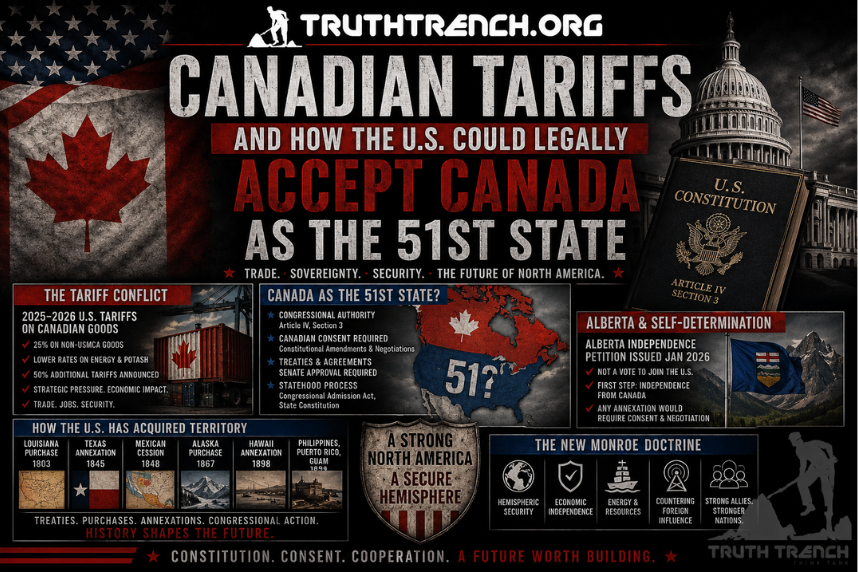
In January 2026, Elections Alberta issued a citizen-initiative petition proposing a future constitutional referendum on Alberta independence. The petition process requires at least 177,732 valid signatures before the proposal can proceed further. The question concerns separation from Canada—not automatic annexation by the United States.
That distinction matters.
There are at least three separate political questions:
- Should Alberta remain part of Canada?
- If Alberta became independent, should it remain a sovereign country?
- Should an independent Alberta seek admission into the United States?
A vote on the first question would not decide the other two.
Even a successful independence referendum would not, by itself, remove Alberta from Canada. Under the Supreme Court of Canada’s 1998 Reference re Secession of Quebec, a clear majority voting for separation on a clear question would create a constitutional obligation to negotiate. It would not authorize unilateral secession. Secession would still require constitutional changes and negotiations involving the federal government and other affected parties.
The Tariff Conflict
Trade pressure provides the immediate backdrop to the renewed discussion about Canada’s future relationship with the United States.
In 2025, the Trump administration imposed tariffs on Canadian goods that did not qualify for preferential treatment under the United States–Mexico–Canada Agreement. The administration applied a general 25 percent rate to many noncompliant goods, with lower rates for certain Canadian energy products and potash. Goods that qualified under the agreement were generally exempted from those particular duties.
The dispute expanded in 2026.
On July 21, 2026, the White House announced additional 50 percent tariffs on selected Canadian products, including categories such as alcoholic beverages, cement, recreational goods, and other specified imports. The proclamations stated that certain exemptions would remain for energy, potash, critical minerals, fish, and products covered by other tariff programs. Some of the newly announced duties are scheduled to take effect on August 19, 2026.
The administration argues that the tariffs respond to discriminatory Canadian practices and protect American commerce. Canada disputes the American characterization and maintains its own countermeasures and trade policies.
This is not a minor commercial disagreement.
Canada has historically sent the overwhelming majority of its merchandise exports to the United States. The two countries also share highly integrated supply chains involving motor vehicles, steel, aluminum, energy, agriculture, lumber, chemicals, defense products, and critical infrastructure.
Tariffs can therefore produce several consequences at once:
- They may pressure foreign governments to negotiate.
- They may protect selected domestic industries.
- They may increase costs for manufacturers using imported materials.
- They may alter investment decisions.
- They may accelerate efforts to move production across the border.
- They may encourage Canada to expand trade with China or other markets.
- They may weaken the broader political relationship between the countries.
Tariffs alone, however, cannot legally convert Canada into an American state.
Can the United States Admit Canada as a State?
Article IV, Section 3 of the United States Constitution states:
“New States may be admitted by the Congress into this Union.”
That language gives Congress broad authority to admit new states. It does not limit admission to territory already controlled by the United States. Congress has historically used different legal mechanisms to acquire territory, annex independent republics, establish territorial governments, and eventually admit states.
The President could negotiate and recommend an agreement, but the President could not unilaterally make Canada the 51st state.
Congress would have to act.
Depending on the structure chosen, the process could involve:
- A bilateral treaty between Canada and the United States.
- Canadian constitutional amendments.
- Approval by Canada’s Parliament and affected provincial governments.
- Approval by the United States Senate if a treaty were used.
- Federal implementing legislation.
- An admission act passed by Congress.
- A transition agreement governing citizenship, property, debt and public institutions.
- Approval of a state constitution or constitutions consistent with the U.S. Constitution.
Congress could theoretically admit Canada as one state. It could also admit individual former provinces as separate states, place certain regions under territorial administration, or negotiate another form of political association.
The first option would be politically extraordinary.
Canada contains ten provinces, three territories, roughly forty million people, two official languages, distinct provincial governments, treaty obligations, Indigenous nations, and major regional differences. Treating the entire country as a single state would give that population only two senators, while dividing Canada into several states would transform the balance of power in the United States Senate.
The constitutional authority to admit states exists. The political and administrative challenge would be enormous.
Canada Would Have to Consent
The United States cannot lawfully absorb Canada merely because American officials believe statehood would be economically or strategically beneficial.
Canada is a sovereign country.
The United Nations Charter prohibits the threat or use of force against the territorial integrity or political independence of another state. Modern international law does not recognize territorial acquisition achieved through unlawful force as a valid method of changing national borders.
A lawful union would therefore need to be consensual.
For Canada as a whole, that would require action through Canada’s democratic and constitutional institutions. Part V of the Constitution Act, 1982 establishes formal procedures for amending Canada’s Constitution. A decision ending Canadian sovereignty, abolishing or radically changing federal institutions, and transferring territory to another country would require much more than an ordinary act of Parliament.
The exact amendment formula for dissolving Canada or transferring the entire federation has never been tested. However, such an action would almost certainly require extensive federal-provincial agreement and constitutional negotiations.
It would also raise questions involving:
- The Crown and Canada’s constitutional monarchy.
- Provincial boundaries and powers.
- French-language protections.
- Quebec’s distinct legal and cultural institutions.
- Indigenous treaties and Aboriginal rights.
- Federal and provincial debts.
- Public pensions and social programs.
- Military personnel and installations.
- Ownership of public lands and natural resources.
- Canadian citizenship and American nationality.
- Representation in Congress.
- Existing trade and defense treaties.
- Arctic sovereignty.
This would not resemble a corporate merger.
It would be one of the most complicated constitutional transitions in modern history.
Could Alberta Join Separately?
Alberta presents a different scenario.
If Alberta held a clear referendum favoring independence, Canada would have a duty to negotiate under the principles identified by the Supreme Court of Canada. But Alberta could not simply declare itself independent and immediately request admission to the United States.
A plausible legal sequence would look something like this:
First, a valid Alberta referendum.
The question would need to be clear, and the result would need to demonstrate a clear democratic mandate.
Second, negotiations with Canada.
The parties would have to resolve borders, debt, federal property, pensions, citizenship, natural resources, transportation corridors, military obligations, and Indigenous rights.
Third, a constitutional settlement.
Canada would need to amend its constitutional arrangements to permit Alberta’s lawful departure.
Fourth, temporary independence or a negotiated transfer.
Alberta might become an independent state before applying for U.S. admission, or Canada, Alberta, and the United States might negotiate a coordinated transfer.
Fifth, congressional approval.
Congress would decide whether to admit Alberta as a state, accept it initially as a territory, or reject the application.
Sixth, establishment of republican government.
Alberta would need a state constitution compatible with the U.S. Constitution and would have to transition its parliamentary institutions into an American state-government structure.
None of those steps would be automatic.
A referendum expressing dissatisfaction with Ottawa would not amount to legal consent to American statehood.
How Has the United States Acquired Territory Before?
The United States did not reach its present boundaries through a single process. It expanded through purchases, treaties, annexations, negotiated settlements, war, and congressional admission.
The Louisiana Purchase
In 1803, the United States purchased a vast region from France. The transaction nearly doubled the country’s territorial size and eventually produced all or part of numerous states.
The Constitution does not expressly describe a federal power to acquire foreign territory. President Thomas Jefferson initially worried that a constitutional amendment might be needed, but the acquisition proceeded through the treaty power and congressional legislation.
Florida
Spain transferred Florida to the United States under the Adams–Onís Treaty, signed in 1819 and implemented in 1821.
This was a negotiated transfer of sovereignty between governments.
Texas
Texas had been part of Mexico before becoming an independent republic. The United States attempted to annex Texas through a treaty, but the Senate rejected it. Congress later adopted a joint resolution consenting to annexation, and Texas entered the Union as a state in 1845.
Texas is therefore an important comparison when considering whether an independent Alberta could seek U.S. admission. It was an internationally separate republic that consented to annexation and was then admitted through congressional action.
The historical circumstances, however, included disputes over slavery, borders, and relations with Mexico that soon contributed to war.
The Oregon Country
The United States and Britain disputed control of the Pacific Northwest. The Oregon Treaty of 1846 divided much of the contested region along the 49th parallel.
This was not the annexation of Canada. It was a negotiated settlement of competing territorial claims.
The Mexican Cession
The Treaty of Guadalupe Hidalgo ended the Mexican-American War in 1848. Mexico transferred a vast territory that included present-day California, Nevada, Utah, and parts of several other states.
The United States later purchased additional land from Mexico through the Gadsden Purchase of 1853–1854, paying $10 million for territory that became part of Arizona and New Mexico.
These acquisitions remain among the most controversial episodes in American expansion because military victory and unequal bargaining power shaped the outcome.
Alaska
The United States purchased Alaska from the Russian Empire in 1867.
Alaska remained under American territorial administration for decades before becoming a state in 1959.
Hawaii
The Republic of Hawaii was annexed by a congressional joint resolution in 1898 following the overthrow of the Hawaiian Kingdom several years earlier. Hawaii became a U.S. territory and was admitted as a state in 1959.
Hawaii demonstrates both Congress’s broad approach to annexation and the lasting controversy that can arise when consent, sovereignty, and the rights of an Indigenous population are disputed.
Puerto Rico, Guam and the Philippines
Following the Spanish-American War, Spain transferred Puerto Rico, Guam, and the Philippines to the United States under the Treaty of Paris of 1898.
Puerto Rico and Guam remain U.S. territories. The Philippines moved through colonial administration, commonwealth status, and eventual independence in 1946.
This history shows that American acquisition has not always resulted in statehood.
Territory, statehood, political association, and independence are legally distinct outcomes.
Would Canada Be the 51st State—or Several New States?
The phrase “Canada as the 51st state” is politically memorable but constitutionally incomplete.
Canada could not realistically enter the Union without resolving the status of its provinces and territories.
Possible models might include:
One State
Canada could theoretically be admitted as a single state.
This would preserve much of Canada’s geographic unity but create major disputes over internal governance, Senate representation, language protections, and the status of existing provinces.
Multiple States
Individual provinces—or groups of provinces—could become separate states.
This would better reflect regional identity but could add numerous senators and substantially change the American political system.
State and Territorial Combination
Heavily populated provinces could become states while northern territories entered under federal territorial status.
This might resemble earlier periods of American expansion, but it would create difficult questions concerning local consent, Indigenous governance, Arctic sovereignty, and the future path to statehood.
Independent Alberta First
Alberta could theoretically leave Canada, establish itself as an independent country, and later apply for admission.
This would be closer to the Texas precedent, although the Canadian constitutional process and modern international legal environment are very different.
No Political Union
Canada and the United States could remain separate while deepening economic, military, energy, border, and Arctic integration.
This is by far the least constitutionally disruptive option.
Strategic Geography and the Revived Monroe Doctrine
The renewed debate does not exist in isolation.
The Trump administration has increasingly framed the Western Hemisphere as a distinct strategic theater. Public statements and policy documents have emphasized preventing hostile or rival powers from gaining control over ports, minerals, transportation routes, energy supplies, communications networks, military facilities, or political influence in the Americas.
Administration officials have described the Monroe Doctrine as being “back and in full effect,” while analysts have referred to the approach as a “Trump Corollary.”
The original Monroe Doctrine of 1823 warned European powers against renewed colonial intervention in the Western Hemisphere. It did not initially authorize American annexation of neighboring countries.
Later presidents expanded the doctrine.
The Roosevelt Corollary asserted a broader American role in regional affairs. During the Cold War, U.S. governments invoked hemispheric security against Soviet influence. The current version appears focused on China, Russia, Iran, organized crime, migration, critical infrastructure, energy, maritime access, and control of strategic supply chains.
Canada fits into that analysis because of its:
- Arctic territory.
- Energy reserves.
- Critical minerals.
- Atlantic and Pacific access.
- Border infrastructure.
- Aerospace and defense cooperation.
- Proximity to Russia across the Arctic.
- Economic exposure to China.
- Role in NATO and NORAD.
Greenland fits for similar reasons, particularly Arctic access, missile warning, shipping routes, rare-earth minerals, and competition with Russia and China.
Mexico presents a different but related set of concerns involving trade, migration, cartel power, manufacturing, ports, energy, and Chinese investment.
The strategic logic may explain renewed American attention to these neighboring countries. It does not eliminate their sovereignty or the requirement for consent.
Tariffs Are Leverage—not a Statehood Process
Tariffs may be used to change trade behavior, encourage investment, protect industries, or create negotiating pressure.
They are not an admission mechanism under Article IV.
Economic pressure could theoretically influence Canadian public opinion. It could also produce the opposite result by strengthening Canadian nationalism, encouraging retaliation, and driving Canada toward alternative commercial partners.
Any American strategy must therefore consider the difference between leverage and alienation.
Canada is not merely a market. It is a defense partner, intelligence partner, NATO member, NORAD partner, major energy supplier, and immediate neighbor.
The strategic objective should be clearly defined.
Is the purpose of tariffs to:
- Enforce trade reciprocity?
- Move manufacturing into the United States?
- Reduce dependence on foreign materials?
- Secure the northern border?
- Counter Chinese influence?
- Renegotiate USMCA?
- Encourage political integration?
- Prepare for a broader continental security arrangement?
Different objectives require different policies.
Without clarity, trade measures can create costs without producing a sustainable strategic outcome.
The Constitutional Bottom Line
The United States could legally admit Canada, Alberta, or another former Canadian province as a state.
But several conditions would have to be satisfied:
- Canadians or Albertans would need to express democratic consent.
- Canada would need to follow its own constitutional process.
- The terms of separation or union would need to be negotiated.
- Indigenous and treaty rights would have to be addressed.
- The transfer could not lawfully be achieved through force.
- Congress would need to approve admission.
- The new state would need a government compatible with the U.S. Constitution.
- Citizenship, debts, resources, borders, representation, and public institutions would require detailed agreements.
The constitutional doorway exists.
Walking through it would require far more than a campaign slogan.
Weigh In
Should the United States pursue deeper integration with Canada through trade and defense agreements, or should statehood remain entirely outside the relationship?
Could an independent Alberta succeed as a sovereign country?
Would Alberta benefit from American statehood—or lose more authority than it gained?
And does the renewed Monroe Doctrine represent necessary continental security planning, or an expansion of American power that could weaken relationships with strategic neighbors?
Review the history. Examine the constitutional process. Consider the strategic consequences.
Then form your own conclusion.
Truth Trench Think Tank is a nonprofit research institute dedicated to public education, primary-source research, government transparency, and informed civic discussion. This article examines constitutional and historical questions and does not advocate political action, annexation, or interference in the democratic affairs of another country.